
Spanish adverbs: how to form them and the muy/mucho trap
Spanish builds most adverbs of manner by adding -mente to the feminine singular form of an adjective, the way English adds “-ly” to an adjective to build an adverb. What complicates it for an English speaker isn’t the ending itself — it’s the handful of adverbs that never take -mente, and the constant confusion between muy and mucho, two words that both translate as “very” or “a lot” in a pinch but never work the same way. At 1on1Spanish we cover both in 25-minute one-on-one lessons with qualified native teachers, online across the United States.
Once the -mente pattern is automatic, the rest of the topic is mostly a short list of exceptions worth memorizing on their own, rather than a whole new set of rules to learn.
Reviewed by María Jiménez — Licenciada en Filología Hispánica (BA in Hispanic Philology) · Updated Sep 2026
Forming -mente adverbs
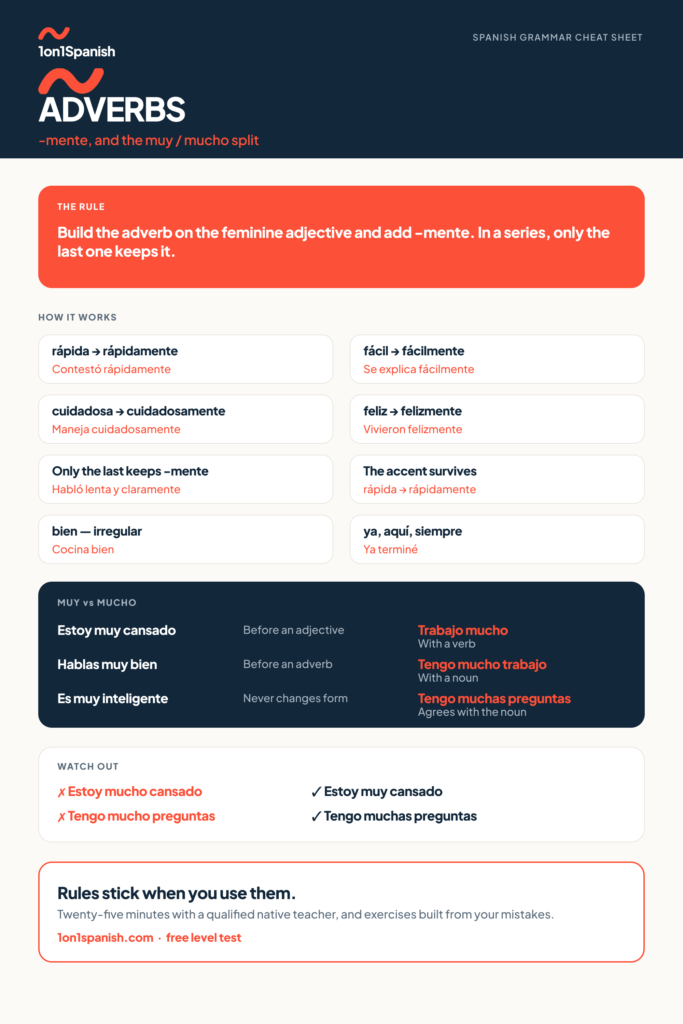
Start from the adjective’s feminine singular form and add -mente: rápida becomes rá-pi-da-MEN-te, lenta becomes len-ta-MEN-te, cuidadosa becomes cui-da-do-sa-MEN-te. For adjectives that don’t change by gender — those ending in a consonant or in -e — the adverb just adds -mente to that same form with no other change: fácil becomes fácilmente, feliz becomes felizmente, frecuente becomes frecuentemente.
That’s why the feminine forms on the Spanish adjectives page do double duty: get rápida and cuidadosa right and the adverb builds itself.
If the adjective already carried a written accent, that accent stays exactly where it was: fácil keeps its accent in fácilmente even though the stress of the whole word has moved. The new word also picks up a second stressed syllable on -men-te itself, which is why it’s read with two beats instead of one. The tilde survives because fácil on its own would break the stress rule without it, and that rule is the whole logic behind written accents in Spanish.
Only the last one keeps -mente in a series
When two or more -mente adverbs describe the same action, only the last one takes the full ending; the earlier ones drop -mente and stay in their plain feminine form. Habló lenta y claramente — she spoke slowly and clearly — not lentamente y claramente. The same rule applies to three or more in a row: Lo explicó clara, lenta y pacientemente. This mirrors a pattern English sometimes uses too (“slowly and clearly”), so it’s more a matter of remembering it applies here than of learning something new.
Adverbs that don’t follow the -mente pattern
A short, high-frequency group of adverbs never takes -mente because they aren’t built from an adjective at all: bien (well), mal (badly), muy (very), mucho (a lot), ya (already), and todavía (still, yet). Habla bien español., Trabajó mal ese día., Comimos mucho., Ya llegamos. Two more belong on this list: siempre (always) and nunca (never), also common in daily speech: Siempre llego temprano., Nunca he estado en Chile. These are some of the most common adverbs in the language, and none of them fit the rule that governs everything else — they simply have to be memorized as their own words.
Reference chart
| Adjective | Adverb | Example | English |
|---|---|---|---|
| rápida | rápidamente | Contestó rápidamente. | She answered quickly. |
| fácil | fácilmente | Se explica fácilmente. | It’s easily explained. |
| cuidadosa | cuidadosamente | Maneja cuidadosamente. | He drives carefully. |
| feliz | felizmente | Vivieron felizmente. | They lived happily. |
| lenta y clara | lenta y claramente | Habló lenta y claramente. | She spoke slowly and clearly. |
| — | bien | Cocina bien. | She cooks well. |
| — | ya | Ya terminé. | I already finished. |
Muy vs mucho: the pair that changes what it modifies
Muy modifies an adjective or another adverb, and never changes form. Mucho modifies a verb or a noun, and — only when it modifies a noun — agrees with it in gender and number. English speakers default to “very” and “a lot” almost interchangeably, so the fastest fix is a quick test: if the next word is an adjective or adverb, it’s muy; if there’s no next word to describe, it’s mucho. Next to a noun it behaves like any -o adjective, four endings and all, so the adjective agreement rules apply: mucha tarea, muchas preguntas.
| Muy — before adjective/adverb | Mucho — with verb or noun |
|---|---|
| Estoy muy cansado. — I’m very tired. | Trabajo mucho. — I work a lot. |
| Hablas muy bien español. — You speak Spanish very well. | Tengo mucho trabajo. — I have a lot of work. |
| Es muy inteligente. — She’s very intelligent. | Tengo muchas preguntas. — I have many questions. |
Common mistakes English speakers make
Mucho can’t modify an adjective. Before an adjective or another adverb, Spanish always reaches for muy.
Dropping the accent that the adjective already carried is one of the most common spelling errors in -mente adverbs, especially for adjectives that don’t otherwise look accented in their base form.
In a series, only the final adverb keeps -mente — but it does have to keep it. Dropping it from all of them turns the last word back into an adjective with nothing to describe.
When mucho modifies a noun instead of a verb, it has to agree in gender and number with that noun, the same as any other adjective would.
Muy can never stand alone after a verb; it needs an adjective or adverb right after it to modify. When nothing follows, mucho is the word that belongs.
Take the chart with you
The chart is free to view and share. Drop your email and we’ll send the print-ready US Letter PDF — the version you stick on the fridge.
Practice
Practice Spanish adverbs with a real teacher
Charts get you halfway. The other half is saying it out loud to someone who corrects you on the spot. At 1on1Spanish you get 25-minute private lessons with a qualified native teacher, exercises built from the mistakes you make in class, and AI practice between lessons.
First month $1. No contracts, cancel anytime.
Everything on this page is free to use. If you want feedback on your own Spanish, learn Spanish online with us.
Take your free level testBuilt on RingTeacher's method — 700,000+ classes delivered since 2017, teaching English to Spanish speakers. Now in the other direction.
Frequently asked questions
How do you form adverbs in Spanish?
Add -mente to the feminine singular form of the adjective: rápida becomes rápidamente, clara becomes claramente. For adjectives that don’t change by gender, like fácil or feliz, -mente just attaches to that same form, and any written accent the adjective already had stays put: fácilmente, felizmente.
Do you add -mente to every adjective to make an adverb?
No. A small group of very common adverbs — bien, mal, muy, mucho, ya, todavía — aren’t built from an adjective at all and never take -mente. They have to be learned as their own words, separate from the -mente pattern that covers most other adverbs.
What’s the difference between muy and mucho in Spanish?
Muy modifies an adjective or another adverb and never changes form: muy cansado, muy bien. Mucho modifies a verb or a noun, and only agrees in gender and number when it modifies a noun: trabajo mucho, mucha tarea. Using mucho before an adjective, as in mucho cansado, is incorrect.
What happens when two -mente adverbs describe the same verb?
Only the last one keeps the -mente ending; the earlier ones stay in their plain feminine adjective form. Habló lenta y claramente, not lentamente y claramente. The rule holds for three or more adverbs in a row as well: Lo explicó clara, lenta y pacientemente keeps just one -mente, on the final word of the series.
What’s the most common mistake with Spanish adverbs?
Using mucho where muy belongs, producing mucho cansado or mucho importante instead of muy cansado and muy importante. It comes from English collapsing “very” and “a lot” into overlapping territory that Spanish keeps strictly separate based on what’s being modified.