
Spanish question words: qué, cuál and the rest
Every Spanish question word carries a written accent when it’s asking something, directly or indirectly, and loses that accent the moment the same word works as a relative pronoun instead. Which word to use trips up English speakers less than the accent does — with one exception: qué and cuál, which English flattens into a single “what”. At 1on1Spanish we drill both in 25-minute one-on-one lessons with qualified native teachers, online across the United States.
The full set covers just eight base words, and once each one has a clear job, building a question in Spanish stops feeling like guessing and starts feeling like following a short, fixed menu. That accent is a special case of how written accents work in Spanish: it marks a difference in meaning, not a change in stress.
Reviewed by María Jiménez — Licenciada en Filología Hispánica (BA in Hispanic Philology) · Updated Sep 2026
Qué vs cuál: the question that isn’t about “what”
Qué asks for a definition — it wants to know what something is. Cuál asks for a selection — it wants to know which one, out of a set. English uses “what” for both jobs, which is why ¿Qué es tu nombre? sounds reasonable to a beginner and is wrong in Spanish: a name isn’t defined, it’s picked out of every possible name, so the question is ¿Cuál es tu nombre? The same logic holds even where English keeps saying “what”: ¿Cuál es tu número de teléfono?, ¿Cuál es la capital de México? Qué comes back the moment the question really is asking for a definition or an explanation, not a choice: ¿Qué es la envidia?, ¿Qué hora es?, ¿Qué significa esta palabra? Notice how often cuál pairs with ser — ¿cuál es tu dirección?, ¿cuál fue el problema? — which makes the forms of ser worth having cold.
Quién, dónde, cuándo, cómo
Quién asks “who” for one person and quiénes for more than one: ¿Quién llamó?, ¿Quiénes vienen a la fiesta? Dónde asks where something is, while adónde asks where something is going, and only pairs with verbs of motion: ¿Dónde vives? against ¿Adónde vas de vacaciones? Cuándo asks “when” with no complications, and cómo covers everything from a method to a state of mind: ¿Cómo llegaste al aeropuerto?, ¿Cómo está tu mamá?
None of these four change form for gender or number the way cuál and cuánto can, which makes them the easiest part of the whole set to learn once the accent rule is in place.
Cuánto: the one that has to agree
Cuánto asks “how much” or “how many”, and unlike the rest of the list, it changes for gender and number to match the noun that follows it: cuánto dinero, cuánta agua, cuántos hijos, cuántas veces. Used alone, without a noun right after it, it defaults to the masculine singular: ¿Cuánto cuesta?, ¿Cuánto falta?
Reference chart
| Question word | Asks for | Example | English |
|---|---|---|---|
| qué | a definition or explanation | ¿Qué quieres cenar? | What do you want for dinner? |
| cuál / cuáles | a choice among options | ¿Cuál prefieres, el rojo o el azul? | Which one do you prefer, the red or the blue? |
| quién / quiénes | a person or people | ¿Quiénes van a la reunión? | Who is going to the meeting? |
| dónde | a location | ¿Dónde trabajas? | Where do you work? |
| adónde | a destination | ¿Adónde vamos este fin de semana? | Where are we going this weekend? |
| cuándo | a time | ¿Cuándo es tu cita? | When is your appointment? |
| cómo | a manner or state | ¿Cómo se dice esto en español? | How do you say this in Spanish? |
| cuánto/-a/-os/-as | a quantity | ¿Cuántas horas trabajaste hoy? | How many hours did you work today? |
Por qué, porque, por que and porqué
This four-way split hides behind a single sound and decides more grades than any other question word on this page. Por qué, two words with a tilde, asks “why”: ¿Por qué llegaste tarde? Porque, one word, no tilde, answers it: Porque el tráfico estaba imposible. Por que, two words with no tilde, is rarer and shows up when por is a preposition governing a relative que, usually after a noun: La razón por que renunció fue el sueldo. Porqué, one word, with a tilde, is a noun meaning “the reason”: No entiendo el porqué de su decisión. All four sound identical when spoken out loud, so this is a rule that lives almost entirely in writing. So does the opening ¿ in front of ¿Por qué llegaste tarde?: the Spanish opening question mark is as mandatory as the tilde.
| Form | Job | Example |
|---|---|---|
| por qué | asks “why” | ¿Por qué estudias español? |
| porque | answers “because” | Porque quiero viajar a México. |
| por que | preposition + relative que | Esa es la razón por que se fue. |
| el porqué | noun, “the reason” | Nadie sabe el porqué del cambio. |
Common mistakes English speakers make
Asking for a name with qué treats it as a definition instead of a selection. This is the single most common qué/cuál error and it doesn’t sound like a small mistake to a native ear.
The accent stays even in an indirect question buried inside a bigger sentence. Losing it there is the second most common slip, because the sentence no longer has a question mark to remind you.
Porque answers; it never asks. If the sentence is a question, it needs the two-word, accented por qué.
Dropping both accents — on the question word and on the verb — is the most visible mark of a beginner in writing, even when the pronunciation is fine.
Dinero is a masculine, uncountable noun, so cuánto stays singular here. The plural cuántos is reserved for countable nouns, like cuántos hijos or cuántos años.
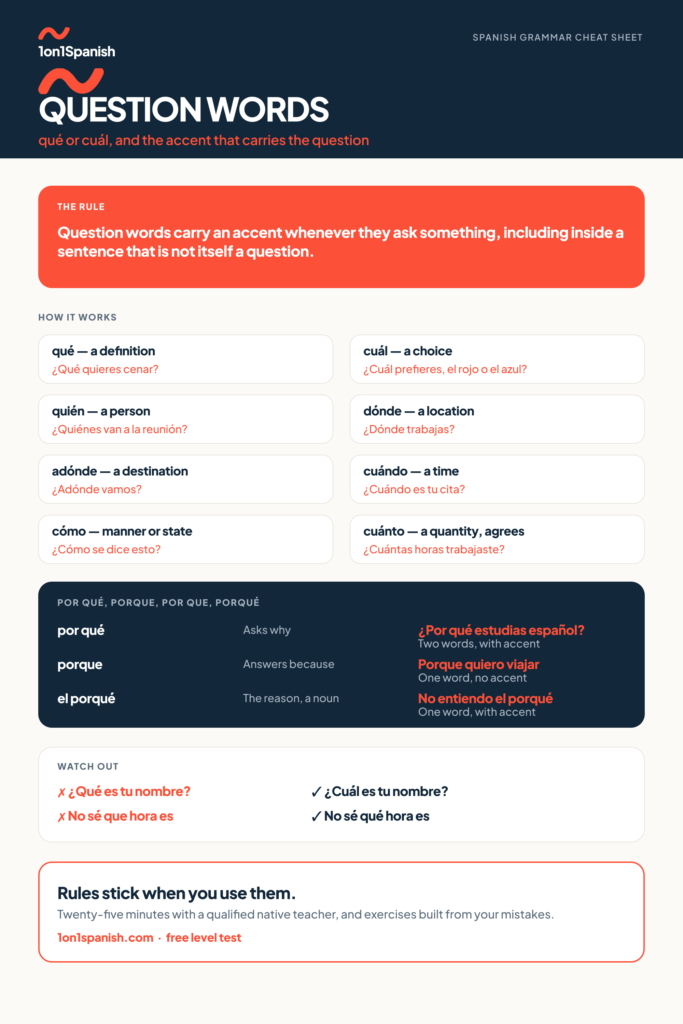
Take the chart with you
The chart is free to view and share. Drop your email and we’ll send the print-ready US Letter PDF — the version you stick on the fridge.
Practice
Practice Spanish question words with a real teacher
Charts get you halfway. The other half is saying it out loud to someone who corrects you on the spot. At 1on1Spanish you get 25-minute private lessons with a qualified native teacher, exercises built from the mistakes you make in class, and AI practice between lessons.
First month $1. No contracts, cancel anytime.
The fastest way to make this stick is to say it to someone. Learn Spanish online with a real teacher.
Take your free level testBuilt on RingTeacher's method — 700,000+ classes delivered since 2017, teaching English to Spanish speakers. Now in the other direction.
Frequently asked questions
What’s the difference between qué and cuál in Spanish?
Qué asks for a definition — what something is — while cuál asks for a selection out of a set — which one. English uses “what” for both, which is why ¿Cuál es tu nombre? sounds odd to a beginner even though ¿Qué es tu nombre? is wrong. The test is simple: if the answer picks one item from a group, use cuál.
Do Spanish question words always need an accent mark?
Yes, whenever they’re asking something, directly (¿Dónde vives?) or indirectly, inside a bigger sentence with no question mark (No sé dónde vive). The same words lose the accent when they work as relative pronouns instead: La casa donde vivo es pequeña has no tilde because it isn’t asking anything.
What’s the difference between porque, por qué, por que and porqué?
Por qué (two words, accented) asks “why”. Porque (one word, no accent) answers with “because”. Por que (two words, no accent) is a preposition plus a relative que, and shows up mostly after a noun like razón. Porqué (one word, accented) is a noun meaning “the reason”. All four sound identical out loud.
Is adónde different from dónde in Spanish?
Yes. Dónde asks where something already is: ¿Dónde está tu casa? Adónde asks where something is headed, and only pairs with a verb of motion: ¿Adónde vas?, ¿Adónde viajaste el año pasado? Using dónde instead of adónde is understood everywhere, but adónde is the more precise choice.
What’s the most common mistake with Spanish question words?
Using qué where cuál belongs, especially when asking for a name, an address or a phone number: ¿Qué es tu dirección? instead of ¿Cuál es tu dirección? The second most common mistake is dropping the written accent on the question word once it’s buried inside a longer, indirect sentence.