
Spanish greetings and farewells: tú, usted and timing
Every Spanish class teaches hola in week one. What almost none of them teach clearly is when buenas tardes becomes buenas noches, or why the same “how are you” sounds completely different to a boss than to a friend. Greetings are the first words in every conversation, which means getting the register wrong sets the wrong tone before you’ve said anything else. At 1on1Spanish a qualified native teacher corrects exactly this — tone, timing, formality — in every 25-minute one-on-one lesson.
Reviewed by María Jiménez — Licenciada en Filología Hispánica (BA in Hispanic Philology) · Updated Sep 2026
The greeting itself: time of day decides the word
Buenos días covers the morning, until roughly noon or whenever lunch happens. Buenas tardes takes over from early afternoon and runs until it starts getting dark — the boundary is genuinely fuzzy and shifts with the season and the country, not a fixed clock hour. Buenas noches covers the evening and night, and unlike English “good night,” it’s also used as a greeting when you arrive somewhere after dark, not only as a farewell when you leave. Hola works at any hour and is safe as a default, though pairing it with the time-appropriate greeting — hola, buenas tardes — sounds more complete in a first interaction.
Tú or usted: the decision that shapes everything else
This is the real grammar underneath every greeting, and it’s not optional the way formality is in English. Tú is informal “you,” used with friends, family, peers, children, and — in most of Latin America — increasingly with coworkers too. Usted is formal “you,” used with strangers, elders, authority figures, and in professional or customer-service settings, especially on a first meeting. The verb conjugation changes depending on which you choose: ¿cómo estás? (tú) versus ¿cómo está? (usted) — same question, different level of respect built into the grammar itself, not just word choice. The verb doing that work is estar, and the estar conjugation gives you both forms side by side.
When in doubt, usted is the safer default with someone new, older, or in a position of authority; you can shift to tú once they invite it, often with a direct cue like me puedes tratar de tú (“you can address me informally”). Getting this backwards — using tú with someone who expects usted — reads as overly casual or even disrespectful, more than it would in English.
Saying goodbye
Adiós is the general goodbye, used for real partings — it can feel slightly final, so it’s less common for “see you later” than English speakers expect. Hasta luego (“see you later”) and nos vemos (“we’ll see each other,” casual “see you”) cover the everyday, no-big-deal goodbye. Hasta mañana (see you tomorrow), hasta pronto (see you soon), que tengas un buen día (have a good day, tú) or que tenga un buen día (usted) round out common closings. Cuídate (take care, tú) or cuídese (usted) works as a warm sign-off with someone you know. That tengas/tenga is your first brush with the Spanish subjunctive, hidden inside a phrase you’ll say daily long before you study the tense. More of these ready-made lines are in our everyday Spanish phrases.
Quick reference
| English | Spanish (tú) | Spanish (usted) |
|---|---|---|
| good morning | buenos días | buenos días |
| good afternoon | buenas tardes | buenas tardes |
| good evening/night | buenas noches | buenas noches |
| how are you? | ¿cómo estás? | ¿cómo está? |
| nice to meet you | mucho gusto | mucho gusto |
| what’s up? | ¿qué tal? / ¿qué onda? | — (too casual for usted) |
| goodbye | adiós | adiós |
| see you later | hasta luego | hasta luego |
| see you soon | hasta pronto | hasta pronto |
| see you tomorrow | hasta mañana | hasta mañana |
| take care | cuídate | cuídese |
| have a good day | que tengas un buen día | que tenga un buen día |
Where this actually goes wrong out loud
Timing and formality are both invisible on a flashcard and obvious the moment you get them wrong in person.
| Pattern | The risk |
|---|---|
| buenas tardes/noches boundary | There’s no fixed hour — it shifts with sunset, season and country. Saying buenas noches at 4pm in a place where the sun sets late sounds premature; the safest anchor is whether it’s getting dark, not the clock |
| tú with someone expecting usted | A new boss, a doctor, an older in-law, a customer-service interaction — defaulting to tú here can read as too familiar, even disrespectful, in a way that has no real equivalent in casual American English |
| adiós for a casual goodbye | Adiós can sound like a real, final farewell — using it to end a five-minute chat with a coworker can land oddly. Hasta luego or nos vemos fits nearly every everyday goodbye better |
| ¿qué onda? in a formal setting | Fine with friends, especially in Mexican Spanish; out of place with usted, an interviewer, or someone significantly older |
Common mistakes English speakers make
Shift to tú only if invited.
The boundary tracks daylight, not a set hour.
Adiós can feel more final than intended for an everyday goodbye.
¿Cómo estás? ¿Cómo se llama usted? mixes registers mid-sentence and sounds confused, not polite.
Fine between friends; too relaxed for a first meeting even if you’re both using tú.
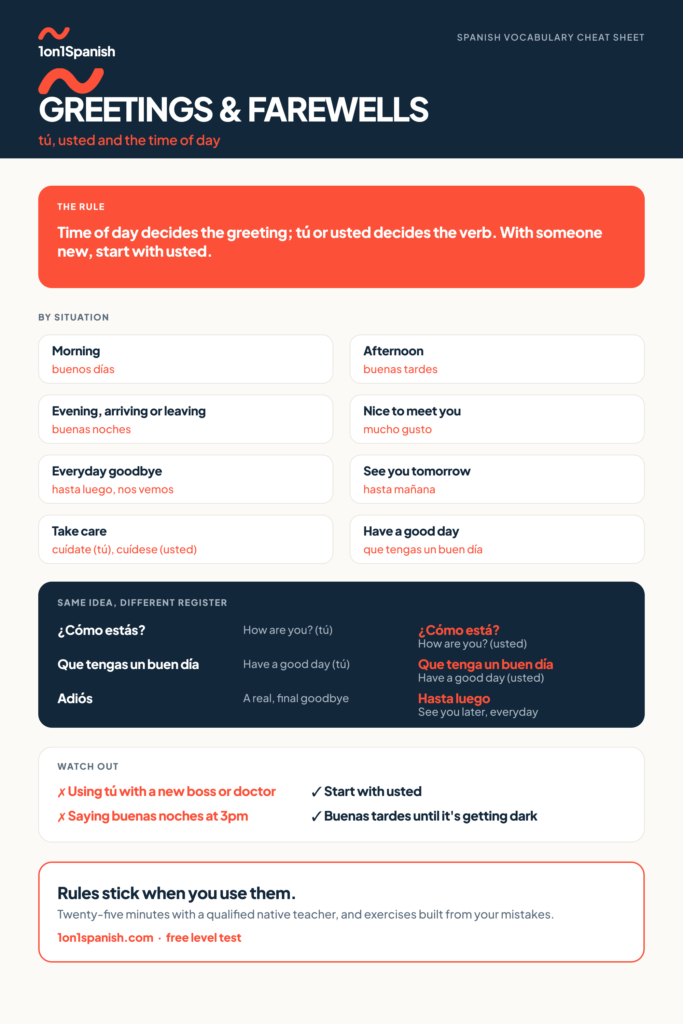
Take the chart with you
The chart is free to view and share. Drop your email and we’ll send the print-ready US Letter PDF — the version you stick on the fridge.
Practice
Practice Spanish greetings and farewells with a real teacher
Charts get you halfway. The other half is saying it out loud to someone who corrects you on the spot. At 1on1Spanish you get 25-minute private lessons with a qualified native teacher, exercises built from the mistakes you make in class, and AI practice between lessons.
First month $1. No contracts, cancel anytime.
When you are ready to speak it out loud, try online Spanish lessons with a native teacher.
Take your free level testBuilt on RingTeacher's method — 700,000+ classes delivered since 2017, teaching English to Spanish speakers. Now in the other direction.
Frequently asked questions
When do you switch from buenas tardes to buenas noches?
There’s no fixed clock hour — the switch tracks whether it’s getting dark, which shifts with season, latitude and country. As a rule of thumb, once the sun is down or close to it, buenas noches is the better choice, and unlike English “good night,” it works as a greeting when you arrive somewhere, not just as a farewell when you leave.
What’s the difference between tú and usted?
Tú is informal “you,” used with friends, family, peers and children. Usted is formal “you,” used with strangers, elders, authority figures and professional settings, especially at first meeting. It’s not just a word choice — the verb conjugation itself changes, so the formality is built into the grammar of the sentence, not layered on top of it.
Is “adiós” the right way to say goodbye in Spanish?
It’s correct, but it can sound more final than you intend for an everyday goodbye — closer to “farewell” than a casual “bye.” For ending a normal chat with a coworker or friend, hasta luego (“see you later”) or nos vemos (“we’ll see each other”) fits better and is far more common in daily conversation.
How do I know if I should use tú or usted with someone new?
Default to usted with anyone older, in a position of authority, or in a professional context you’re meeting for the first time. Many Spanish speakers will explicitly invite you to switch, often with a phrase like me puedes tratar de tú. Starting formal and shifting to informal reads as respectful; starting informal and needing to be corrected reads as presumptuous.
What does “¿qué onda?” mean and when can I use it?
It’s a casual, Mexican-Spanish way of saying “what’s up,” and it only fits with tú-level relationships — friends, peers, people you already know informally. It’s too relaxed for a first professional meeting or anyone you’d address with usted, even if the setting is otherwise friendly.