
N with tilde: how to say and type the Spanish ñ
The letter people search for as “n with tilde” is the ñ, and it isn’t a decorated n — it’s its own letter of the Spanish alphabet, the fifteenth of twenty-seven, with its own name (eñe) and its own sound. Skip it and you don’t get a lazy version of the right word, you often get a different word: año is “year”, ano is not. Below is what the ñ sounds like for an American ear, where the mark over it came from, the pairs where it changes meaning, and how to actually type it on a US keyboard. 1on1Spanish works on pronunciation in 25-minute one-on-one lessons with qualified native teachers, online across the United States.
Reviewed by María Jiménez — Licenciada en Filología Hispánica (BA in Hispanic Philology) · Updated Sep 2026
The sound you already make: canyon and onion
The ñ sounds like the ny in canyon and onion — not two sounds run together, but one single sound made with the middle of the tongue against the roof of the mouth. English speakers already produce it constantly without noticing, tucked inside those two words and a handful of others like piñata (already borrowed into English) and jalapeño. The jump from “onion” to Spanish año is shorter than it looks: say “own-yon”, cut it down to one syllable of nasal sound, and you’re most of the way there.
How it’s produced
The ñ is a nasal palatal sound, which sounds technical and isn’t. Two things happen at once:
- Nasal — air flows out through the nose the whole time, the same as with a regular n or m.
- Palatal — instead of the tongue tip touching the ridge behind your teeth (which is where an English n happens), the middle of the tongue presses up against the hard palate, the roof of your mouth further back.
That’s the whole difference between n and ñ: where the tongue makes contact. Move the contact point back from your teeth to the roof of your mouth, keep the air going through your nose, and the n becomes ñ. It’s a single, continuous sound — not “n” followed by “y” as two separate letters, which is the version most English speakers produce by default. It’s the same contact point the old Spanish ll used before most speakers merged it with y.
Where the ñ shows up in a word
| Position | Example | Sound |
|---|---|---|
| Start of a word | ñoño, ñame, ñu | ñ (rare — very few Spanish words start with it) |
| Middle of a word, between vowels | año, señor, mañana | ñ (by far the most common position) |
| End of a word | none in standard Spanish | ñ never closes a syllable or a word |
The ñ almost never opens a word — most native speakers can only think of a handful, like ñoño (“dull, uncool”) or ñame (“yam”). It does its real work in the middle of extremely common words: año, señor, mañana, español, niño, cumpleaños.
Where it comes from
The ñ started as shorthand. Medieval Spanish scribes, copying Latin words with a double n — annus (“year”), cannna — got tired of writing two letters for one sound and began abbreviating nn as a single n with a small wavy line above it, standing in for the missing letter. That wavy line is called a virgulilla, and it stuck: by the time printing arrived, año had replaced anno for good, and the mark had turned from an abbreviation into a permanent part of the alphabet. Spanish is the language that kept it; French and Italian eventually spelled the same historical sound with gn instead (montagne, montagna). That’s why it has its own slot, right after n, in the 27-letter Spanish alphabet.
The pairs that change meaning
The ñ isn’t cosmetic. These words are spelled the same except for that one mark, and native speakers hear the difference instantly. The other tilde, the one over vowels, does the same job in pairs like tú and tu, and the accents and stress in Spanish page has the three rules behind it.
| n | ñ |
|---|---|
| ano (anus) | año (year) |
| campana (bell) | campaña (campaign) |
| canon (canon) | cañón (canyon, cannon) |
| sueno (I sound / I ring) | sueño (dream, sleep) |
| pena (sorrow) | peña (rocky outcrop, social club) |
Cumplo años en enero — “My birthday is in January” — is a sentence where dropping the ñ produces a different, unrelated word instead of a mild accent. It’s the clearest reason to treat the ñ as its own letter rather than an optional flourish on an n.
Common mistakes English speakers make
✗ Reading ñ as “n” plus “y”, two sounds. Año becomes “ahn-yo” instead of one smooth nasal sound. It’s understandable and close enough to work in conversation, but it’s not the target sound.
✗ Skipping the mark entirely when typing. Autocorrect and predictive keyboards trained on English often “fix” ñ back to n. In a language where año and ano are different words, that autocorrect is not harmless.
✗ Confusing the ñ with the accent mark on vowels. The tilde on á, é, í, ó, ú shows stress. The wave over the ñ is a different mark, on a different kind of letter, doing a different job — it’s not a stressed n, it’s a separate letter of the alphabet.
✗ Placing the tongue too far forward. Trying to make the ñ with the tongue tip, the way English makes n, produces something closer to “ny” said quickly than the true single nasal sound. The contact point needs to move back to the roof of the mouth.
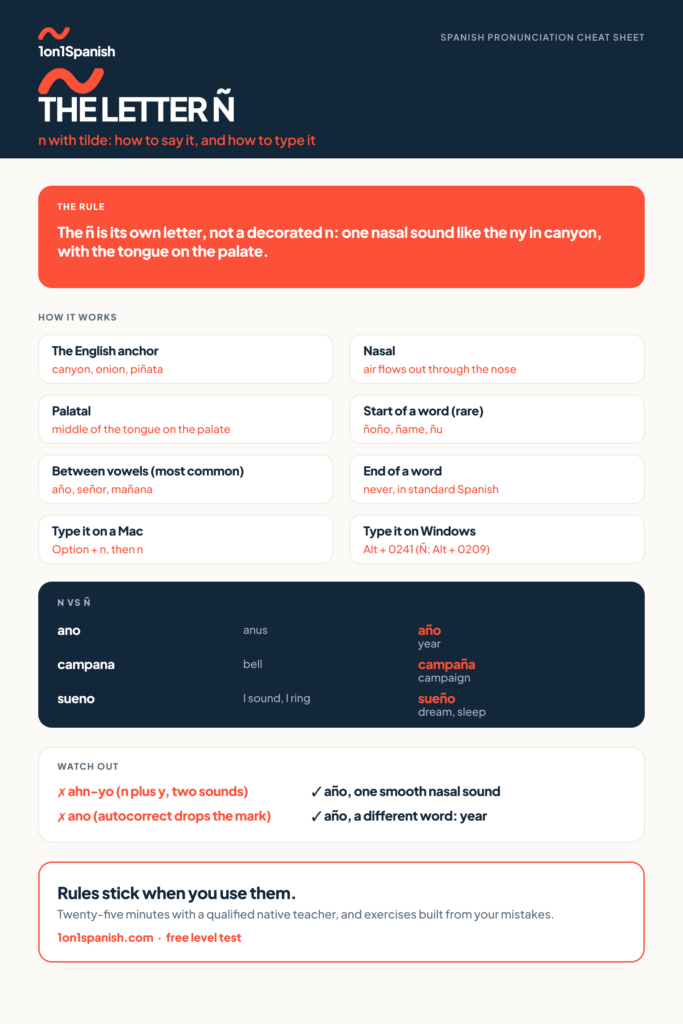
Take the chart with you
The chart is free to view and share. Drop your email and we’ll send the print-ready US Letter PDF — the version you stick on the fridge.
How to type ñ on an American keyboard
On a Mac: hold Option, tap n, release, then type n again: ñ. The same Option+n combination followed by a capital N gives you Ñ.
On Windows: switch to the United States-International keyboard layout (Settings → Time & Language → Language → add a keyboard), and then a tilde key ~ followed by n produces ñ. Without switching layouts, hold Alt and type 0241 on the numeric keypad for ñ, or 0209 for the capital Ñ.
On a phone: press and hold the n key on the default keyboard, and ñ appears as one of the pop-up options, on both iOS and Android.
Practice
Practice the Spanish ñ with a real teacher
Charts get you halfway. The other half is saying it out loud to someone who corrects you on the spot. At 1on1Spanish you get 25-minute private lessons with a qualified native teacher, exercises built from the mistakes you make in class, and AI practice between lessons.
First month $1. No contracts, cancel anytime.
Everything on this page is free to use. If you want feedback on your own Spanish, learn Spanish online with us.
Take your free level testBuilt on RingTeacher's method — 700,000+ classes delivered since 2017, teaching English to Spanish speakers. Now in the other direction.
Frequently asked questions
What does the Spanish ñ sound like in English?
Close to the ny in “canyon” or “onion”, but as one continuous nasal sound instead of two separate ones. The tongue presses against the roof of the mouth, further back than where an English n happens, while air flows through the nose the whole time. Words like piñata and jalapeño, already borrowed into English, carry that exact sound.
Is ñ a separate letter in the Spanish alphabet, or just an accented n?
A separate letter, officially, with its own name — eñe — and its own position, fifteenth of twenty-seven, right after n. Spanish dictionaries and word games treat it as distinct from n, the same way English treats i and j as separate letters even though one grew out of the other historically.
Where does the wavy line over the ñ come from?
Medieval scribes copying Latin words with a double n, like annus (“year”), got tired of writing two letters for one sound and started writing a single n with a small wave above it instead. That wave, called a virgulilla, eventually became permanent, and año replaced anno for good. French and Italian kept the same original sound but spell it with gn instead.
How do I type ñ on an American keyboard?
On a Mac, hold Option, tap n, then type n again. On Windows, switch to the United States-International keyboard layout and type a tilde (~) before n, or hold Alt and type 0241 on the numeric keypad. On a phone, press and hold the n key and ñ appears as a pop-up option.
Do año and ano really mean different things?
Yes, and it’s the example every Spanish teacher uses to show the ñ isn’t decorative. Año means “year” — Feliz año nuevo, “Happy New Year”. Ano is an anatomical term. The words are spelled identically except for that one mark, and mixing them up in writing is a real, noticeable mistake, not a stylistic choice.