
Spanish alphabet pronunciation: all 27 letters
The Spanish alphabet has 27 letters — the same 26 as English plus ñ, and its spelling is far more phonetic than English: once you know a small set of rules, you can usually pronounce a word you have never seen. A few letters do shift with what follows them — c, g and r are the ones to learn — but the five vowels hold steady, which is why a Spanish word is readable out loud the first time you see it. What you have to learn is the handful of letters whose sound has no English equivalent and the handful that look familiar and aren’t. 1on1Spanish works on pronunciation in 25-minute one-on-one lessons with qualified native teachers, online across the United States.
Reviewed by María Jiménez — Licenciada en Filología Hispánica (BA in Hispanic Philology) · Updated Sep 2026
The 27 letters, with names and sounds
The name is what you say when you spell something over the phone. The sound is what the letter does inside a word. They’re different jobs, and most letters have a simple version of each.
| Letter | Name | Sound for an American ear |
|---|---|---|
| a | a | ah, as in father. Never the a of “cat” |
| b | be | b, softer between vowels — lips barely close |
| c | ce | k before a, o, u; s before e, i (Latin America) |
| d | de | d; between vowels closer to the th of “this” |
| e | e | eh, as in bet. Never the ay glide of “day” |
| f | efe | f, same as English |
| g | ge | hard g of “go” before a, o, u; raspy h before e, i |
| h | hache | silent, always |
| i | i | ee, as in see |
| j | jota | raspy h, from the back of the throat |
| k | ka | k. Only in loanwords: kilo, karate |
| l | ele | l as in “leaf”, never the dark l of “full” |
| m | eme | m, same as English |
| n | ene | n, same as English |
| ñ | eñe | ny, as in canyon |
| o | o | oh, pure, with no w glide at the end |
| p | pe | p with no puff of air |
| q | cu | k. Always written qu before e, i: queso, quince |
| r | erre | a single tap, like the dd in “ladder” |
| s | ese | s as in “sit”. Never the z sound of “rose” |
| t | te | t against the teeth, no puff of air |
| u | u | oo, as in food. Silent in que, qui, gue, gui |
| v | uve | identical to b. Spanish makes no b/v distinction |
| w | uve doble | only in loanwords: whisky, wifi |
| x | equis | ks; a raspy h in México and Texas |
| y | ye | y as in “yes”; on its own, the word y is ee |
| z | zeta | s in Latin America; th in most of Spain |
Regional naming varies and nobody minds: v is uve in Spain and often ve or ve corta in Latin America, where b becomes be larga or be grande to keep them apart. Y was called i griega for generations and plenty of speakers still call it that.
The five vowels never change
This is the reason Spanish is easier to read aloud than English. A, e, i, o, u have one sound each: ah, eh, ee, oh, oo. That holds in every word, stressed or not, and the vowels stay short and pure.
English vowels glide. “No” drifts toward “nowoo” and “say” toward “seiy”, while the Spanish no stops dead and se doesn’t move. Cutting that glide is the single fastest improvement an American speaker can make, and it costs nothing but attention.
Unstressed vowels also keep their full value. English reduces them to a mumble, the a in “about”; Spanish never does. Banana in Spanish is ba-na-na, three clean ah sounds. Holding a vowel still is a skill on its own, and Spanish vowels get a full page of drills for it.
The four sounds English doesn’t have
RR — the trill. Perro, carro, arroz. The tongue tip vibrates against the ridge behind your teeth. It’s also what a single r does at the start of a word — Roberto, rojo — even though it’s written with one letter. This one takes weeks for some people and arrives in an afternoon for others, and neither says anything about your Spanish. If it hasn’t arrived yet, the step-by-step for how to roll your rs starts from the tap you already make in “ladder”.
Ñ. Año, señor, mañana. The ny of “canyon”, but as one sound, not two. It matters: año is year and ano is not.
J and soft G. Jugar, jefe, gente, gimnasio. A rasp made at the back of the throat, much further back than the English h of “hot”. Spain’s version scrapes harder than the Caribbean’s, which sits close to an English h. Both are understood everywhere.
LL and Y. Llamar, lluvia, yo, ya. Across most of the Spanish-speaking world these two sound the same, a phenomenon called yeísmo, and that sound sits near the English y in “yes”. In Buenos Aires and Montevideo it becomes a sh sound: calle comes out as ca-she. Nowhere will pronouncing it as y cause a problem.
The letters that trick you
H is silent. Always. Hola is ola, hospital starts with o, ahora is two syllables run together. There is no exception in native Spanish vocabulary. The reason it’s still written at all is on the silent h page, along with the one digraph where you do hear it.
B and V are the same sound. Vaca and baca are homophones. Spanish speakers spelling a word out loud will say be de burro or uve de vaca precisely because you can’t tell them apart by ear. Making an English v with your teeth on your lip marks you as a foreigner instantly.
G changes with the next vowel. Gato, gorra, gusto are hard. Gente, gimnasio are the raspy j sound. To keep the hard g before e or i, Spanish inserts a u: guerra, guitarra, where that u is silent. To make it heard again it takes two dots: pingüino.
C follows the same logic. Casa, color, cuenta are k. Cero, cinco are s in Latin America and th in most of Spain. The th is a regional accent, not a mistake, and neither version is more correct.
Q is never alone. It’s always qu, always sounds like k, and the u is silent: queso, aquí, quince.
Ch and ll are no longer letters. Until 1994 they had their own entries in the dictionary, and the Real Academia Española removed them from the alphabet as separate letters, treating them as digraphs, two letters making one sound. The sounds are alive and well; only the alphabet listing changed. That’s why the count is 27 and not 29.
Common mistakes English speakers make
The h is silent, and pronouncing it is the most audible learner marker there is.
No teeth on the lip. V and b are one sound in Spanish.
In México, Texas and Oaxaca the x is pronounced as the raspy j. The spelling keeps the x, and that is the form to write.
Confusing pero (but) with perro (dog) is survivable, but the English r with the tongue curled back doesn’t exist in Spanish at all.
English speakers add a vowel before sp-, st-, sc-. Spanish words that need it already have it written: España, estudiante, escuela.
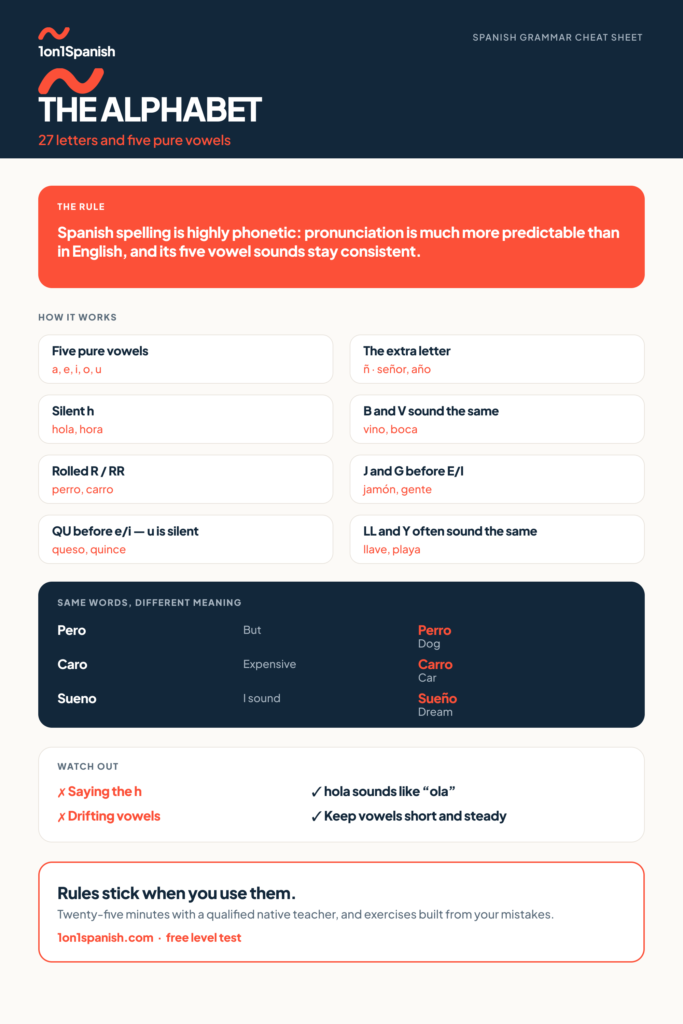
Take the chart with you
The chart is free to view and share. Drop your email and we’ll send the print-ready US Letter PDF — the version you stick on the fridge.
Practice
Practice Spanish pronunciation with a real teacher
Charts get you halfway. The other half is saying it out loud to someone who corrects you on the spot. At 1on1Spanish you get 25-minute private lessons with a qualified native teacher, exercises built from the mistakes you make in class, and AI practice between lessons.
First month $1. No contracts, cancel anytime.
You can go further with someone listening: Learn Spanish with 1on1Spanish, 25 minutes at a time.
Take your free level testBuilt on RingTeacher's method — 700,000+ classes delivered since 2017, teaching English to Spanish speakers. Now in the other direction.
Frequently asked questions
How many letters are in the Spanish alphabet?
Twenty-seven: the 26 English letters plus ñ. Until 1994 ch and ll were listed as separate letters, which is why older textbooks say 29. The Real Academia Española now treats them as digraphs, two letters spelling one sound, so they no longer have their own place in the alphabet, though both sounds are as common as ever in words like muchacho and llamar.
How do you pronounce the letter j in Spanish?
Like a raspy h produced at the back of the throat, further back than the English h in “hot”. Jefe, jugar and trabajo all use it. The same sound appears when g comes before e or i, as in gente and gimnasio. The rasp is stronger in Spain than in the Caribbean, where it sits close to a plain English h, and both are understood everywhere.
Are b and v really pronounced the same in Spanish?
Yes. Vaca and baca sound identical, and no Spanish accent distinguishes them. Both are made with the lips, never with teeth on the lip the way an English v is. Because they’re indistinguishable by ear, Spanish speakers spelling out loud clarify with be de burro and uve de vaca. Using an English v is one of the most recognizable learner accents.
Why is the h silent in Spanish?
It’s a leftover from Latin and from Arabic loanwords, kept in the spelling long after the sound disappeared. Hola, hombre and hotel all begin with a vowel sound. The only time an h is heard is inside the digraph ch, as in carro. There are no exceptions to memorize, which makes this one of the easiest rules in the language.
Do I need to roll my r to speak Spanish?
You’ll be understood without it, and plenty of native speakers have a weak trill. But the distinction is real (pero means “but”, perro means “dog”), so it’s worth working on. The single r between vowels is the easy one: it’s the same tap as the dd in “ladder”, a sound American English already has. The full trill in rr is what takes practice.