
The Spanish g: when it’s hard, when it’s raspy
The Spanish g isn’t one sound, it’s two, and which one you get depends entirely on the letter that comes right after it. Before a, o or u, it is the hard g of English “go”. Before e or i, it flips to a raspy sound made at the back of the throat, the same sound as the Spanish j. Miss the switch and gente — people — comes out sounding like it starts with the g of “get”, which is one of the more noticeable non-native markers in spoken Spanish.
Below is the rule, the exceptions that keep the hard sound alive before e and i, and where the raspy version actually comes from. 1on1Spanish works on pronunciation in 25-minute one-on-one lessons with qualified native teachers, online across the United States.
Reviewed by María Jiménez — Licenciada en Filología Hispánica (BA in Hispanic Philology) · Updated Sep 2026
The sound you already have: the hard g
Before a, o and u, the Spanish g is close to the English g in “go”, “gum” or “got” — a sound made by the back of the tongue touching the soft palate and releasing. English speakers already produce it correctly most of the time in this position without any adjustment:
- gato (cat) · gorra (cap) · gusto (taste) · agosto (August) · ganar (to win)
The only refinement worth making: between vowels, Spanish softens it slightly, so the g in lago (lake) is a touch weaker than the g that opens gato. It’s a small adjustment, not a different sound, and it comes on its own with exposure.
The sound you have to build: the raspy g
Before e and i, the Spanish g stops being a g at all and becomes a raspy sound produced at the back of the throat — the exact same sound as the Spanish j (covered on its own page, since it deserves the full explanation). Gente (people), gimnasio (gym) and general both use it. There’s no equivalent in standard American English; the closest anchor is an exaggerated, breathy “h” like the one some speakers use for emphasis in “he he he” — pushed further back in the throat than a normal English h, with real friction against the airflow.
Two things go wrong most often: importing the hard English g anyway (gente sounding like “hentay” turns into “ghen-tay”), or reaching for the American h, which is close but too soft to be convincing. The target sits between the two, closer to the raspy end. Building the sound itself, step by step, is the job of the Spanish j page; this one is about knowing when g turns into it.
The silent u that keeps the hard sound alive
Spanish needs a way to write a hard g before e or i — guerra (war), guitarra (guitar) — and it does that by inserting a u that isn’t pronounced. The u is purely a spelling device, there to tell you “hard g, not raspy”:
- guerra → hard g, silent u → sounds like “GHEH-rrah”
- guitarra → hard g, silent u → sounds like “ghee-TAH-rrah”
Read that silent u out loud and you get a mispronunciation, not an accent — guerra would sound like “goo-EH-rrah”, a word nobody says.
When the u in gue/gui is supposed to be heard: the dieresis
Occasionally a word needs the hard g and an audible u right after it, before e or i — pingüino (penguin), vergüenza (shame), bilingüe (bilingual). Spanish marks that with two dots over the u, called a dieresis: ü. Seeing ü is the signal to pronounce the u that would otherwise stay silent.
- pingüino → hard g, u is heard → “peen-GWEE-noh”
- pinguino (no dots, hypothetical) would be misread with a silent u
Where the letter g sounds, by position
| Position | Example | Sound |
|---|---|---|
| Before a, o, u | gato, gorra, gusto | hard g, like “go” |
| Before e, i | gente, gimnasio | raspy, same as j |
| gue, gui (u silent) | guerra, guitarra | hard g, u not heard |
| güe, güi (u heard) | pingüino, vergüenza | hard g, u heard |
| gua, guo (u always heard) | agua, antiguo | hard g, u always heard |
The last row is its own case: in gua and guo, the u is always pronounced — no dots needed, because a isn’t e or i, so there’s nothing for the silent-u spelling rule to protect against. Agua (water) is “AH-gwah”, not “AH-gah”. That gw glide is a diphthong, the same two-vowels-one-syllable fusion that keeps agua at two syllables instead of three.
The words that change meaning
Spanish has fewer true minimal pairs on hard versus raspy g than on other sounds, because the two almost never sit in the exact same slot. Where the contrast shows up most is between related word forms, and getting it wrong changes how a whole sentence reads:
| Hard g | Raspy g |
|---|---|
| pago — I pay | (compare with j:) viaje — trip |
| llego — I arrive | (compare with j:) viajé — I traveled |
| ganga — bargain | gigante — giant |
The clearest test case is a single word that carries both sounds: gigante. The first g sits before an i, so it comes out raspy; the second sits before an a, so it’s the hard g of “go”. Same letter, two sounds, three syllables apart. The safest drill is reading full words aloud and checking the letter that follows each g, rather than memorizing pairs.
Common mistakes English speakers make
✗ Using the hard English g before e or i. Gente said with the g of “get” is understandable but marks the accent immediately. The switch to raspy is not optional.
✗ Reading the silent u in gue/gui. Guitarra pronounced with an audible u (“goo-ee-tarra”) turns a normal word into a mispronunciation. The u there is spelling, not sound.
✗ Skipping the u in güe/güi. Without hearing the dieresis rule, pingüino often loses its u entirely and comes out as “pin-gee-no”. The two dots are there for a reason.
✗ Softening the hard g everywhere, including at the start of a word. Between vowels the hard g does weaken (lago), but at the start of a word or after a pause it needs its full force: gato should sound clearly like “go”, not a breathy version of it.
✗ Avoiding words with the raspy g. Learners route around gente, general, gimnasio for months. A soft approximation is far better than skipping words that common — say it, even imperfectly, and it improves with practice.
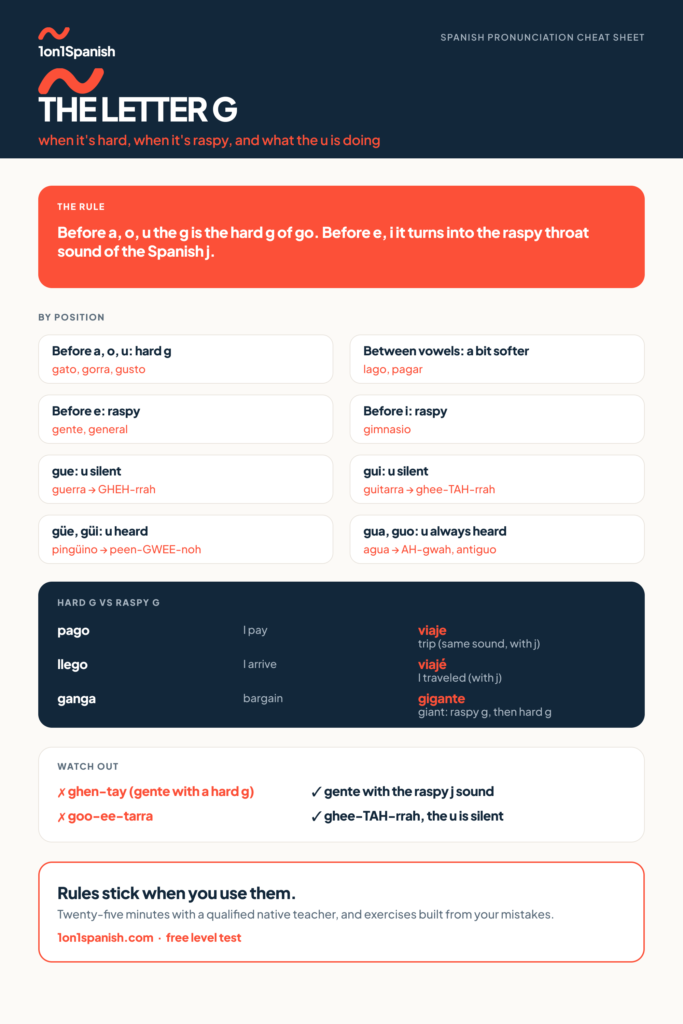
Take the chart with you
The chart is free to view and share. Drop your email and we’ll send the print-ready US Letter PDF — the version you stick on the fridge.
Practice
Practice the Spanish g with a real teacher
Charts get you halfway. The other half is saying it out loud to someone who corrects you on the spot. At 1on1Spanish you get 25-minute private lessons with a qualified native teacher, exercises built from the mistakes you make in class, and AI practice between lessons.
First month $1. No contracts, cancel anytime.
When you are ready to speak it out loud, try online Spanish lessons with a native teacher.
Take your free level testBuilt on RingTeacher's method — 700,000+ classes delivered since 2017, teaching English to Spanish speakers. Now in the other direction.
Frequently asked questions
How do you know if a Spanish g is hard or soft?
Look at the letter right after it. Before a, o or u, the g is hard, close to the English g in “go”. Before e or i, it becomes a raspy sound made at the back of the throat, the same sound as the Spanish j. The two exceptions to watch are gue/gui, where an inserted silent u keeps the hard sound before e or i, and güe/güi, where two dots over the u mean it should be heard.
Why is there a u in words like guerra and guitarra?
That u isn’t pronounced. Spanish needs a way to write a hard g before e or i, since g alone in that position would be raspy, so it inserts a silent u as a spelling signal: gue and gui are both read as a hard g with no u sound. Guerra is “GHEH-rrah”, not “goo-EH-rrah”.
What do the two dots over the u in pingüino mean?
They’re called a dieresis, written ü, and they mean the u should be pronounced after all, even though it comes after g and before e or i. Without the dots, gue and gui have a silent u by default. Pingüino and vergüenza need the u heard, so Spanish marks it explicitly with the dieresis.
Is the Spanish g before e or i the same sound as the letter j?
Yes, exactly the same raspy sound made at the back of the throat. Gente and jefe start with an identical sound even though they’re spelled with different letters. The full explanation of that sound — how to produce it and where it varies by country — is worth reading on its own, since it’s one of the sounds English speakers find hardest to build from scratch.
Does the hard g change at all between vowels in Spanish?
Slightly. At the start of a word or after a pause, the hard g is firm, like the g in “go”. Between vowels — lago, pagar — it softens a little, without becoming a different sound. It’s a small, automatic adjustment that develops with exposure to spoken Spanish rather than something to drill on its own.