
X in Spanish pronunciation: 4 different sounds
No other letter in Spanish carries this many different sounds. The Spanish x can be ks, like in English (examen, éxito), a plain s at the start of a word (xilófono), the raspy j sound in a specific set of place names including the country’s own name (México, Oaxaca), or a sh sound in words that come from Indigenous languages (Xel-Há, mixiote). There’s no single rule that predicts which one applies — it depends on the word’s history, not a spelling pattern.
Below is each sound with real examples, and the full explanation of why México is written with an x but said with a j. 1on1Spanish works on pronunciation in 25-minute one-on-one lessons with qualified native teachers, online across the United States.
Reviewed by María Jiménez — Licenciada en Filología Hispánica (BA in Hispanic Philology) · Updated Sep 2026
Sound 1 — ks, the sound you already have
Inside most words, especially between vowels, x sounds exactly like the English x in “exam” or “taxi”: a k sound immediately followed by an s. This is the most common pronunciation and the one to default to when you don’t recognize a word:
- examen (exam) · éxito (success) · exacto (exact) · extra (extra) · tóxico (toxic)
Nothing new to build here — this is the same consonant cluster English already uses in the same spot. It’s the same k-then-s pair the double cc makes in acción, covered on the Spanish c page.
Sound 2 — a plain s, at the start of a word
When x opens a word, Spanish speakers almost always simplify it to a plain s sound rather than the full ks cluster, since starting a word with a k-s combination is awkward to produce quickly:
- xilófono (xylophone) · xenofobia (xenophobia)
These words are rare — very few Spanish words actually start with x — but when they show up, expect s, not ks.
Sound 3 — the raspy j sound, in a specific set of words
A small group of words, mostly Mexican place names, spell a sound with x that is actually pronounced like the Spanish j — the same raspy throat sound covered on its own page. This isn’t random: these words kept an older Spanish spelling convention from centuries ago, when x itself represented that raspy sound, before spelling reforms replaced most of those x’s with j. A handful of proper nouns never got updated:
- México — said “MEH-hee-koh”, with a j sound, even though the letter is x
- Oaxaca — said “wah-HAH-kah”
- Texas — said “TEH-hahs” in Spanish (English keeps its own pronunciation)
- Don Quixote — the older spelling, said with a j sound: “kee-HOH-teh”
México is the case that matters most. The country’s own name is the clearest example: it’s written with an x by official convention, in Mexico and internationally, but a native speaker says it with the same sound as jefe. Writing “Méjico” is considered incorrect and outdated in modern Spanish, even though it would better match the pronunciation — the x spelling is the fixed, correct one, and the j sound is simply how that particular x is read.
If the raspy sound itself is still shaky, how to say the Spanish j is the page to work through first — every x in this group borrows it wholesale.
Sound 4 — sh, in words from Indigenous languages
A fourth pronunciation shows up in words borrowed from Nahuatl, Maya and other Indigenous languages of Mexico and Central America, mostly place names and food terms, where x represents a sh sound that has no other letter to spell it with in Spanish:
- Xel-Há — a natural park in Quintana Roo, said “shel-HAH”
- mixiote — a traditional dish, said “mee-SHOH-teh”
- Xochimilco — a district of Mexico City, said “so-chee-MEEL-koh” (the x here shifted further, toward an s)
These words carry real cultural weight — many are place names tied to Indigenous heritage that predates Spanish colonization — and mispronouncing them as ks is a common tourist mistake worth avoiding.
Where the letter x sounds, by context
| Context | Example | Sound |
|---|---|---|
| Between vowels, most words | examen, éxito | ks |
| Start of a word | xilófono | s |
| Certain Mexican place names (historical spelling) | México, Oaxaca | raspy j |
| Words from Nahuatl, Maya and other Indigenous languages | Xel-Há, mixiote | sh |
Common mistakes English speakers make
✗ Reading México with ks. “MEK-see-koh” is the single most common x mistake, and it’s the name of the country itself. The correct sound is the raspy j, the same as in jefe.
✗ Applying ks to every x automatically. It’s the right default for most words, but place names and Indigenous-language words don’t follow that rule — check the word rather than assume.
✗ Adding a full ks at the start of xilófono-type words. A hard ks opening is awkward in Spanish; native speakers simplify it to a plain s.
✗ Guessing “sh” words are misspelled. Words like Xel-Há look unfamiliar to an ear trained only on the ks and j patterns, and learners sometimes assume they’re typos. They’re correct spellings preserving sounds from languages older than Spanish in the Americas.
✗ Writing “Méjico” thinking it’s more correct. It’s the phonetic spelling, but modern standard Spanish keeps México with an x as the only accepted form, both in Mexico and internationally.
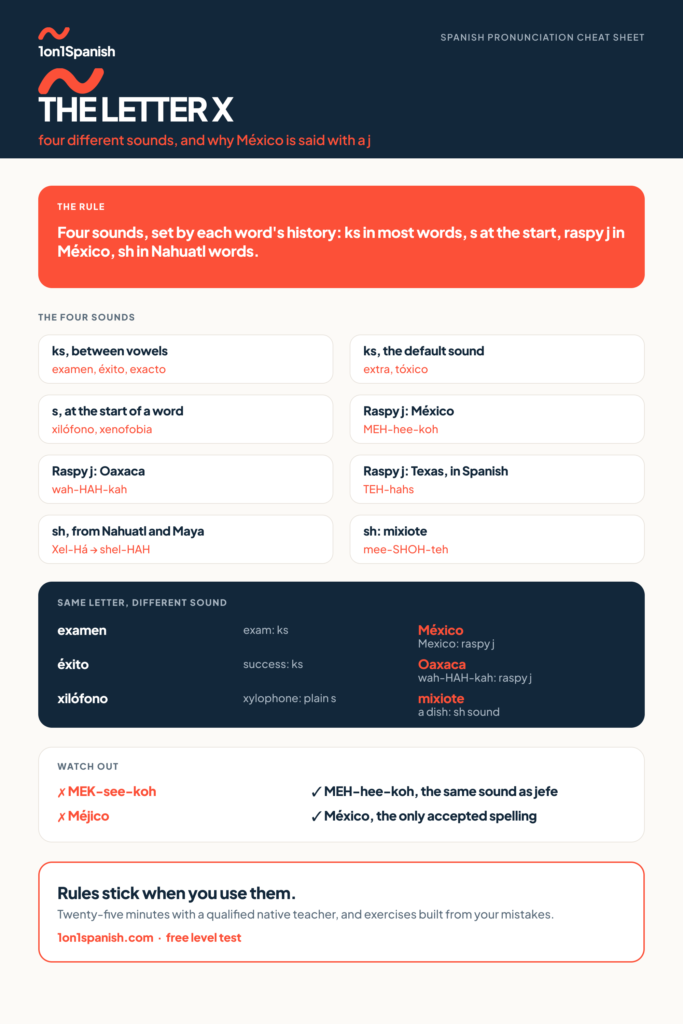
Take the chart with you
The chart is free to view and share. Drop your email and we’ll send the print-ready US Letter PDF — the version you stick on the fridge.
Practice
Practice Spanish pronunciation with a real teacher
Charts get you halfway. The other half is saying it out loud to someone who corrects you on the spot. At 1on1Spanish you get 25-minute private lessons with a qualified native teacher, exercises built from the mistakes you make in class, and AI practice between lessons.
First month $1. No contracts, cancel anytime.
Guides help. A teacher hears what a guide cannot — Learn Spanish online with a real teacher.
Take your free level testBuilt on RingTeacher's method — 700,000+ classes delivered since 2017, teaching English to Spanish speakers. Now in the other direction.
Frequently asked questions
How many sounds does the letter x have in Spanish?
Four. It’s a ks sound in most words, like examen and éxito. It simplifies to a plain s when it starts a word, as in xilófono. In a small set of mostly Mexican place names, including México itself, it’s pronounced like the raspy Spanish j. And in words borrowed from Nahuatl, Maya and other Indigenous languages, like Xel-Há, it represents a sh sound.
Why is México pronounced with a j sound if it’s spelled with an x?
Because that x preserves an older Spanish spelling convention. Centuries ago, x represented the raspy j sound in Spanish, before a spelling reform replaced most of those x’s with j. A handful of proper nouns, including the name of the country, kept the original x spelling while the pronunciation stayed the raspy j sound — so the spelling is historical, not phonetic.
Is it correct to write Méjico instead of México?
No. Modern standard Spanish, in Mexico and internationally, treats México with an x as the only correct spelling, even though Méjico would match the pronunciation more closely. Méjico is considered outdated and is not used in official or standard writing today.
What does the x sound like in words like Xel-Há or mixiote?
A sh sound, close to the sh in the English word “she”. These words come from Nahuatl, Maya and other Indigenous languages of Mexico and Central America, and Spanish uses x to represent a sound those languages have but that doesn’t map onto any other Spanish letter. Reading them with a ks sound is a common mistake for visitors and learners.
Does the x in Texas sound the same in Spanish as in English?
No. In English, Texas keeps its standard ks-based pronunciation. In Spanish, Texas is pronounced with the raspy j sound, “TEH-hahs”, the same historical pattern as México. Both are proper names that kept an older x spelling while the sound shifted to j.