
The Spanish c: when it sounds like k, when like s
The Spanish c works like the English c in one way and unlike it in another. Before a, o or u, it’s always a hard k sound — no exceptions, no soft version. Before e or i, it changes: across Latin America it becomes an s, a pattern called seseo, while in most of Spain it becomes the th sound in “think”, called distinción. Cero (zero) and cinco (five) both use that second sound. 1on1Spanish teaches Latin American Spanish by default, so the version taught here is the s sound — the one used by the vast majority of Spanish speakers worldwide.
Below is the rule, the digraphs ch and cc, and why Spain sounds different without either version being wrong. 1on1Spanish works on pronunciation in 25-minute one-on-one lessons with qualified native teachers, online across the United States.
Reviewed by María Jiménez — Licenciada en Filología Hispánica (BA in Hispanic Philology) · Updated Sep 2026
The sound you already have: c before a, o, u
Before a, o or u, the Spanish c is a plain, hard k — identical to the k in “cat”, “cot” or “cut”. This is consistent everywhere Spanish is spoken, with zero regional variation:
- casa (house) · cosa (thing) · cuenta (bill/account) · carro (car) · poco (a little)
There’s no puff of air after it the way English sometimes adds one — Spanish stops consonants are crisper, with less breath released — but the core sound is one you already produce correctly by default.
The sound that changes by region: c before e, i
Before e or i, the letter c stops being a k and becomes something else entirely, and which something depends on where the speaker is from.
Seseo — the sound taught here. Across all of Latin America, and in parts of southern Spain and the Canary Islands, c before e or i sounds like a plain s, identical to the s in “sit”. Cero (zero), cinco (five) and cien (one hundred) all start with a clean s sound. This is the pronunciation the vast majority of Spanish speakers use, and it’s what 1on1Spanish teaches as the default.
Distinción — the sound used in most of Spain. In central and northern Spain, that same c becomes the th sound in the English word “think” — a sound made with the tongue between or just behind the teeth. Cero there sounds close to “THEH-roh”. Some English speakers call this “the lisp”, but that’s a misleading label: it’s a full, consistent regional pronunciation, produced deliberately by millions of native speakers, not a speech difference.
Neither version is more correct. They’re both standard, native pronunciations of the same letter, and the difference tells you where a speaker is from, not whether they’re saying it right. Everything here applies to z as well: the Spanish z follows seseo and distinción letter for letter, with no vowel condition at all.
Where the letter c sounds, by position
| Position | Example | Sound |
|---|---|---|
| Before a, o, u | casa, cosa, cuenta | k, everywhere |
| Before e, i (Latin America) | cero, cinco | s |
| Before e, i (most of Spain) | cero, cinco | th (as in “think”) |
| ch (digraph, two letters, one sound) | chico, mucho | ch, as in “chip” |
| cc (double c, two sounds) | acción, dirección | k + s (or k + th in Spain) |
The digraph ch and the double cc
Ch used to be its own letter in the Spanish alphabet and still makes its own single sound, the same ch as in the English word “chip”: chico (boy/small), mucho (a lot), noche (night). It’s never a k sound and never an s sound — it’s a separate combination with its own identity. It no longer counts among the twenty-seven letters of the Spanish alphabet, but the sound didn’t go anywhere — and it’s the one place the otherwise silent h earns its keep.
Cc, on the other hand, is two different sounds stacked back to back, not a digraph: the first c is always a hard k, and the second follows the normal rule for the vowel after it. Acción (action) is “ak-SYOHN”, with a k followed by an s. Dirección (address/direction) works the same way: “dee-rek-SYOHN”.
The words seseo and distinción tell apart — and don’t
Because seseo merges c-before-e/i with s, a handful of words that are spelled differently sound identical in Latin American Spanish but stay distinct in Spain:
| Word with c or z | Word with s | Sound in Latin America (seseo) | Sound in Spain (distinción) |
|---|---|---|---|
| cazar — to hunt | casar — to marry | identical | different |
| cocer — to cook/boil | coser — to sew | identical | different |
| ciento — one hundred | siento — I feel | identical | different |
In every case, context makes the meaning obvious in conversation — the same way “flower” and “flour” don’t confuse an English listener out loud. These pairs matter for spelling far more than for speaking.
Common mistakes English speakers make
✗ Using k before e or i. Cero said with a hard k, like “keh-roh”, is a common import from English spelling rules (English c is often hard) and immediately marks the accent.
✗ Adding a puff of air after k. English speakers often aspirate the k in “casa” the way they would in “cat” at the start of a sentence. Spanish k sounds are crisper, with less breath.
✗ Mixing seseo and distinción in the same word. Some learners who’ve heard both versions start alternating unpredictably. Pick one — 1on1Spanish teaches seseo — and stay consistent.
✗ Treating the Spain th sound as a speech impediment. It’s a full regional pronunciation used correctly by millions of native speakers, not a lisp. Framing it that way is inaccurate and, to a Spanish speaker from Madrid, mildly insulting.
✗ Reading cc as one sound. Acción pronounced with a single c-sound loses the k. It’s genuinely two consonant sounds back to back, not a digraph like ch.
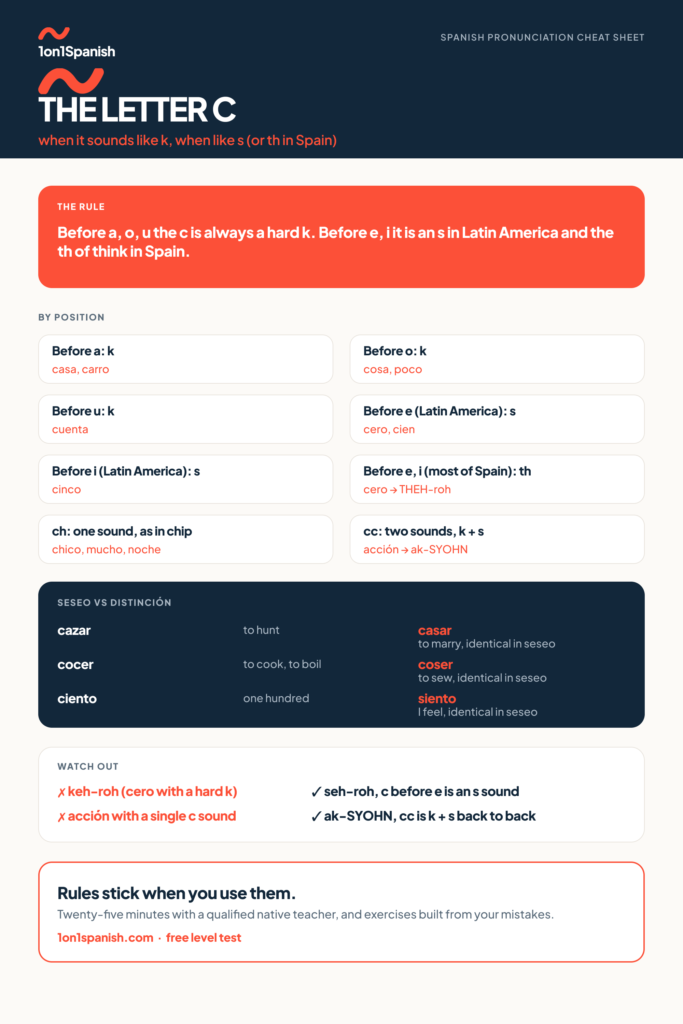
Take the chart with you
The chart is free to view and share. Drop your email and we’ll send the print-ready US Letter PDF — the version you stick on the fridge.
Practice
Practice the Spanish c with a real teacher
Charts get you halfway. The other half is saying it out loud to someone who corrects you on the spot. At 1on1Spanish you get 25-minute private lessons with a qualified native teacher, exercises built from the mistakes you make in class, and AI practice between lessons.
First month $1. No contracts, cancel anytime.
When you are ready to speak it out loud, try online Spanish lessons with a native teacher.
Take your free level testBuilt on RingTeacher's method — 700,000+ classes delivered since 2017, teaching English to Spanish speakers. Now in the other direction.
Frequently asked questions
How do you pronounce the letter c in Spanish?
It depends on the letter that follows it. Before a, o or u, it’s always a hard k sound, like the c in “cat” — no exceptions. Before e or i, it changes by region: across Latin America it sounds like an s (seseo), and in most of Spain it sounds like the th in “think” (distinción). 1on1Spanish teaches the Latin American s sound as the default.
What’s the difference between seseo and distinción in Spanish?
Both refer to how c and z sound before e or i. Seseo, used across Latin America and parts of southern Spain, pronounces them as a plain s. Distinción, used in most of Spain, pronounces them as the th in “think”. Neither is more correct — they’re both standard native pronunciations, and the difference simply marks where a speaker learned Spanish.
Is the Spanish th sound in cero a lisp?
No, and calling it that is inaccurate. It’s a full, deliberate regional pronunciation used correctly by millions of native speakers across central and northern Spain, the same way a British and an American accent both correctly pronounce English differently. A lisp is an individual speech difference; distinción is a shared feature of an entire regional accent.
How is cc pronounced in words like acción and dirección?
As two separate sounds, not one. The first c is always a hard k, and the second follows the normal rule for the vowel after it — an s in Latin American Spanish, a th in most of Spain. Acción is pronounced “ak-SYOHN”, with both sounds audible back to back, not compressed into a single c.
Is ch the same as c plus h in Spanish?
No. Ch is a distinct combination with its own single sound, the same ch as in the English word “chip” — chico, mucho, noche. It’s never pronounced as a k followed by a silent or separate h. Until 1994 it was even listed as its own letter of the Spanish alphabet.