
Pronunciation of z in Spanish: never like English z
The Spanish z never buzzes. English “zoo”, “lazy” and “zebra” all use a voiced z, with the vocal cords vibrating against the airflow — Spanish doesn’t have that sound anywhere, in any word, in any country. Across Latin America, z is pronounced exactly like an s: zapato sounds like “sapato”. In most of Spain, it’s pronounced like the th in “think”: zapato sounds closer to “thapato”.
Importing the buzzing English z into either version is the one true error here — both correct pronunciations are unvoiced, with no vibration at all. At 1on1Spanish we teach Latin American Spanish by default, so the version covered here is the s sound used by the vast majority of Spanish speakers worldwide.
Below is why the sound splits by region, the spelling rule that swaps z for c, and the words where this actually changes meaning.
Reviewed by María Jiménez — Licenciada en Filología Hispánica (BA in Hispanic Philology) · Updated Sep 2026
The sound you already have: a plain s
For Latin American Spanish, z is simply an s, the same unvoiced sound at the start of “sun” or “sit” in English. You already produce it correctly without adjustment:
- zapato (shoe) · zorro (fox) · empezar (to begin) · lápiz (pencil) · cabeza (head)
Say the English word “sun”, then carry that exact sound into zorro: that’s a correct Latin American pronunciation of the Spanish z. This pattern, where z and s sound identical, is called seseo, and it’s the standard across nearly every Spanish-speaking country in the Americas. The deeper explanation of seseo — including how it interacts with the letter c before e and i — lives on its own page, since c carries the same split. That page is the Spanish c, and it’s worth reading next: cero and zapato start with the same sound in Mexico and with the same th in Madrid.
Where the sound changes: Spain’s th
In most of Spain, z is pronounced like the English th in “think” — a sound made by placing the tongue tip between or just behind the front teeth. This pattern is called distinción, because it keeps z distinct from s rather than merging them. Zapato in Spain sounds close to “thapato”, and cabeza sounds close to “cabetha”. It’s a regional standard, not a speech impediment or a mistake, and it applies consistently to every z in the language.
Why the buzzing English z is always wrong
Neither Spanish pronunciation of z — the Latin American s or the Spanish th — involves any vocal cord buzz. English “zebra” and “zoo” use a voiced sound that doesn’t exist anywhere in standard Spanish z pronunciation. This is the actual error to fix: not choosing the wrong regional version, but importing a third sound that belongs to neither one. Zapato said with an English z sounds distinctly foreign in every Spanish-speaking country.
The spelling rule: z becomes c before e and i
Spanish has a strict spelling rule that swaps z for c the moment the next letter is e or i, because ze and zi are avoided in standard spelling in favor of ce and ci. This shows up constantly in plurals and in verb conjugation:
- lápiz → lápices (pencils): the plural adds -es, and z becomes c before that e
- luz → luces (lights): same pattern
- comenzar → comencé (I began): the yo form of the preterite adds -é, forcing the swap
- empezar → empecé (I began)
The sound doesn’t change at all when this happens — lápiz and lápices are pronounced with the exact same consonant, just spelled differently. This is a writing rule, not a pronunciation rule, and it trips up learners in writing far more than in speech. The same swap is why the preterite of empezar is written empecé, one of the first places you’ll meet it in a verb: see the empezar conjugation.
Reference chart
| Context | Example | Latin America | Spain |
|---|---|---|---|
| z + a, o, u | zapato, zorro, azul | s sound | th sound |
| z at the end of a syllable | lápiz, feliz | s sound | th sound |
| z → c before e/i (spelling) | lápiz → lápices | s sound (unchanged) | th sound (unchanged) |
| z → c in verb conjugation | empezar → empecé | s sound (unchanged) | th sound (unchanged) |
The words where the sound matters
Latin American Spanish merges z and s completely, so casa (house) and caza (hunt) are exact homophones: a Mexican, Colombian or Argentine speaker pronounces them identically and only the spelling and the sentence tell them apart. In Madrid they are two clearly different words, because caza takes the th sound. This is the single clearest demonstration of what seseo does, and it is why the same pair is a spelling problem in Latin America and not in Spain. The clearer test case is a single word carrying the rule twice: zapatos has a z that stays an s sound in Latin America and a th sound in Spain, consistently, from the first letter to the last.
Common mistakes English speakers make
✗ Using the buzzing English z. Zapato said with the z of “zoo” is the single most common error and it’s foreign to both correct Spanish pronunciations, not just one of them.
✗ Reading lápices with a z-sound because the singular has a z. The plural is spelled with c, not z, and it should be — the sound stays the same as the singular, but a learner reading letter by letter sometimes reintroduces a z-like sound that was never there.
✗ Mixing regional versions inconsistently. Switching between the Latin American s and the Spanish th mid-conversation, rather than picking one and staying consistent, sounds unnatural to native ears in a way that either version alone doesn’t.
✗ Avoiding words with z out of uncertainty. Empezar, comenzar, zapato are everyday words. The s-sound version is correct almost everywhere Spanish is spoken and there’s no reason to hesitate over it.
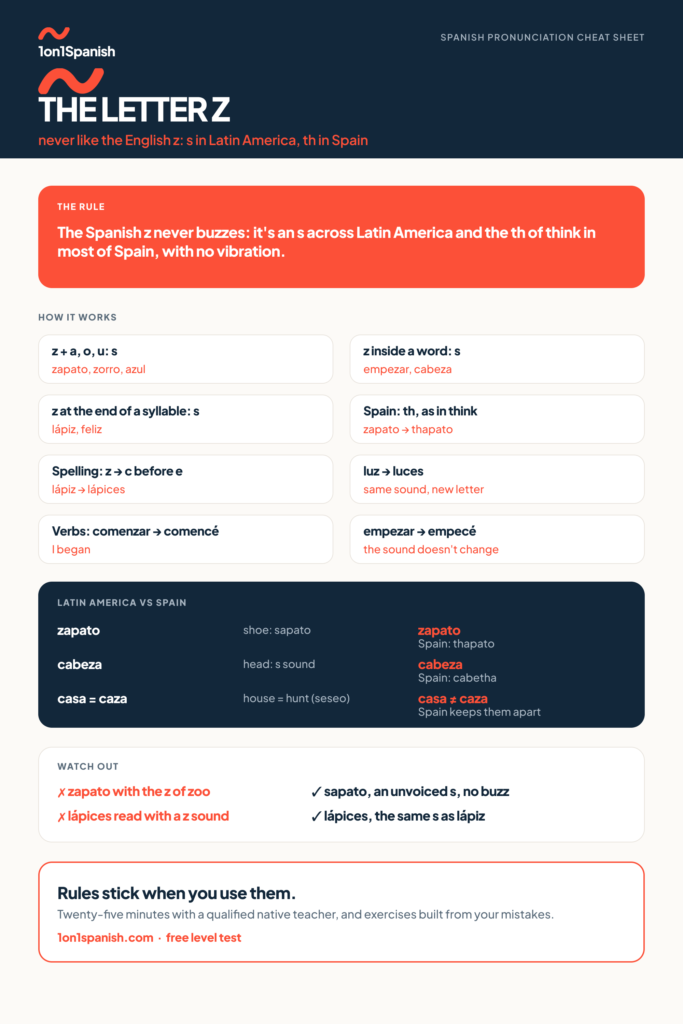
Take the chart with you
The chart is free to view and share. Drop your email and we’ll send the print-ready US Letter PDF — the version you stick on the fridge.
Practice
Practice Spanish pronunciation with a real teacher
Charts get you halfway. The other half is saying it out loud to someone who corrects you on the spot. At 1on1Spanish you get 25-minute private lessons with a qualified native teacher, exercises built from the mistakes you make in class, and AI practice between lessons.
First month $1. No contracts, cancel anytime.
Grammar you can read. Speaking you cannot. Learn Spanish online and practice it live.
Take your free level testBuilt on RingTeacher's method — 700,000+ classes delivered since 2017, teaching English to Spanish speakers. Now in the other direction.
Frequently asked questions
How do you pronounce z in Spanish?
It depends on the region, but never like the buzzing English z in “zoo”. Across Latin America, z sounds exactly like an unvoiced s — zapato sounds like “sapato”. In most of Spain, it sounds like the th in “think” — zapato sounds closer to “thapato”. Both correct versions have no vocal cord vibration at all.
Does the Spanish z ever sound like the English z?
No, not in any standard variety of Spanish. English “zoo” uses a voiced, buzzing sound that doesn’t exist in Spanish z pronunciation anywhere. The two correct options are an unvoiced s (Latin America) or an unvoiced th (most of Spain) — importing the English buzz is the actual mistake to avoid.
Why does lápiz become lápices in the plural?
Because Spanish spelling avoids writing z directly before e or i, swapping it for c instead: lápiz → lápices, luz → luces. The sound stays exactly the same in both forms; only the letter changes. The same swap happens in verb conjugation, like empezar becoming empecé.
What’s the difference between z in Latin America and z in Spain?
In Latin America, z merges with s completely, a pattern called seseo — both letters sound identical. In most of Spain, z keeps a separate identity as a th sound, called distinción. Neither version is more correct than the other; 1on1Spanish teaches the Latin American s sound by default, since it’s used by the vast majority of Spanish speakers.
Is the Spanish z pronunciation the same as the Spanish c?
Before e and i, yes — c follows the exact same regional split as z: an s sound in Latin America, a th sound in most of Spain. That connection, including how c behaves before a, o and u where it sounds like a k instead, is covered in full on its own page.