
The silent H in Spanish: when to write it and how not to confuse it
The letter h is always silent in Spanish, with no exceptions in native vocabulary, so the real difficulty it creates isn’t pronunciation — it’s spelling. Because h makes no sound, several common word pairs sound completely identical out loud and are only told apart by whether one of them carries an h on paper. At 1on1Spanish we work through the spelling side of h in 25-minute one-on-one lessons with qualified native teachers, online across the United States. For how the letter sounds — or rather, doesn’t — as part of the full alphabet, see Spanish alphabet.
Since a listener can never hear the difference, most silent-h mistakes only show up in writing — texts, emails, forms — which is exactly where a native reader notices them first.
Reviewed by María Jiménez — Licenciada en Filología Hispánica (BA in Hispanic Philology) · Updated Sep 2026
Where the silent h shows up
H opens a long list of everyday words, and in every one of them it’s simply not pronounced: hola, hacer, haber, hombre, hospital, hermano, ahora, ahí, prohibido. Say any of these out loud and the h contributes nothing to the sound; hola is pronounced exactly like ola would be if it existed as its own word. The letter survives in spelling because Spanish kept it from Latin roots and, in some words, from Arabic ones, long after the sound itself disappeared from speech. Because there’s no sound to guide you, the only reliable way to know whether a word takes an h is to have seen it written before — memorization, not pronunciation, does the work here.
The one place h isn’t just sitting there silently
Paired with c, h forms the digraph ch, which represents a single sound of its own — the one in chico, noche, muchacho — and that sound doesn’t come from “hearing” the h; it comes from the two letters working together as one unit. Outside of ch, h never contributes to pronunciation at all, which means you can drop it from a word’s sound in your head and never be wrong. Loanwords borrowed straight from English, like hobby or hockey, are the rare exception: some speakers pronounce the h there, closer to the English original, precisely because the word still feels foreign rather than fully adopted into Spanish spelling and sound. The ch side of that story — and the k-versus-s rule that comes with it — is on the c and ch in Spanish page.
The homophone pairs that hide behind h
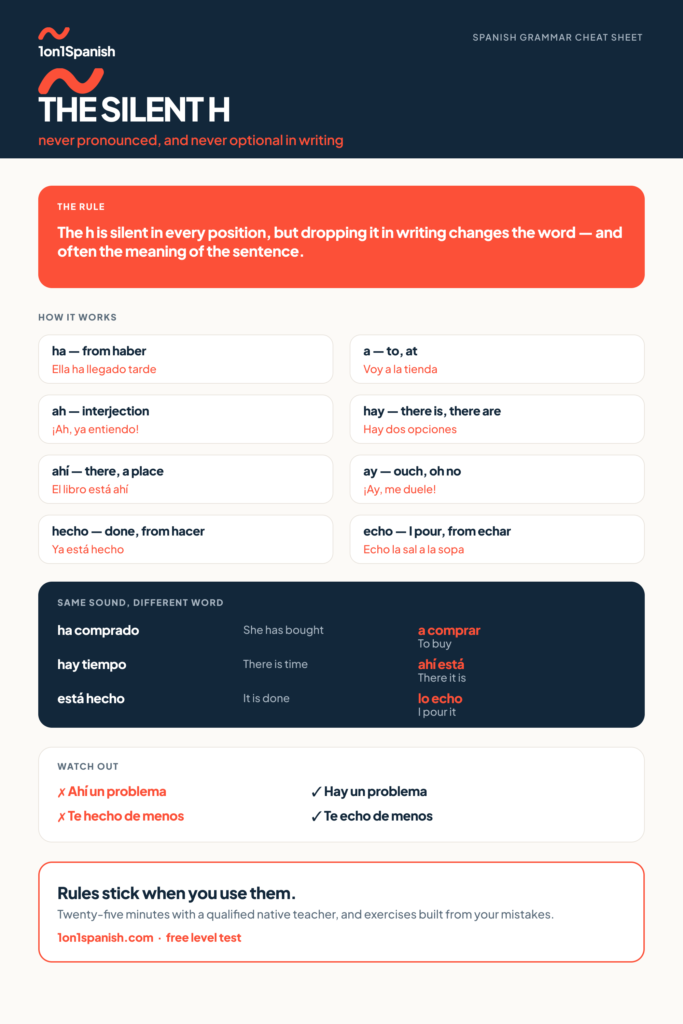
Because h is silent, several short, extremely common words sound identical to a word that has no h at all, and only spelling tells them apart. Ha (from haber, “has/have”) sounds exactly like a (the preposition “to/at”) and like the interjection ah. Hay (“there is/are”) sounds exactly like ahí (“there”, a place) and close to ay (“ouch”, an exclamation). Hecho (from hacer, “done” or “fact”) sounds exactly like echo (from echar, “I throw” or “I pour”). None of these pairs can be told apart by ear — only by knowing which word the sentence needs, which is why native speakers still occasionally misspell them when typing quickly.
Ha and hecho come up constantly because they belong to the compound tenses: ha is the third-person form on the haber conjugation chart, and hecho is the irregular past participle of hacer. Know those two and most of the h-versus-no-h decisions make themselves.
Reference chart
| Pair | Meaning | Example |
|---|---|---|
| ha | form of haber, “has” | Ella ha llegado tarde. |
| a | preposition, “to/at” | Voy a la tienda. |
| ah | interjection, “ah” | ¡Ah, ya entiendo! |
| hay | “there is/are” | Hay dos opciones. |
| ahí | “there” (a place) | El libro está ahí. |
| ay | interjection, “ouch/oh no” | ¡Ay, me duele! |
| hecho | “done”, “fact” (from hacer) | Ya está hecho. |
| echo | “I throw/pour” (from echar) | Yo echo la sal a la sopa. |
Ha/a/ah, hay/ahí/ay, hecho/echo: minimal pairs, same sound
| Sounds like | Word 1 | Word 2 |
|---|---|---|
| “ah” | ha comprado — she has bought | a comprar — to buy |
| “ai” | hay tiempo — there’s time | ahí está — there it is |
| “eh-cho” | lo he hecho — I’ve done it | lo echo aquí — I pour it here |
Common mistakes English speakers make
Dropping the h in writing — often because it’s inaudible in speech — turns he (from haber) into a word that doesn’t exist in standard spelling.
Ahí means “there” as a location; hay means “there is”. Mixing them up is easy because they sound almost identical and both English translations start with “there.”
“I miss you” uses echar, not hacer, so the correct spelling has no h. Writing hecho here is a common autocorrect-driven slip, since both words are common and both sound similar.
Ha is a conjugated form of haber and only makes sense attached to a participle. Confusing it with the preposition a changes the sentence from “has bought” to something that doesn’t parse.
Dropping the h from the most common greeting in the language is a small mistake, but it’s a very visible one, since hola shows up in almost every written conversation, including the very first message someone reads from you.
Take the chart with you
The chart is free to view and share. Drop your email and we’ll send the print-ready US Letter PDF — the version you stick on the fridge.
Practice
Practice the silent H in Spanish with a real teacher
Charts get you halfway. The other half is saying it out loud to someone who corrects you on the spot. At 1on1Spanish you get 25-minute private lessons with a qualified native teacher, exercises built from the mistakes you make in class, and AI practice between lessons.
First month $1. No contracts, cancel anytime.
Prefer to practice with a person? Take one-on-one Spanish lessons online with a qualified native teacher.
Take your free level testBuilt on RingTeacher's method — 700,000+ classes delivered since 2017, teaching English to Spanish speakers. Now in the other direction.
Frequently asked questions
Is the h always silent in Spanish?
Yes, in every native Spanish word. Hola, hospital, ahora and hermano all start or continue with a vowel sound, no matter how the h looks on paper. The one place h isn’t simply invisible is inside the digraph ch, where it pairs with c to represent a single distinct sound, as in chico.
Why do hay and ahí sound the same in Spanish?
Because both words end in a vowel sound with no consonant between the syllables — hay has a silent h, and ahí has a silent h in the middle too. They mean completely different things: hay is “there is/are”, and ahí is “there” as a place. Only spelling and context tell them apart.
What’s the difference between hecho and echo in Spanish?
Hecho comes from hacer and means “done” or “a fact”: Ya está hecho. Echo comes from echar and means “I throw” or “I pour”: Yo echo la sal. They’re pronounced identically because the h in hecho is silent, so only the spelling and the surrounding sentence show which verb is meant.
Does every word that starts with h come from Latin?
Most do, but not all — some entered Spanish from Arabic during centuries of contact in the Iberian Peninsula, and others are simply spelling conventions that stuck. Either way, none of them keep any trace of an aspirated sound today; the h survives on paper only.
What’s the most common mistake with the silent h in Spanish?
Confusing hay, ahí and ay, or ha and a, because all of them sound identical or nearly identical out loud. The mistake is almost always in writing, not speech, since a listener can’t tell which spelling you meant — only a reader can.