
Conocer conjugation in Spanish: every tense you need, with examples
Conocer means “to know” in the sense of being familiar with a person, a place or a thing. In the preterite it means “to meet”. It’s regular everywhere except in one spot: the c becomes zc before o and a, which gives you conozco and the whole subjunctive conozca. Every tense is below, plus the line that separates it from saber. 1on1Spanish teaches this in 25-minute one-on-one lessons with qualified native teachers, online across the United States.
Reviewed by María Jiménez — Licenciada en Filología Hispánica (BA in Hispanic Philology) · Updated Aug 2026
What conocer means
Conocer is acquaintance. You conoces a person, a city, a restaurant, a song, a neighborhood: anything you’ve experienced directly. Conozco a tu hermano. No conozco Chicago. ¿Conoces este sitio?
Because it usually takes a person as its object, it usually needs the personal a: conozco a María, but conozco Madrid. Places don’t take it; people do.
With a person, the preterite usually means “met for the first time”: La conocí en una boda is “I met her at a wedding”, not “I knew her”. The verb doesn’t change. The tense does.
Grammatically it’s an irregular yo form (c→zc). Everything else, including the preterite, is regular. The participle is conocido and the gerund is conociendo.
Conocer conjugation: present tense
One irregular form, and it’s the one you use to introduce yourself into a conversation.
| Form | Example | |
|---|---|---|
| yo | conozco | Conozco un buen taller por aquí. (I know a good garage around here.) |
| tú | conoces | ¿Conoces a mi cuñado? (Do you know my brother-in-law?) |
| él / ella / usted | conoce | Mi mujer conoce bien la zona. (My wife knows the area well.) |
| nosotros | conocemos | No conocemos a los vecinos nuevos. (We don’t know the new neighbors.) |
| vosotros | conocéis | ¿Conocéis algún hotel barato por aquí? (Do you know a hotel around here?) |
| ellos / ellas / ustedes | conocen | Mis padres conocen Sevilla de memoria. (My parents know Seville inside out.) |
Conocer conjugation: preterite
Completely regular, but the meaning changes to “met”.
| Form | |
|---|---|
| yo | conocí |
| tú | conociste |
| él / ella / usted | conoció |
| nosotros | conocimos |
| vosotros | conocisteis |
| ellos / ellas / ustedes | conocieron |
Nos conocimos en un curso de fotografía. — We met at a photography class.
Conocer conjugation: imperfect
Regular, and this is where the verb keeps its “knew” meaning.
| Form | |
|---|---|
| yo | conocía |
| tú | conocías |
| él / ella / usted | conocía |
| nosotros | conocíamos |
| vosotros | conocíais |
| ellos / ellas / ustedes | conocían |
Ya la conocía de antes. — I already knew her from before. The contrast with la conocí is the clearest example of what preterite vs imperfect actually does to meaning.
Conocer conjugation: future
Regular endings on the infinitive.
| Form | |
|---|---|
| yo | conoceré |
| tú | conocerás |
| él / ella / usted | conocerá |
| nosotros | conoceremos |
| vosotros | conoceréis |
| ellos / ellas / ustedes | conocerán |
Conocerás a mis padres en Navidad. — You’ll meet my parents at Christmas.
Conocer conjugation: conditional
| Form | |
|---|---|
| yo | conocería |
| tú | conocerías |
| él / ella / usted | conocería |
| nosotros | conoceríamos |
| vosotros | conoceríais |
| ellos / ellas / ustedes | conocerían |
Conocer conjugation: present subjunctive
Built on the irregular yo form, so the zc runs through every single form.
| Form | |
|---|---|
| yo | conozca |
| tú | conozcas |
| él / ella / usted | conozca |
| nosotros | conozcamos |
| vosotros | conozcáis |
| ellos / ellas / ustedes | conozcan |
No creo que conozca la ciudad. — I don’t think he knows the city.
Conocer conjugation: imperfect subjunctive
Built on the preterite stem, so it’s regular: no zc anywhere.
| Form (-ra) | Form (-se) | |
|---|---|---|
| yo | conociera | conociese |
| tú | conocieras | conocieses |
| él / ella / usted | conociera | conociese |
| nosotros | conociéramos | conociésemos |
| vosotros | conocierais | conocieseis |
| ellos / ellas / ustedes | conocieran | conociesen |
Si conociera a alguien allí, te lo diría. — If I knew someone there, I’d tell you.
Conocer commands (imperative)
| Affirmative | Negative | |
|---|---|---|
| tú | conoce | no conozcas |
| usted | conozca | no conozca |
| nosotros | conozcamos | no conozcamos |
| vosotros | conoced | no conozcáis |
| ustedes | conozcan | no conozcan |
The affirmative tú and vosotros forms come from the present and the infinitive, so they keep the plain c. Everything built on the subjunctive takes zc.
Participle, gerund and compound tenses
Participle conocido, gerund conociendo. Compounds use haber:
He conocido a mucha gente aquí (present perfect) · No la había conocido en persona (past perfect) · Para entonces ya habré conocido al equipo (future perfect).
Conocido also works as a noun meaning “an acquaintance”: es un conocido, no un amigo — a useful distinction Spanish makes explicitly and English tends to leave vague.
When to use conocer
Meeting someone
Encantado de conocerte is the standard phrase when you shake hands, and nos conocimos en 2018 is how you tell the story afterwards.
Being familiar with a place
No conozco bien Nueva York means you’ve never been, or never spent much time there. It’s not about facts; it’s about experience.
Knowing a person
¿Conoces a Marta? Any question about a person takes conocer, with the personal a.
Knowing something through practice
Conoce bien el sector, conozco el procedimiento. Here conocer implies familiarity built over time, while saber would imply having the information.
Conocer vs saber
Both are “to know”. Conocer is familiarity through experience; saber is information, facts and skills. The pairs below change meaning, not register.
| Conocer | Saber |
|---|---|
| Conozco a tu jefe — I know your boss | Sé quién es tu jefe — I know who your boss is |
| Conozco Barcelona — I’ve been to Barcelona | Sé dónde está Barcelona — I know where Barcelona is |
| Conoce el barrio — She knows the neighborhood | Sabe llegar al barrio — She knows how to get there |
| La conocí ayer — I met her yesterday | Lo supe ayer — I found out yesterday |
Practical rule: if the next word is a question word (qué, quién, dónde, cómo) or an infinitive, you need saber. If it’s a person or a place, you need conocer.
Common mistakes English speakers make with conocer
The yo form adds a z. The same happens in every verb ending in -cer or -cir after a vowel: parezco, ofrezco, traduzco.
People take the personal a. Places don’t: conozco Madrid is correct without it.
Skills belong to saber. Conocer never takes an infinitive.
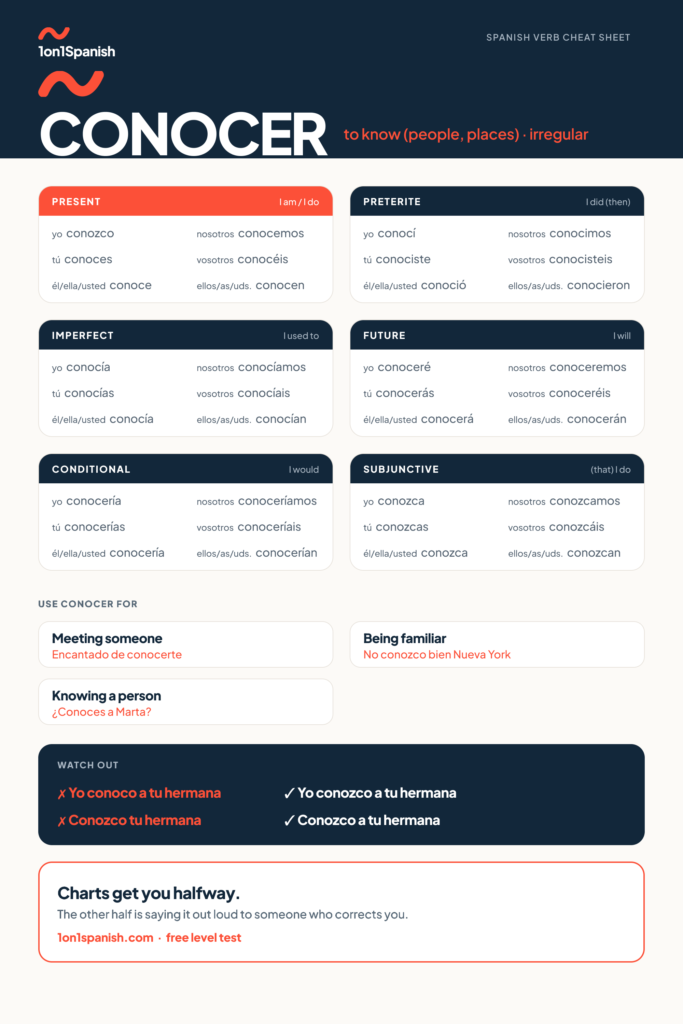
Take the chart with you
The chart is free to view and share. Drop your email and we’ll send the print-ready US Letter PDF — the version you stick on the fridge.
Practice
Practice conocer with a real teacher
Charts get you halfway. The other half is saying it out loud to someone who corrects you on the spot. At 1on1Spanish you get 25-minute private lessons with a qualified native teacher, exercises built from the mistakes you make in class, and AI practice between lessons.
First month $1. No contracts, cancel anytime.
Want a teacher listening while you practice? Learn Spanish online with us, one lesson at a time.
Take your free level testBuilt on RingTeacher's method — 700,000+ classes delivered since 2017, teaching English to Spanish speakers. Now in the other direction.
Frequently asked questions
Is conocer regular or irregular in Spanish?
Conocer is irregular in exactly one place: the first person singular of the present, where the c becomes zc to give conozco. Because the present subjunctive is built on that form, the zc carries through all of it: conozca, conozcas, conozcamos, conozcan. The preterite, imperfect, future, conditional, participle and gerund are all regular.
What’s the difference between conocer and saber?
Familiarity gained through experience takes conocer: you know a person, a city, a restaurant. Saber is information and ability, so you know a fact, an answer, or how to do something. Conozco a tu hermano means I’ve met him; sé quién es tu hermano means I know who he is. Before a question word or an infinitive, Spanish always uses saber.
What does “conocí” mean in Spanish?
Conocí is the preterite of conocer, and it means “I met”, not “I knew”. Conocí a mi jefe en una conferencia means I met my boss at a conference. To say you already knew someone, use the imperfect conocía: ya la conocía de antes. This meaning shift between preterite and imperfect also happens with saber, poder and querer.
Do you need the personal “a” with conocer?
With people, yes: conozco a tu hermana, ¿conoces a Luis?. With places and things, no: conozco Madrid, conozco ese restaurante. The personal a has no translation in English, which is why it gets dropped, but leaving it out with a person is one of the most noticeable errors an English speaker makes.
How do you say “nice to meet you” in Spanish?
Encantado if you’re male, encantada if you’re female, or the full encantado de conocerte with someone you’d address as tú and encantado de conocerlo/conocerla with usted. Mucho gusto is the more common choice across Latin America and works in any register. All of them use conocer, never saber.