
Conjugate saber in Spanish: every tense you need, with examples
Saber means “to know”: facts, information, and how to do something. It’s irregular in four places that matter: the yo form (sé), the whole preterite (supe, supiste, supo), the future stem (sabré) and the subjunctive (sepa). Everything else follows regular -er endings. The tables below cover every tense you need, and then the part most English speakers actually come for: why saber is not conocer. 1on1Spanish teaches this in 25-minute one-on-one lessons with qualified native teachers, online across the United States.
Reviewed by María Jiménez — Licenciada en Filología Hispánica (BA in Hispanic Philology) · Updated Aug 2026
What saber means
Saber covers knowledge you can state: a fact, a number, an address, a piece of news. Sé su teléfono, No sé qué día es la reunión. Followed directly by an infinitive it means “to know how to”: Sé manejar, No sabe nadar. No extra word for “how” is needed.
In the preterite it shifts meaning. Supe is not “I knew” but “I found out”: Lo supe esta mañana. That shift is regular in Spanish for verbs of state, and it’s the single most useful thing on this page after the tables.
It has a second, unrelated sense: to taste. Esta sopa sabe a ajo is “this soup tastes like garlic”. Same verb, no relation to knowledge.
The participle is sabido and the gerund is sabiendo, both regular.
Saber conjugation: present tense
Only the yo form breaks the pattern.
| Form | Example | |
|---|---|---|
| yo | sé | Sé dónde está la farmacia. (I know where the pharmacy is.) |
| tú | sabes | ¿Sabes su apellido? (Do you know his last name?) |
| él / ella / usted | sabe | Mi hija sabe nadar. (My daughter knows how to swim.) |
| nosotros | sabemos | No sabemos el precio todavía. (We don’t know the price yet.) |
| vosotros | sabéis | ¿Sabéis a qué hora abre? (Do you know what time it opens?) |
| ellos / ellas / ustedes | saben | Ellos saben lo que pasó. (They know what happened.) |
Saber conjugation: preterite
Fully irregular: the stem becomes sup- and the endings lose their accents. In this tense saber means “found out”, not “knew”.
| Form | |
|---|---|
| yo | supe |
| tú | supiste |
| él / ella / usted | supo |
| nosotros | supimos |
| vosotros | supisteis |
| ellos / ellas / ustedes | supieron |
Supimos lo del despido por un compañero. — We found out about the layoff from a coworker.
Saber conjugation: imperfect
Regular. This is the tense that actually means “knew”, as a background state.
| Form | |
|---|---|
| yo | sabía |
| tú | sabías |
| él / ella / usted | sabía |
| nosotros | sabíamos |
| vosotros | sabíais |
| ellos / ellas / ustedes | sabían |
Yo no sabía que estabas enfermo. — I didn’t know you were sick.
Saber conjugation: future
The e of the infinitive drops: the stem is sabr-.
| Form | |
|---|---|
| yo | sabré |
| tú | sabrás |
| él / ella / usted | sabrá |
| nosotros | sabremos |
| vosotros | sabréis |
| ellos / ellas / ustedes | sabrán |
Mañana sabremos los resultados. — Tomorrow we’ll know the results.
Saber conjugation: conditional
Same sabr- stem.
| Form | |
|---|---|
| yo | sabría |
| tú | sabrías |
| él / ella / usted | sabría |
| nosotros | sabríamos |
| vosotros | sabríais |
| ellos / ellas / ustedes | sabrían |
¿Sabrías explicármelo otra vez? — Would you know how to explain it to me again?
Saber conjugation: present subjunctive
Built on sep-, which looks nothing like the infinitive. It appears constantly after negatives and doubts: No creo que sepa la dirección.
| Form | |
|---|---|
| yo | sepa |
| tú | sepas |
| él / ella / usted | sepa |
| nosotros | sepamos |
| vosotros | sepáis |
| ellos / ellas / ustedes | sepan |
Saber conjugation: imperfect subjunctive
Built on the preterite stem sup-. Both endings are correct; the -ra set is what you’ll hear.
| Form (-ra) | Form (-se) | |
|---|---|---|
| yo | supiera | supiese |
| tú | supieras | supieses |
| él / ella / usted | supiera | supiese |
| nosotros | supiéramos | supiésemos |
| vosotros | supierais | supieseis |
| ellos / ellas / ustedes | supieran | supiesen |
Si supiera su dirección, le escribiría. — If I knew his address, I’d write to him.
Saber commands (imperative)
Rarely used as an order, but it shows up in warnings and set phrases: Que lo sepas.
| Affirmative | Negative | |
|---|---|---|
| tú | sabe | no sepas |
| usted | sepa | no sepa |
| nosotros | sepamos | no sepamos |
| vosotros | sabed | no sepáis |
| ustedes | sepan | no sepan |
Sepa usted que hay lista de espera. — Be aware that there’s a waiting list.
Participle, gerund and compound tenses
Participle sabido, gerund sabiendo, both regular. Compounds use haber:
Siempre he sabido que era mala idea (present perfect) · No había sabido nada de ella en años (past perfect) · Para el viernes ya habré sabido si me dan el puesto (future perfect).
When to use saber
Facts and information
Anything you could write down: Sé su número, ¿Sabes cuánto cuesta la consulta?, No sabemos si el vuelo sale a tiempo.
Skills, with a bare infinitive
Sé manejar. Mi padre sabe cocinar muy bien. Spanish does not insert cómo here. Sé cómo manejar sounds translated.
Finding out, in the preterite
Supe lo del divorcio por mi cuñada. If the news arrived at a specific moment, it’s supe, not sabía.
Taste
El café sabe amargo. Esto sabe a limón. Used with a for “tastes like”.
As a hedge in conversation
No sé, quizá el martes. Native speakers use no sé the way English uses “I don’t know, maybe”. It’s a softener, not a gap in knowledge.
Saber vs conocer
Both are “to know” in English. Saber takes facts and skills; conocer takes people, places and things you’re familiar with. When conocer refers to a person it needs the personal a.
| With saber | With conocer |
|---|---|
| Sé la respuesta — I know the answer | Conozco al médico — I know the doctor |
| Sé dónde vive — I know where he lives | Conozco su barrio — I know his neighborhood |
| Supe la verdad ayer — I found out the truth yesterday | Conocí a mi jefa en 2019 — I met my boss in 2019 |
| Sabe cocinar — He knows how to cook | Conoce bien la ciudad — He knows the city well |
Common mistakes English speakers make with saber
The yo form is one syllable and carries an accent. Sabo doesn’t exist, though it’s the first form almost everyone invents.
People are never saber. If the object is a human being, you need conocer and the personal a.
Saber plus infinitive already means “know how”. Adding cómo is a word-for-word import from English.
A precise moment forces the preterite, and in the preterite the verb means “found out”. Sabía describes a state that was already there.
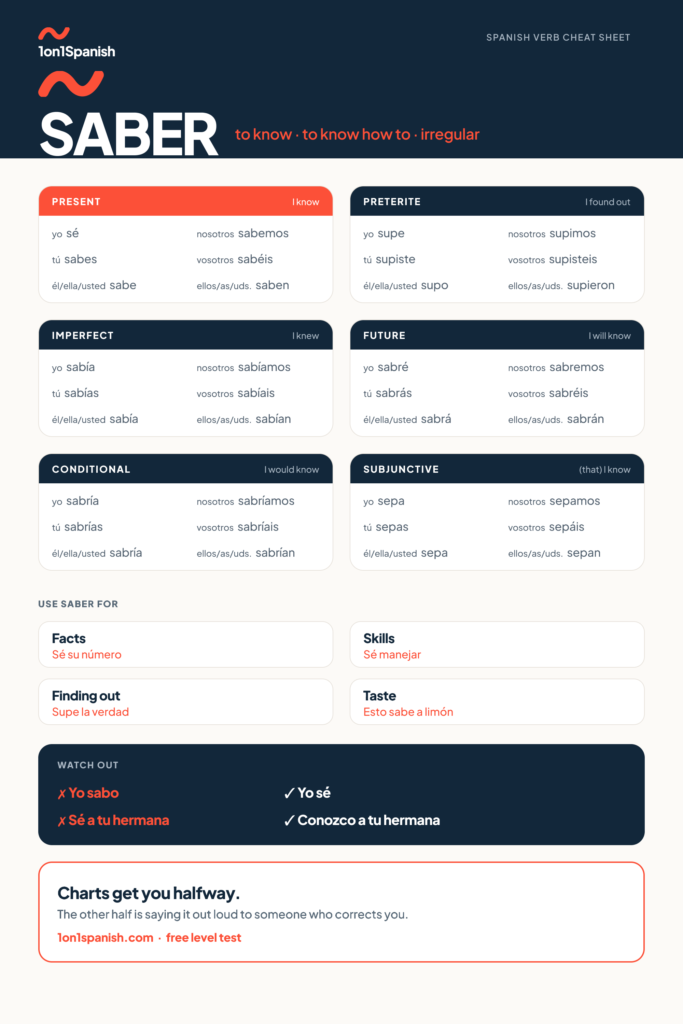
Take the chart with you
The chart is free to view and share. Drop your email and we’ll send the print-ready US Letter PDF — the version you stick on the fridge.
Practice
Practice saber and conocer with a real teacher
Charts get you halfway. The other half is saying it out loud to someone who corrects you on the spot. At 1on1Spanish you get 25-minute private lessons with a qualified native Spanish tutor, exercises built from the mistakes you make in class, and AI practice between lessons.
First month $1. No contracts, cancel anytime.
Guides help. A teacher hears what a guide cannot — Learn Spanish online with a real teacher.
Take your free level testBuilt on RingTeacher's method — 700,000+ classes delivered since 2017, teaching English to Spanish speakers. Now in the other direction.
Frequently asked questions
Is saber regular or irregular in Spanish?
Saber is irregular, but not everywhere. The present tense is regular except for sé, and the imperfect (sabía) is completely regular. The irregular parts are the preterite (supe, supiste, supo), the future and conditional stem sabr-, and the subjunctive stem sep-. Learn those three blocks and the rest follows normal -er patterns.
What’s the difference between saber and conocer?
Saber is for information and abilities: sé su teléfono, sé manejar. Conocer is for familiarity with people, places and works: conozco a tu jefe, conozco Chicago. English collapses both into “to know”, so the choice has to be made from the object, not the translation. A person after the verb almost always means conocer.
Why does supe mean “I found out” instead of “I knew”?
Spanish verbs of mental state change meaning in the preterite because the preterite marks a single completed moment. Knowing something is a state, so it lives in the imperfect: sabía. The moment the knowledge arrives is an event, so it takes the preterite: supe. The same shift happens with conocer (conocí = I met) and querer (quise = I tried).
How do you say “I don’t know how to” in Spanish?
No sé plus the infinitive: No sé cocinar, No sé usar este programa. There is no word for “how” in this structure, which is the most common error English speakers make. If you want to stress the method rather than the ability, you can say no sé cómo funciona esto. With a verb alone, drop cómo.
Do I need the subjunctive of saber in everyday conversation?
Yes. Sepa appears every time you deny or doubt someone’s knowledge, which happens constantly: No creo que lo sepa, No hay nadie que sepa arreglarlo, Que yo sepa, no (“as far as I know, no”). That last phrase is worth memorizing whole. The full rule lives in our guide to the Spanish subjunctive, and more verbs are listed under Spanish verbs.