
Escuchar conjugation in Spanish: every tense you need, with examples
Escuchar means “to listen”, and every form of it is completely regular. The real question people have isn’t how to conjugate it — it’s when to use escuchar instead of oír, and whether it needs a preposition the way English “listen to” does. It doesn’t. Every tense is below, along with the line between escuchar and oír, which is where the actual confusion lives. 1on1Spanish teaches this in 25-minute one-on-one lessons with qualified native teachers, online across the United States.
Reviewed by María Jiménez — Licenciada en Filología Hispánica (BA in Hispanic Philology) · Updated Sep 2026
What escuchar means
Escuchar is deliberate listening: paying attention on purpose. Escucho música mientras trabajo, escucha a tu mamá. It’s the verb for podcasts, playlists, and conversations you’re actually following, not just sound that happens to reach you.
It also means to heed advice or instructions: nunca escucha consejos, escúchame bien. And it’s how you check that someone is following what you’re saying: ¿me escuchas? — are you paying attention — a different question from ¿me oyes?, which asks about the connection or the volume.
The key structural point: escuchar takes its object directly, like the direct object pronouns that later replace it — never a preposition before the thing you’re listening to. Escucho música, never escucho a la música. The only preposition it takes is the personal a, and only in front of a specific person: escucho a mi hermano.
Grammatically it’s completely regular, a standard -ar verb with no stem change, no spelling change and regular participle (escuchado) and gerund (escuchando).
Escuchar conjugation: present tense
| Form | Example | |
|---|---|---|
| yo | escucho | Escucho el podcast en el carro. (I listen to the podcast in the car.) |
| tú | escuchas | ¿Escuchas la radio en las mañanas? (Do you listen to the radio in the mornings?) |
| él / ella / usted | escucha | Mi abuelo escucha las noticias a las siete. (My grandfather listens to the news at seven.) |
| nosotros | escuchamos | Escuchamos al doctor con atención. (We listened to the doctor carefully.) |
| vosotros | escucháis | ¿Escucháis música en español? (Do you listen to music in Spanish?) |
| ellos / ellas / ustedes | escuchan | Mis vecinos escuchan reggaetón todo el día. (My neighbors listen to reggaeton all day.) |
Escuchar conjugation: preterite
| Form | |
|---|---|
| yo | escuché |
| tú | escuchaste |
| él / ella / usted | escuchó |
| nosotros | escuchamos |
| vosotros | escuchasteis |
| ellos / ellas / ustedes | escucharon |
Escuché el mensaje dos veces para entenderlo bien. — I listened to the message twice to understand it properly.
Escuchar conjugation: imperfect
| Form | |
|---|---|
| yo | escuchaba |
| tú | escuchabas |
| él / ella / usted | escuchaba |
| nosotros | escuchábamos |
| vosotros | escuchabais |
| ellos / ellas / ustedes | escuchaban |
De niña, escuchaba esa canción todas las noches. — As a kid, I used to listen to that song every night.
Escuchar conjugation: future
| Form | |
|---|---|
| yo | escucharé |
| tú | escucharás |
| él / ella / usted | escuchará |
| nosotros | escucharemos |
| vosotros | escucharéis |
| ellos / ellas / ustedes | escucharán |
Escucharemos su propuesta en la junta del lunes. — We’ll listen to their proposal at Monday’s meeting.
Escuchar conjugation: conditional
| Form | |
|---|---|
| yo | escucharía |
| tú | escucharías |
| él / ella / usted | escucharía |
| nosotros | escucharíamos |
| vosotros | escucharíais |
| ellos / ellas / ustedes | escucharían |
Yo escucharía su versión de la historia antes de juzgar. — I’d listen to their side of the story before judging.
Escuchar conjugation: present subjunctive
| Form | |
|---|---|
| yo | escuche |
| tú | escuches |
| él / ella / usted | escuche |
| nosotros | escuchemos |
| vosotros | escuchéis |
| ellos / ellas / ustedes | escuchen |
Quiero que me escuches un momento. — I want you to listen to me for a moment.
Escuchar conjugation: imperfect subjunctive
| Form (-ra) | Form (-se) | |
|---|---|---|
| yo | escuchara | escuchase |
| tú | escucharas | escuchases |
| él / ella / usted | escuchara | escuchase |
| nosotros | escucháramos | escuchásemos |
| vosotros | escucharais | escuchaseis |
| ellos / ellas / ustedes | escucharan | escuchasen |
Le pedí que escuchara mi lado de la historia. — I asked him to listen to my side of the story.
Escuchar commands (imperative)
| Affirmative | Negative | |
|---|---|---|
| tú | escucha | no escuches |
| usted | escuche | no escuche |
| nosotros | escuchemos | no escuchemos |
| vosotros | escuchad | no escuchéis |
| ustedes | escuchen | no escuchen |
Escúchame bien, esto es importante. — Listen to me carefully, this is important. Note the written accent when the pronoun attaches to the command: escúchame, not escuchame.
Participle, gerund and compound tenses
Participle escuchado, gerund escuchando. Both regular. Compounds take haber:
He escuchado ese álbum cien veces (present perfect) · Nunca había escuchado esa canción antes (past perfect) · Para el viernes ya habré escuchado todos los episodios (future perfect).
When to use escuchar
Listening to music, podcasts or media
Escucho el podcast de camino al trabajo. The everyday use, and the one most learners meet first.
Listening to a person, with attention
Escucha a tu doctor. Note the personal a before a specific person — it marks who’s being listened to, not a translation of “to”.
Checking someone is paying attention
¿Me escuchas? This is a different question from ¿me oyes?: it asks whether the person is following what you’re saying, not whether the sound is reaching them.
Heeding advice
Nunca escucha los consejos de su hermano. Common in family conversations, and a natural way to describe someone who’s stubborn.
Escuchar vs oír
Both can be translated “to hear” or “to listen”, and English blurs the line more than Spanish does. Oír is passive: sound reaches you whether you’re paying attention or not. Escuchar is active: you’re deliberately paying attention.
| Spanish | What it means |
|---|---|
| Oigo el tráfico desde mi cuarto. | I hear the traffic from my room. (it just reaches me) |
| Escucho el podcast todos los días. | I listen to the podcast every day. (on purpose) |
| ¿Me oyes bien? | Can you hear me okay? (checking a connection) |
| ¿Me escuchas? | Are you listening to me? (checking attention) |
| Oí un ruido raro anoche. | I heard a strange noise last night. |
Rule of thumb: if there’s intent behind it, escuchar. If it’s just sound arriving, oír.
Common mistakes English speakers make with escuchar
Escuchar never takes a preposition before a thing. The personal a only appears before a specific person: escucho a mi hermano.
Oír is passive hearing; when there’s real attention involved, Spanish reaches for escuchar instead.
When a pronoun attaches to an affirmative command, the stress shifts and needs a written accent: escúchame, not escuchame.
After espero que, the verb takes the subjunctive: escuche, not escucha.
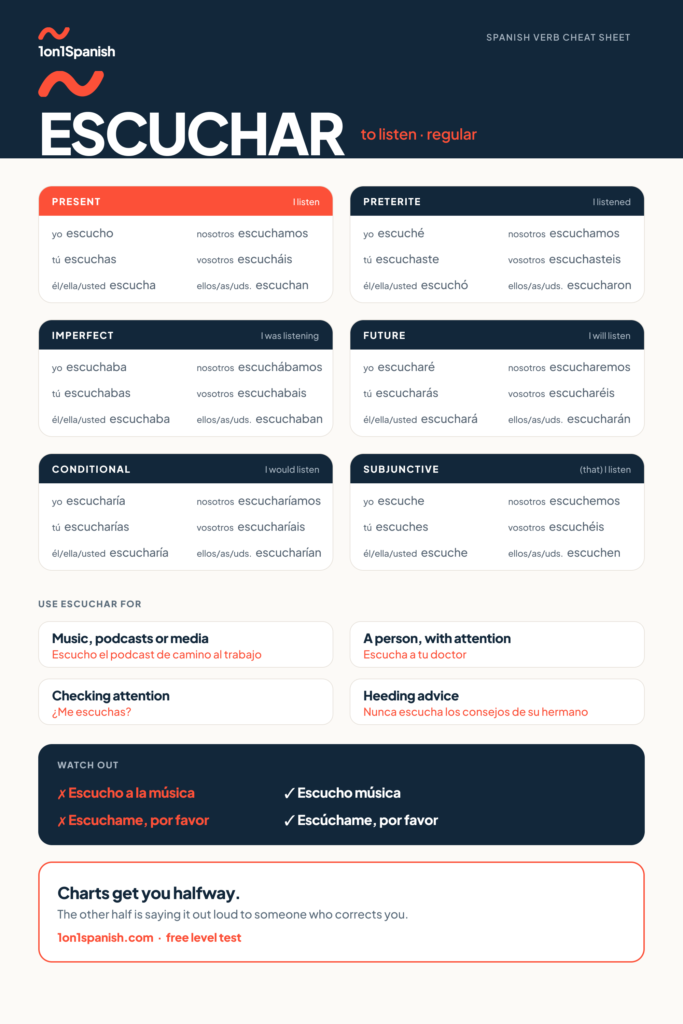
Take the chart with you
The chart is free to view and share. Drop your email and we’ll send the print-ready US Letter PDF — the version you stick on the fridge.
Practice
Practice escuchar with a real teacher
Charts get you halfway. The other half is saying it out loud to someone who corrects you on the spot. At 1on1Spanish you get 25-minute private lessons with a qualified native teacher, exercises built from the mistakes you make in class, and AI practice between lessons.
First month $1. No contracts, cancel anytime.
Prefer to practice with a person? Take one-on-one Spanish lessons online with a qualified native teacher.
Take your free level testBuilt on RingTeacher's method — 700,000+ classes delivered since 2017, teaching English to Spanish speakers. Now in the other direction.
Frequently asked questions
Is escuchar regular or irregular in Spanish?
Completely regular — a standard -ar verb with no stem change, no spelling change, and a regular participle (escuchado) and gerund (escuchando) in every tense, including the preterite and subjunctive. The difficulty isn’t the forms; it’s knowing when to reach for escuchar instead of oír.
What’s the difference between escuchar and oír?
Oír is passive: sound reaches your ears, on purpose or not. Escuchar is active: you choose to pay attention. Oigo el tráfico just means the noise is there; escucho el podcast means you’re actually following it. Checking a phone connection uses oír (¿me oyes?); checking that someone’s paying attention uses escuchar (¿me escuchas?).
Do you need a preposition after escuchar?
No. Escuchar takes its object directly: escucho música, escucho el podcast, never escucho a la música. The one exception is the personal a, used only before a specific person: escucho a mi doctor. Adding a preposition before a thing is a direct calque from English “listen to” and sounds foreign in Spanish.
What is the past tense of escuchar in Spanish?
Two forms for two different jobs. The preterite — escuché, escuchaste, escuchó, escuchamos, escuchasteis, escucharon — marks a single completed act: escuché el mensaje anoche. The imperfect — escuchaba, escuchabas, escuchaba, escuchábamos, escuchabais, escuchaban — marks a repeated habit: escuchaba esa emisora todas las mañanas.
Do I need the subjunctive of escuchar in everyday conversation?
Yes, mainly after wishes and requests. Escuche appears after quiero que (quiero que me escuches) and after espero que (espero que escuchen mis razones). It’s a fully regular subjunctive, so it follows the same pattern as any other -ar verb once you know it.