
Haber conjugation in Spanish: every tense you need, with examples
Haber is the verb Spanish uses to build every compound tense (he comido, había salido, habrá terminado) and, in a separate impersonal form, to say that something exists: hay. It is never “to have” in the sense of owning something; that’s tener. It’s irregular in every main tense, and its most common form, hay, doesn’t appear in the normal chart at all. Everything is below. 1on1Spanish teaches this in 25-minute one-on-one lessons with qualified native teachers, online across the United States.
Reviewed by María Jiménez — Licenciada en Filología Hispánica (BA in Hispanic Philology) · Updated Aug 2026
What haber means
Haber has two jobs and no third one.
As an auxiliary, it carries the person and tense while a past participle carries the meaning: he trabajado, habíamos llegado, hayan salido. In this role it never stands alone and it never translates as a word by itself. English “have” in I have eaten is the same idea.
As an impersonal verb it means “there is” or “there are”, and it appears only in the third person singular: hay, había, hubo, habrá, haya.
The participle is habido and the gerund is habiendo, both of which you’ll meet rarely and mostly in writing. Everything else about this verb is irregular.
Haber conjugation: present tense
These are the auxiliary forms. The impersonal hay sits outside the table and is covered further down.
| Form | Example | |
|---|---|---|
| yo | he | He terminado el informe. (I’ve finished the report.) |
| tú | has | ¿Has llamado al seguro? (Have you called the insurance company?) |
| él / ella / usted | ha | Mi vuelo ha salido con retraso. (My flight has left late.) |
| nosotros | hemos | Hemos vivido aquí ocho años. (We’ve lived here eight years.) |
| vosotros | habéis | ¿Habéis comido ya? (Have you all eaten yet?) |
| ellos / ellas / ustedes | han | Los niños han vuelto del colegio. (The kids are back from school.) |
Impersonal present: hay. Hay dos mensajes nuevos.
Haber conjugation: preterite
Irregular stem hub-. As an auxiliary this tense is almost extinct in speech; as an impersonal, hubo is entirely normal.
| Form | |
|---|---|
| yo | hube |
| tú | hubiste |
| él / ella / usted | hubo |
| nosotros | hubimos |
| vosotros | hubisteis |
| ellos / ellas / ustedes | hubieron |
Hubo un accidente en la autopista. — There was an accident on the highway.
Haber conjugation: imperfect
| Form | |
|---|---|
| yo | había |
| tú | habías |
| él / ella / usted | había |
| nosotros | habíamos |
| vosotros | habíais |
| ellos / ellas / ustedes | habían |
Había mucha gente en la sala. — There were a lot of people in the room. Impersonal había is one of the most frequent forms of this verb in everyday speech.
Haber conjugation: future
Irregular stem habr-.
| Form | |
|---|---|
| yo | habré |
| tú | habrás |
| él / ella / usted | habrá |
| nosotros | habremos |
| vosotros | habréis |
| ellos / ellas / ustedes | habrán |
Habrá tres reuniones esta semana. — There will be three meetings this week.
Haber conjugation: conditional
| Form | |
|---|---|
| yo | habría |
| tú | habrías |
| él / ella / usted | habría |
| nosotros | habríamos |
| vosotros | habríais |
| ellos / ellas / ustedes | habrían |
Habría llamado, pero no tenía cobertura. — I would have called, but I had no signal.
Haber conjugation: present subjunctive
| Form | |
|---|---|
| yo | haya |
| tú | hayas |
| él / ella / usted | haya |
| nosotros | hayamos |
| vosotros | hayáis |
| ellos / ellas / ustedes | hayan |
Espero que haya llegado bien. — I hope she got there safely. Impersonal: No creo que haya problema.
Haber conjugation: imperfect subjunctive
Built on the preterite stem hub-. This is the form behind every “would have” sentence in Spanish.
| Form (-ra) | Form (-se) | |
|---|---|---|
| yo | hubiera | hubiese |
| tú | hubieras | hubieses |
| él / ella / usted | hubiera | hubiese |
| nosotros | hubiéramos | hubiésemos |
| vosotros | hubierais | hubieseis |
| ellos / ellas / ustedes | hubieran | hubiesen |
Si hubiera sabido, no habría venido. — If I’d known, I wouldn’t have come.
Haber commands (imperative)
The imperative of haber exists on paper and is not used. There is no situation in normal Spanish where you tell someone to “have” in this sense, and native speakers go a lifetime without saying habed. The forms are listed for completeness only.
| Affirmative | Negative | |
|---|---|---|
| tú | he | no hayas |
| usted | haya | no haya |
| nosotros | hayamos | no hayamos |
| vosotros | habed | no hayáis |
| ustedes | hayan | no hayan |
What you’ll actually hear is the fixed expression habérselas con alguien, and the impersonal warning no hay que… (“one mustn’t…”), which uses hay, not a command.
Participle, gerund and compound tenses
Participle habido, gerund habiendo. Both are rare on their own: ha habido un cambio (there’s been a change) and habiendo terminado, se fue (having finished, he left, formal).
Haber is the verb that builds the compound tenses of every other verb, so the table you actually need is this one:
| Tense | Structure | Example |
|---|---|---|
| Present perfect | he + participle | He hablado con ella. |
| Past perfect | había + participle | Había hablado con ella. |
| Future perfect | habré + participle | Habré hablado con ella. |
| Conditional perfect | habría + participle | Habría hablado con ella. |
| Perfect subjunctive | haya + participle | Espero que haya hablado con ella. |
| Pluperfect subjunctive | hubiera + participle | Si hubiera hablado con ella… |
The participle never changes for gender or number in a compound tense: ellas han llegado, not llegadas. The rules for forming and irregular participles are in past participle.
Hay: the impersonal form
Hay means “there is” and “there are”, and it’s the single most used form of haber. It’s invariable: one form for singular and plural. Hay un problema and hay tres problemas use exactly the same word, which is where English speakers slip, because English switches between “is” and “are”.
It changes for tense, not for number:
| Tense | Form | Example |
|---|---|---|
| Present | hay | Hay dos farmacias en esta calle. |
| Imperfect | había | Había mucha cola en el banco. |
| Preterite | hubo | Hubo una tormenta el sábado. |
| Future | habrá | Habrá más plazas en septiembre. |
| Conditional | habría | Habría más gente si no lloviera. |
| Present subjunctive | haya | No creo que haya sitio. |
| Present perfect | ha habido | Ha habido un malentendido. |
Two expressions built on it are everywhere: hay que + infinitive means “one has to” with no specific subject (hay que reservar con antelación), and no hay de qué is “you’re welcome”.
Haber vs tener vs estar
All three touch English “have” or “there is”, and each does a different job.
| Sentence | Verb | Why |
|---|---|---|
| He comido — I’ve eaten | haber | Auxiliary for a compound tense |
| Tengo dos carros — I have two cars | tener | Possession |
| Hay dos carros en el garaje — There are two cars in the garage | haber | Existence, unspecified |
| Los carros están en el garaje — The cars are in the garage | estar | Location of something already known |
| Tengo que salir — I have to leave | tener que | Obligation with a subject |
| Hay que salir — We need to leave | hay que | Obligation with no subject |
The hay / estar line is the practical one: hay introduces something new and unidentified, estar locates something already on the table.
Common mistakes English speakers make with haber
Hay never becomes plural. English “there are” pushes learners toward han, which is only an auxiliary.
Compound tenses are built with haber, never with tener. Tener + participle exists but means something else entirely: tengo la mesa reservada.
After haber the participle is frozen in the masculine singular, whatever the subject.
The same rule as hay: the impersonal form stays singular in every main tense. Habían is only correct as an auxiliary, as in habían salido.
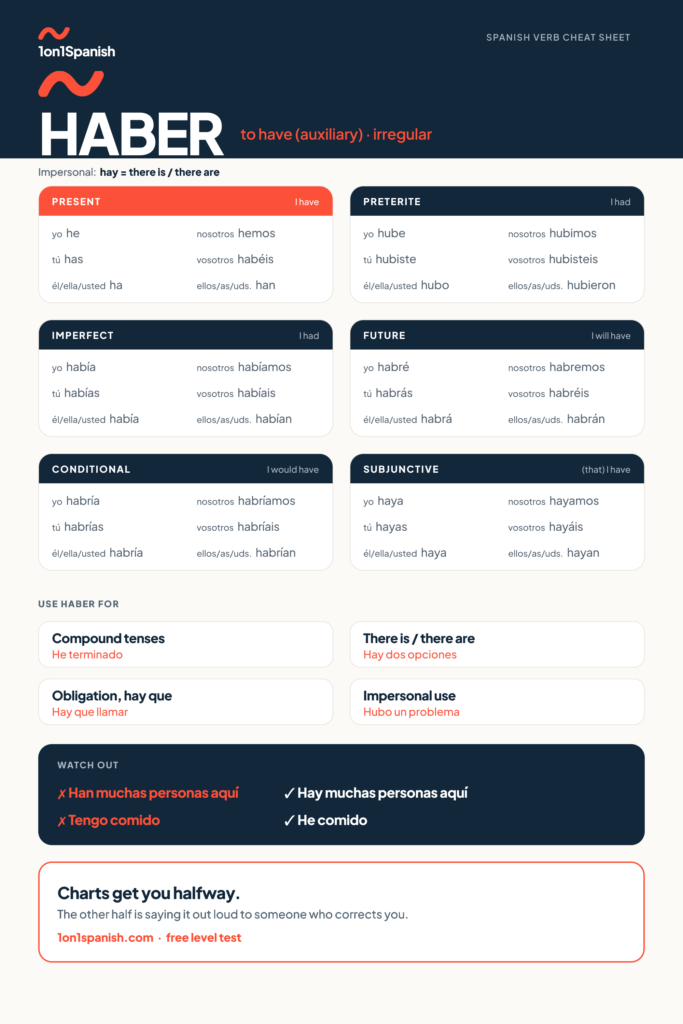
Take the chart with you
The chart is free to view and share. Drop your email and we’ll send the print-ready US Letter PDF — the version you stick on the fridge.
Practice
Practice haber with a real teacher
Charts get you halfway. The other half is saying it out loud to someone who corrects you on the spot. At 1on1Spanish you get 25-minute private lessons with a qualified native teacher, exercises built from the mistakes you make in class, and AI practice between lessons.
First month $1. No contracts, cancel anytime.
Everything on this page is free to use. If you want feedback on your own Spanish, learn Spanish online with us.
Take your free level testBuilt on RingTeacher's method — 700,000+ classes delivered since 2017, teaching English to Spanish speakers. Now in the other direction.
Frequently asked questions
What does haber mean in Spanish?
Haber does two things. As an auxiliary it builds compound tenses together with a past participle: he comido, había salido, habrán llegado. As an impersonal verb it means “there is” or “there are” and takes the special form hay. It never means “to have” in the sense of owning something. That’s tener, a completely separate verb.
What’s the difference between haber and tener?
Tener is possession: tengo un carro, tiene dos hermanos. Haber is grammatical machinery: it carries tense and person for compound verbs, as in he tenido un carro. English uses “have” for both, so the sentence “I have eaten” needs haber while “I have a car” needs tener. Getting them backwards produces tengo comido, which native speakers notice immediately.
Why is it “hay” and not “han” for “there are”?
Because hay is impersonal: there is no subject doing anything, so the verb never agrees with the noun that follows. Hay una silla and hay veinte sillas use the same form. The same rule applies in every other tense: había tres carros, not habían tres carros. Han is the auxiliary used with a participle, as in han llegado.
What is the past tense of haber in Spanish?
For the impersonal use, the imperfect había covers a state (había mucha gente) and the preterite hubo covers an event (hubo un accidente). As an auxiliary, había + participle forms the past perfect: había terminado. The preterite auxiliary forms hube, hubiste, hubo are essentially literary and are not needed in conversation.
When do you use hubiera in Spanish?
Hubiera is the pluperfect subjunctive auxiliary, and it appears in hypothetical statements about the past: si hubiera sabido, te habría llamado (“if I’d known, I’d have called you”). The pattern is si + hubiera + participle in one half and habría + participle in the other. Hubiese is an equally correct variant and slightly more formal.