
Conjugate the Spanish verb venir: every tense you need, with examples
Venir means “to come”, and it is irregular in almost every tense you need you will use. It adds a g in the present (vengo), changes the stem to vin- in the preterite (vine, viniste, vino), builds its future on vendr- (vendré), and shortens to a single syllable in the command form (ven). On top of that, it does not point in the same direction as English “come”. Every table is below, followed by the rule that decides between venir and ir. 1on1Spanish teaches this in 25-minute one-on-one lessons with qualified native teachers, online across the United States.
Reviewed by María Jiménez — Licenciada en Filología Hispánica (BA in Hispanic Philology) · Updated Aug 2026
What venir means
Venir is movement toward the speaker. If you are here and somebody moves in your direction, they vienen. If you are here and you move somewhere else, you vas — even when English says “I’m coming”. That single rule causes more confusion than any of the irregular forms.
It also has uses that have nothing to do with walking. Venir de means to come from a place or an origin: Vengo de la oficina. La palabra viene del latín. Venir bien and venir mal are how Spanish says something suits you or doesn’t: ¿Te viene bien el martes? And venir plus a gerund describes something that has been building up: Viene doliéndome desde el lunes.
Five stems carry the whole verb: ven- (regular forms), veng- (present yo and subjunctive), vien- (stressed present forms), vin- (preterite and imperfect subjunctive) and vendr- (future and conditional). The participle is venido and the gerund is viniendo. Tener is its closest relative and behaves almost identically; both sit in the Spanish verbs index.
Venir conjugation: present tense
The yo form takes a g; the stressed forms take e→ie. Only nosotros and vosotros survive untouched.
| Form | Example | |
|---|---|---|
| yo | vengo | Vengo del gimnasio. (I’m coming from the gym.) |
| tú | vienes | ¿Vienes a la cena? (Are you coming to dinner?) |
| él / ella / usted | viene | Mi hermano viene el viernes. (My brother is coming on Friday.) |
| nosotros | venimos | Venimos en carro. (We’re coming by car.) |
| vosotros | venís | ¿Venís con nosotros? (Are you coming with us?) |
| ellos / ellas / ustedes | vienen | Mis padres vienen en junio. (My parents are coming in June.) |
Venir conjugation: preterite
Completely irregular: the stem is vin- and the endings carry no accents.
| Form | |
|---|---|
| yo | vine |
| tú | viniste |
| él / ella / usted | vino |
| nosotros | vinimos |
| vosotros | vinisteis |
| ellos / ellas / ustedes | vinieron |
Vino a verme al hospital. — He came to see me at the hospital.
Careful with vino: it is also the noun “wine”. Vino vino is a real, if unhelpful, Spanish sentence.
Venir conjugation: imperfect
The one tense with no irregularity at all.
| Form | |
|---|---|
| yo | venía |
| tú | venías |
| él / ella / usted | venía |
| nosotros | veníamos |
| vosotros | veníais |
| ellos / ellas / ustedes | venían |
Antes venía a comer todos los domingos. — She used to come over for lunch every Sunday.
Venir conjugation: future
Built on the irregular stem vendr-, not on the infinitive. The endings themselves are the normal ones, which is how the Spanish future tense works for every verb in this group — tener, poner and salir behave the same way.
| Form | |
|---|---|
| yo | vendré |
| tú | vendrás |
| él / ella / usted | vendrá |
| nosotros | vendremos |
| vosotros | vendréis |
| ellos / ellas / ustedes | vendrán |
El técnico vendrá entre nueve y once. — The technician will come between nine and eleven.
Venir conjugation: conditional
Same vendr- stem.
| Form | |
|---|---|
| yo | vendría |
| tú | vendrías |
| él / ella / usted | vendría |
| nosotros | vendríamos |
| vosotros | vendríais |
| ellos / ellas / ustedes | vendrían |
¿Vendrías conmigo? — Would you come with me?
Venir conjugation: present subjunctive
Built on veng-, the yo form of the present, so every person carries the g.
| Form | |
|---|---|
| yo | venga |
| tú | vengas |
| él / ella / usted | venga |
| nosotros | vengamos |
| vosotros | vengáis |
| ellos / ellas / ustedes | vengan |
Dile que venga sobre las ocho. — Tell him to come around eight.
Venir conjugation: imperfect subjunctive
Built on the preterite stem vin-.
| Form (-ra) | Form (-se) | |
|---|---|---|
| yo | viniera | viniese |
| tú | vinieras | vinieses |
| él / ella / usted | viniera | viniese |
| nosotros | viniéramos | viniésemos |
| vosotros | vinierais | vinieseis |
| ellos / ellas / ustedes | vinieran | viniesen |
Si vinieras antes, cenaríamos juntos. — If you came earlier, we’d have dinner together.
Venir commands (imperative)
| Affirmative | Negative | |
|---|---|---|
| tú | ven | no vengas |
| usted | venga | no venga |
| nosotros | vengamos | no vengamos |
| vosotros | venid | no vengáis |
| ustedes | vengan | no vengan |
Ven has no accent and no ending — it is one of a small group of short tú commands alongside ten, pon, sal and haz. ¡Ven aquí! is what a parent says; venga on its own is used all over Spain as “come on”.
Participle, gerund and compound tenses
Participle venido, gerund viniendo. Compounds use haber:
Ha venido tres veces esta semana (present perfect) · Había venido a devolver las llaves (past perfect) · Para las seis ya habrá venido (future perfect).
When to use venir
Movement toward the person speaking
¿Vienes a mi casa? asked from home. From anywhere else, the same trip is ¿vas a mi casa?
Coming from a place or a source
Vengo del médico. Este vino viene de La Rioja. La palabra viene del árabe.
Fitting your schedule
Venir bien and venir mal: ¿Te viene bien a las seis? Me viene fatal el jueves. This is the phrase you need to reschedule anything.
Something that has been going on
Venir plus a gerund: Vengo diciéndolo desde hace meses. It marks a process that started earlier and is still running.
Being included or written somewhere
Viene en el contrato. La talla viene en la etiqueta. Spanish uses venir where English would say “it says” or “it comes with”.
Venir vs ir
Both translate as “come” in some English sentences, and Spanish decides by where the speaker is, not by where the listener is. This is the difference that trips up every English speaker.
| Where you are | What you say |
|---|---|
| You are at home, your friend is at the party | Voy a la fiesta — I’m coming to the party |
| You are at the party, your friend is at home | ¿Vienes a la fiesta? — are you coming to the party? |
| Someone calls you from the kitchen | ¡Ya voy! — I’m coming! |
| You are in the kitchen calling them | ¡Ven! — come here! |
The English answer “I’m coming!” shouted from another room is ¡Ya voy!, never ya vengo. You are moving away from where you are, toward them.
Common mistakes English speakers make with venir
The yo form takes the g. Veno does not exist, and it is the single most common written error with this verb.
Vendré is “I’ll come” and venderé is “I’ll sell”. One letter apart, and both are perfectly normal sentences, so nothing will flag the mistake for you.
The expression takes the adverb bien, not the adjective bueno.
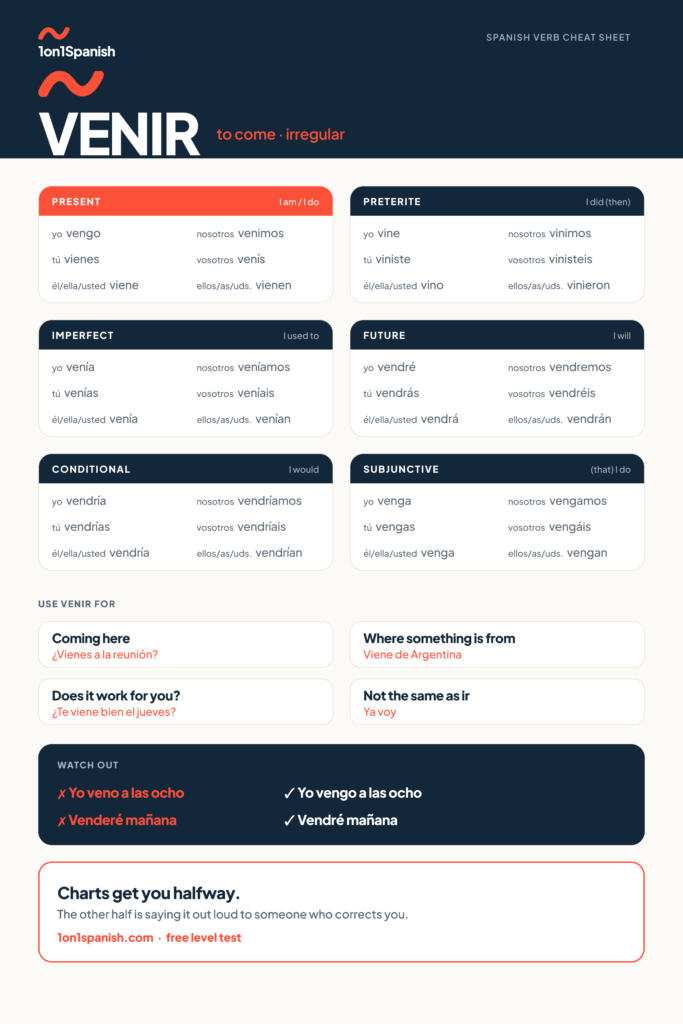
Take the chart with you
The chart is free to view and share. Drop your email and we’ll send the print-ready US Letter PDF — the version you stick on the fridge.
Practice
Practice venir and ir with a real teacher
Charts get you halfway. The other half is saying it out loud to someone who corrects you on the spot. At 1on1Spanish you get 25-minute private lessons with a qualified native teacher, exercises built from the mistakes you make in class, and AI practice between lessons.
First month $1. No contracts, cancel anytime.
Reading about it only gets you so far. Learn Spanish online in 25-minute conversations and use it.
Take your free level testBuilt on RingTeacher's method — 700,000+ classes delivered since 2017, teaching English to Spanish speakers. Now in the other direction.
Frequently asked questions
Is venir regular or irregular in Spanish?
Venir is irregular in every simple tense except the imperfect. The present adds a g in the yo form and changes e to ie elsewhere (vengo, vienes, viene), the preterite runs on the stem vin- (vine, viniste, vino), and the future and conditional use vendr- (vendré, vendría). Only venía, venías, venía follow the regular pattern.
What is the difference between venir and ir?
Spanish decides by where the speaker is. Venir is movement toward the speaker; ir is movement away from them. English uses “come” for both, which is why “I’m coming!” from another room is ¡ya voy! and not ya vengo. If you are not already at the destination, the verb you need is almost always ir.
What is the preterite of venir in Spanish?
Vine, viniste, vino, vinimos, vinisteis, vinieron. The stem changes to vin- and the endings lose their written accents, so it is vine rather than viné and vino rather than vinió. It belongs to the same irregular group as tener (tuve), estar (estuve) and poder (pude), which all share that unaccented set of endings.
How do you say “does Tuesday work for you?” in Spanish?
¿Te viene bien el martes? The expression is venir bien, and it is what Spanish speakers use to check whether a time suits someone. The negative is me viene mal: Me viene mal el jueves por la mañana. A more formal version for work email is ¿le viene bien el martes?
Why is the tú command of venir just “ven”?
Venir belongs to a small group of verbs whose affirmative tú command drops to a single syllable: ven, ten, pon, sal, haz, di, sé, ve. None of them takes an accent. The negative command goes back to the subjunctive, so it is no vengas, and the usted form is venga in both the affirmative and the negative.