
Llevar conjugation in Spanish: every tense you need, with examples
Llevar is completely regular, and it still trips people up — not because of the forms, but because of how many jobs it does. It means to carry, to wear, to give someone a ride, and to mark how long you’ve been doing something, all with the same verb. Every tense is below, along with the line between llevar and traer, which is the real source of confusion. 1on1Spanish teaches this in 25-minute one-on-one lessons with qualified native teachers, online across the United States.
Reviewed by María Jiménez — Licenciada en Filología Hispánica (BA in Hispanic Philology) · Updated Sep 2026
What llevar means
Llevar covers carrying and transporting: llevo las bolsas, llevamos al perro al veterinario. It also means to wear: lleva un vestido azul, llevo lentes desde los doce años.
It gives someone a ride, in the direction away from the speaker: te llevo a la oficina, mi mamá me llevaba a la escuela.
Then there’s the use that has no clean English equivalent: llevar plus a period of time tells you how long something has been going on, using the present tense where English reaches for “have been”: llevo dos años aquí, llevamos tres horas esperando.
Reflexive llevarse changes the meaning again: llevarse bien/mal con alguien is to get along (or not) with someone.
Grammatically it’s fully regular, a standard -ar verb with no stem change, no spelling change and no irregular participle or gerund.
Llevar conjugation: present tense
| Form | Example | |
|---|---|---|
| yo | llevo | Llevo tres años en este trabajo. (I’ve been at this job for three years.) |
| tú | llevas | ¿Qué llevas puesto hoy? (What are you wearing today?) |
| él / ella / usted | lleva | Mi vecino lleva a sus hijos a la escuela. (My neighbor drives his kids to school.) |
| nosotros | llevamos | Llevamos dos horas manejando. (We’ve been driving for two hours.) |
| vosotros | lleváis | ¿Lleváis mucho tiempo casados? (Have you been married long?) |
| ellos / ellas / ustedes | llevan | Se llevan bien desde niños. (They’ve gotten along since they were kids.) |
Llevar conjugation: preterite
| Form | |
|---|---|
| yo | llevé |
| tú | llevaste |
| él / ella / usted | llevó |
| nosotros | llevamos |
| vosotros | llevasteis |
| ellos / ellas / ustedes | llevaron |
Llevé a mi hija al médico ayer. — I took my daughter to the doctor yesterday.
Llevar conjugation: imperfect
| Form | |
|---|---|
| yo | llevaba |
| tú | llevabas |
| él / ella / usted | llevaba |
| nosotros | llevábamos |
| vosotros | llevabais |
| ellos / ellas / ustedes | llevaban |
De joven, siempre llevaba el pelo largo. — When I was young, I always wore my hair long.
Llevar conjugation: future
| Form | |
|---|---|
| yo | llevaré |
| tú | llevarás |
| él / ella / usted | llevará |
| nosotros | llevaremos |
| vosotros | llevaréis |
| ellos / ellas / ustedes | llevarán |
Te llevaré al aeropuerto el domingo. — I’ll take you to the airport on Sunday.
Llevar conjugation: conditional
| Form | |
|---|---|
| yo | llevaría |
| tú | llevarías |
| él / ella / usted | llevaría |
| nosotros | llevaríamos |
| vosotros | llevaríais |
| ellos / ellas / ustedes | llevarían |
Yo llevaría un suéter, va a hacer frío. — I’d bring a sweater, it’s going to be cold.
Llevar conjugation: present subjunctive
| Form | |
|---|---|
| yo | lleve |
| tú | lleves |
| él / ella / usted | lleve |
| nosotros | llevemos |
| vosotros | llevéis |
| ellos / ellas / ustedes | lleven |
Espero que lleves paraguas, va a llover. — I hope you bring an umbrella, it’s going to rain.
Llevar conjugation: imperfect subjunctive
| Form (-ra) | Form (-se) | |
|---|---|---|
| yo | llevara | llevase |
| tú | llevaras | llevases |
| él / ella / usted | llevara | llevase |
| nosotros | lleváramos | llevásemos |
| vosotros | llevarais | llevaseis |
| ellos / ellas / ustedes | llevaran | llevasen |
Si llevara el carro al taller, no tendríamos este problema. — If I took the car to the shop, we wouldn’t have this problem.
Llevar commands (imperative)
| Affirmative | Negative | |
|---|---|---|
| tú | lleva | no lleves |
| usted | lleve | no lleve |
| nosotros | llevemos | no llevemos |
| vosotros | llevad | no llevéis |
| ustedes | lleven | no lleven |
Lleva agua, hace mucho calor afuera. — Bring water, it’s very hot outside.
Participle, gerund and compound tenses
Participle llevado, gerund llevando. Both regular. Compounds take haber:
He llevado el mismo horario todo el año (present perfect) · Ya había llevado a los niños al dentista (past perfect) · Para junio habré llevado el carro a revisión dos veces (future perfect).
When to use llevar
Carrying or transporting something
Llevo las compras hasta el carro. This is the closest sense to the English “carry”, and it’s also how you say you’re bringing food or a gift somewhere: llevamos el postre a la cena.
Wearing clothes or accessories
Lleva lentes de sol todo el año. Spanish also uses usar for this, but llevar is at least as common, especially in Latin American Spanish.
Giving someone a ride, away from the speaker
Te llevo a la oficina si quieres. If a friend offers to drive you somewhere, this is the verb.
Marking how long something has been going on
Llevo cinco años estudiando español. Spanish uses the present tense of llevar where English switches to a present perfect: “I’ve been studying Spanish for five years.” Getting the tense right here — present, not perfect — is one of the biggest habits to build.
Llevar vs traer
Both can mean “to bring” or “to take”, and the difference is direction, not meaning — exactly like English “take” and “bring”. Llevar moves something away from the speaker; traer moves something toward the speaker.
| Spanish | What it means |
|---|---|
| Te llevo el café a tu oficina. | I’ll bring the coffee to your office. (away from me) |
| Tráeme el café cuando vengas. | Bring me the coffee when you come. (toward me) |
| Llevé el carro al taller. | I took the car to the shop. |
| Trae el carro aquí. | Bring the car here. |
Rule of thumb: if it’s heading toward you, traer. If it’s heading anywhere else, llevar.
Common mistakes English speakers make with llevar
English says “I have lived here for two years”, so learners reach for the present perfect. Spanish uses the present tense of llevar for this exact idea. He llevado means something else entirely — that you have carried or worn something.
With llevar plus a time period, the second verb goes in the gerund, not the infinitive.
“To get along” is the reflexive llevarse, and the pronoun me can’t be dropped.
If the coffee is coming toward you, the verb is traer, not llevar. This mix-up is the most common one for this verb.
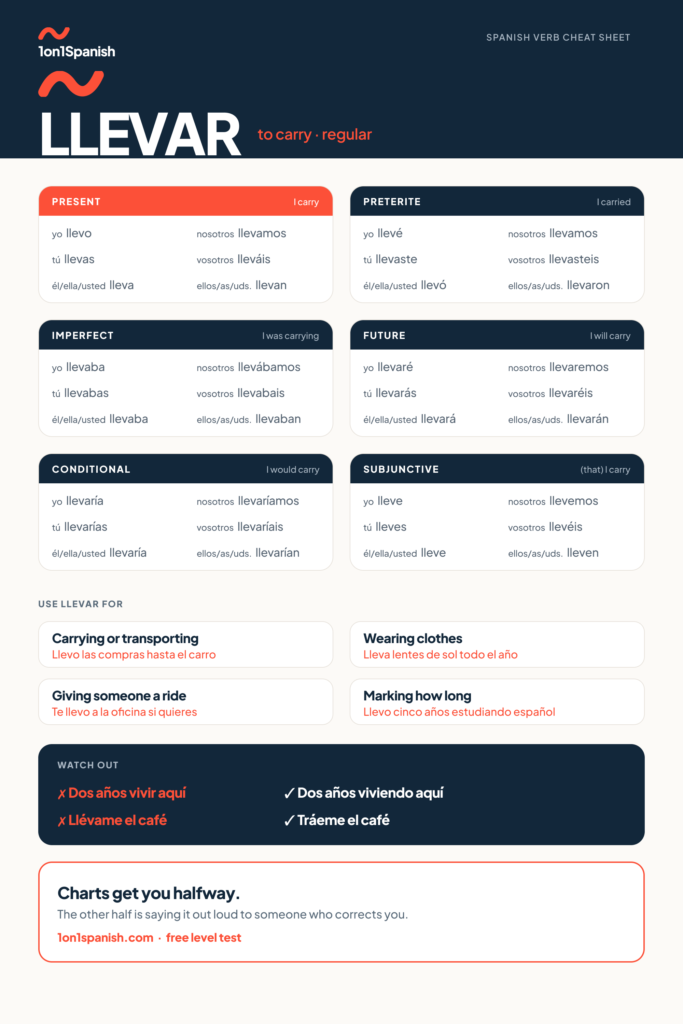
Take the chart with you
The chart is free to view and share. Drop your email and we’ll send the print-ready US Letter PDF — the version you stick on the fridge.
Practice
Practice llevar with a real teacher
Charts get you halfway. The other half is saying it out loud to someone who corrects you on the spot. At 1on1Spanish you get 25-minute private lessons with a qualified native teacher, exercises built from the mistakes you make in class, and AI practice between lessons.
First month $1. No contracts, cancel anytime.
Grammar you can read. Speaking you cannot. Learn Spanish online and practice it live.
Take your free level testBuilt on RingTeacher's method — 700,000+ classes delivered since 2017, teaching English to Spanish speakers. Now in the other direction.
Frequently asked questions
Is llevar regular or irregular in Spanish?
Llevar is completely regular in every tense — a standard -ar verb with no stem change, no spelling change and a regular participle (llevado) and gerund (llevando). The difficulty isn’t the forms, it’s the range of meanings: carry, wear, give someone a ride, and mark how long something has been happening, all with the same verb.
What’s the difference between llevar and traer?
Direction. Llevar moves something away from the speaker, toward somewhere else: le llevo el paquete a mi vecina. Traer moves something toward the speaker: tráeme el paquete. English does the same split with “take” and “bring”, so once you’re looking for it, the distinction is familiar.
How do you say “I’ve been here for two years” using llevar?
Llevo aquí dos años, or with an activity, llevo dos años viviendo aquí. Spanish uses the present tense of llevar plus the time period, where English reaches for the present perfect (“I have been”). Using he estado or he vivido instead isn’t wrong, but llevar is what a native speaker says first.
What is the past tense of llevar in Spanish?
Two, and they mark different things. The preterite — llevé, llevaste, llevó, llevamos, llevasteis, llevaron — is for a completed act: llevé a mi hija al médico. The imperfect — llevaba, llevabas, llevaba, llevábamos, llevabais, llevaban — is for a repeated habit or an ongoing state in the past: siempre llevaba el pelo largo.
Do I need the subjunctive of llevar in everyday conversation?
Yes, mostly after wishes and hopes. Lleve appears after espero que (espero que lleves paraguas) and after ojalá (ojalá que lleve identificación). It’s a fully regular subjunctive, so once you know the pattern for any -ar verb, llevar follows it exactly.