
Traer conjugation in Spanish: every tense you need, with examples
Traer means “to bring”: to move something toward where the speaker is. It’s irregular in three ways: the yo form adds a g (traigo), the preterite switches to a j stem (traje, trajiste, trajo) and drops the i in the third person plural (trajeron, never trajieron), and the gerund is trayendo. Every tense is below, followed by the traer / llevar split that decides which verb the sentence needs. 1on1Spanish teaches this in 25-minute one-on-one lessons with qualified native teachers, online across the United States.
Reviewed by María Jiménez — Licenciada en Filología Hispánica (BA in Hispanic Philology) · Updated Aug 2026
What traer means
Traer is “to bring”, and in Spanish that word carries direction: the thing moves toward the person speaking. Trae el informe a mi despacho only works if the speaker is in the office. If the movement goes away from the speaker, Spanish uses llevar.
It also means “to have on you” in everyday speech: No traigo efectivo, ¿Traes el carnet? And it describes what a document or a piece of news contains: El contrato trae una cláusula de penalización.
Irregularity summary: traigo in the present, a j preterite (traje), subjunctive on traig-, and the spelling-driven forms trayendo and traído. The participle keeps its accent because the i would otherwise merge into the diphthong.
Traer conjugation: present tense
Only yo is irregular; the rest take normal -er endings.
| Form | Example | |
|---|---|---|
| yo | traigo | Te traigo el café. (I’m bringing you your coffee.) |
| tú | traes | ¿Traes el pasaporte? (Do you have your passport on you?) |
| él / ella / usted | trae | El informe trae dos errores. (The report has two mistakes in it.) |
| nosotros | traemos | Traemos el postre nosotros. (We’re bringing dessert.) |
| vosotros | traéis | ¿Traéis a los niños? (Are you bringing the kids?) |
| ellos / ellas / ustedes | traen | Traen buenas noticias. (They bring good news.) |
Traer conjugation: preterite
Fully irregular, on the stem traj-. Note the third person plural: because the stem already ends in j, the ending is -eron, not -ieron.
| Form | |
|---|---|
| yo | traje |
| tú | trajiste |
| él / ella / usted | trajo |
| nosotros | trajimos |
| vosotros | trajisteis |
| ellos / ellas / ustedes | trajeron |
Mis padres trajeron fotos de su viaje. — My parents brought photos from their trip.
Traer conjugation: imperfect
Regular endings. The accent on the í keeps the two vowels in separate syllables.
| Form | |
|---|---|
| yo | traía |
| tú | traías |
| él / ella / usted | traía |
| nosotros | traíamos |
| vosotros | traíais |
| ellos / ellas / ustedes | traían |
Cada verano nos traía regalos de California. — Every summer he’d bring us gifts from California.
Traer conjugation: future
Completely regular: endings on the full infinitive.
| Form | |
|---|---|
| yo | traeré |
| tú | traerás |
| él / ella / usted | traerá |
| nosotros | traeremos |
| vosotros | traeréis |
| ellos / ellas / ustedes | traerán |
El técnico traerá la pieza el jueves. — The technician will bring the part on Thursday.
Traer conjugation: conditional
Also regular.
| Form | |
|---|---|
| yo | traería |
| tú | traerías |
| él / ella / usted | traería |
| nosotros | traeríamos |
| vosotros | traeríais |
| ellos / ellas / ustedes | traerían |
¿Me traerías un vaso de agua? — Would you bring me a glass of water?
Traer conjugation: present subjunctive
Built on traig-, the same stem as traigo.
| Form | |
|---|---|
| yo | traiga |
| tú | traigas |
| él / ella / usted | traiga |
| nosotros | traigamos |
| vosotros | traigáis |
| ellos / ellas / ustedes | traigan |
Dile que traiga el recibo. — Tell him to bring the receipt.
Traer conjugation: imperfect subjunctive
Built on the preterite stem traj-, so again there is no i in the ending.
| Form (-ra) | Form (-se) | |
|---|---|---|
| yo | trajera | trajese |
| tú | trajeras | trajeses |
| él / ella / usted | trajera | trajese |
| nosotros | trajéramos | trajésemos |
| vosotros | trajerais | trajeseis |
| ellos / ellas / ustedes | trajeran | trajesen |
Le pedí que trajera el contrato firmado. — I asked him to bring the signed contract.
Traer commands (imperative)
The affirmative tú form is regular (trae); everything else uses the subjunctive stem.
| Affirmative | Negative | |
|---|---|---|
| tú | trae | no traigas |
| usted | traiga | no traiga |
| nosotros | traigamos | no traigamos |
| vosotros | traed | no traigáis |
| ustedes | traigan | no traigan |
Tráeme la carpeta azul. — Bring me the blue folder. With a pronoun attached, the stress is written: tráeme, tráigamelo.
Participle, gerund and compound tenses
Participle traído (the accent is obligatory), gerund trayendo, where the i becomes y between vowels. Compounds use haber:
He traído el carro al taller (present perfect) · Había traído demasiado equipaje (past perfect) · Para las ocho ya habré traído los papeles (future perfect).
When to use traer
Bringing something toward the speaker
¿Me traes las llaves? You’re where the keys are going. This is the core meaning and the one that decides everything else.
Having something on you right now
No traigo el celular. ¿Traes cambio? Very common in Mexico and much of Latin America, and understood everywhere.
What a text, a package or a piece of news contains
La caja trae instrucciones. El periódico trae una entrevista con ella.
Causing a state, with an adjective
Este proyecto me trae loco is “this project is driving me crazy”. La mudanza nos trae de cabeza.
Fixed phrases
Traer consigo (to entail): El puesto trae consigo mucho viaje.
Traer vs llevar
Same action, opposite direction. Spanish picks the verb from where the speaker is standing, not from who owns the object. English uses “bring” loosely for both, which is why this pair is worth two minutes.
| Traer — toward the speaker | Llevar — away from the speaker |
|---|---|
| Tráeme el informe — Bring me the report | Llévale el informe — Take him the report |
| ¿Traes el postre a mi casa? — Are you bringing dessert to my place? | Llevo el postre a su casa — I’m taking dessert to their place |
| Trajeron a los niños aquí — They brought the kids here | Llevaron a los niños al médico — They took the kids to the doctor |
| Trae vino cuando vengas — Bring wine when you come | Lleva vino cuando vayas — Take wine when you go |
Common mistakes English speakers make with traer
After a j stem the ending loses its i. The same rule applies to dijeron, condujeron and produjeron.
You’re not there yet, so the movement goes away from you. Speaking on the phone from your own kitchen, it’s llevar.
Without the accent, ai reads as one syllable and the word sounds wrong. The written accent is not optional here.
The g in traigo is not a typo; it’s the same insertion you see in pongo, salgo and hago.
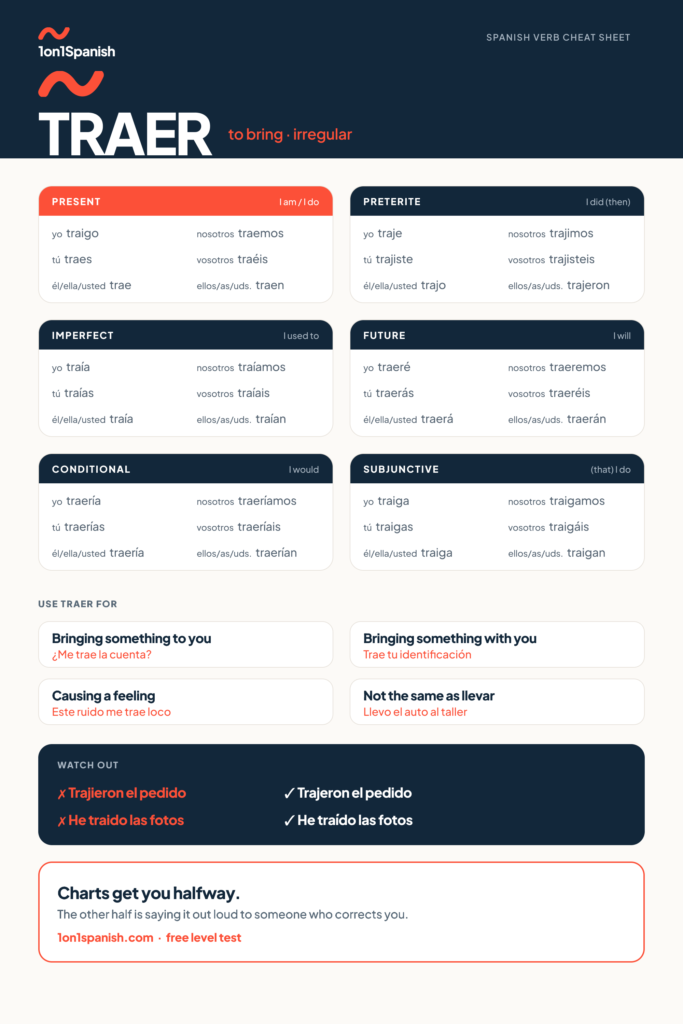
Take the chart with you
The chart is free to view and share. Drop your email and we’ll send the print-ready US Letter PDF — the version you stick on the fridge.
Practice
Practice traer and llevar with a real teacher
Charts get you halfway. The other half is saying it out loud to someone who corrects you on the spot. At 1on1Spanish you get 25-minute private lessons in conversational Spanish with a qualified native teacher, exercises built from the mistakes you make in class, and AI practice between lessons.
First month $1. No contracts, cancel anytime.
You can go further with someone listening: Learn Spanish with 1on1Spanish, 25 minutes at a time.
Take your free level testBuilt on RingTeacher's method — 700,000+ classes delivered since 2017, teaching English to Spanish speakers. Now in the other direction.
Frequently asked questions
Is traer regular or irregular in Spanish?
Traer is irregular. The yo form takes a g (traigo), the whole preterite runs on a j stem (traje, trajiste, trajo, trajimos, trajisteis, trajeron), and the subjunctive uses traig-. The future, conditional and imperfect are regular. The gerund trayendo and the participle traído also change spelling to keep the pronunciation intact.
Why is it trajeron and not trajieron?
Because the stem already ends in j. Spanish preterite stems ending in j (traj-, dij-, conduj-, produj-) take -eron instead of -ieron in the third person plural. The same happens in the imperfect subjunctive: trajeran, not trajieran. It’s a spelling rule, not an exception you need to memorize verb by verb.
What’s the difference between traer and llevar?
Direction, measured from the speaker. Traer moves something toward where you are; llevar moves it away. If you’re at home and someone is coming over, you ask them to traer the wine. If you’re the one going, you llevas the wine. English says “bring” in both cases, so the rule has to be applied consciously at first.
How do you say “bring me” in Spanish?
Tráeme with tú, tráigame with usted. The pronoun attaches to the end of the affirmative command and the written accent moves onto the stem so the stress doesn’t shift. With two pronouns it becomes tráemelo / tráigamelo. How those pronouns order themselves is covered in our guide to indirect object pronouns.
Do I need the subjunctive of traer in everyday conversation?
Yes, mostly for requests. Every time you ask someone to bring something through a second person you need traiga or trajera: Dile que traiga el recibo, Le pedí que trajera el contrato. Those two forms cover almost all real use. More verbs with the same -g- pattern are listed under Spanish verbs.