
Mirar conjugation in Spanish: every tense you need, with examples
Mirar means “to look at”, and it’s a fully regular -ar verb in every tense — nothing irregular to flag in any of the nine tables below. The real question learners bring to this page isn’t how to conjugate it, it’s when to use mirar instead of ver: both can translate as “to look” or “to see” in English, but Spanish keeps them apart by whether the looking is deliberate. 1on1Spanish teaches this in 25-minute one-on-one lessons with qualified native teachers, online across the United States.
Reviewed by María Jiménez — Licenciada en Filología Hispánica (BA in Hispanic Philology) · Updated Sep 2026
What mirar means
Mirar is to look at something on purpose — you choose to direct your eyes there. Mira esto is “look at this”, said constantly to point someone’s attention at an object, a screen, a document. Mírame cuando te hablo is “look at me when I’m talking to you”, a phrase every parent in the Spanish-speaking world has said at least once.
It also covers glancing, checking and watching for something without a screen involved: mirar el reloj (to check the time), mirar por la ventana (to look out the window), mirar fijamente (to stare). Figuratively, mirar por means to look out for someone: ella siempre mira por sus hermanos.
Grammatically it’s fully regular: standard -ar endings throughout, no stem change, no spelling change. Participle mirado, gerund mirando.
Mirar conjugation: present tense
Fully regular. No irregular forms in this table.
| Form | Example | |
|---|---|---|
| yo | miro | Miro el mapa antes de salir de viaje. (I look at the map before I leave on a trip.) |
| tú | miras | ¿Miras el reloj cada cinco minutos? (Do you check the clock every five minutes?) |
| él / ella / usted | mira | Mi jefe mira cada documento con cuidado. (My boss looks over every document carefully.) |
| nosotros | miramos | Miramos las estrellas desde el patio. (We look at the stars from the yard.) |
| vosotros | miráis | ¿Miráis las fotos de la boda todavía? (Do you still look at the wedding photos?) |
| ellos / ellas / ustedes | miran | Los niños miran por la ventana esperando el camión. (The kids look out the window waiting for the truck.) |
Mirar conjugation: preterite
Regular -ar endings, no spelling change.
| Form | |
|---|---|
| yo | miré |
| tú | miraste |
| él / ella / usted | miró |
| nosotros | miramos |
| vosotros | mirasteis |
| ellos / ellas / ustedes | miraron |
Miré el contrato dos veces antes de firmarlo. — I looked over the contract twice before signing it.
Mirar conjugation: imperfect
Fully regular.
| Form | |
|---|---|
| yo | miraba |
| tú | mirabas |
| él / ella / usted | miraba |
| nosotros | mirábamos |
| vosotros | mirabais |
| ellos / ellas / ustedes | miraban |
De niño, miraba las nubes desde mi ventana. — As a kid, I used to look at the clouds from my window.
Mirar conjugation: future
Regular endings on the infinitive.
| Form | |
|---|---|
| yo | miraré |
| tú | mirarás |
| él / ella / usted | mirará |
| nosotros | miraremos |
| vosotros | miraréis |
| ellos / ellas / ustedes | mirarán |
Mañana miraremos el mapa juntos antes del viaje. — Tomorrow we’ll look at the map together before the trip.
Mirar conjugation: conditional
| Form | |
|---|---|
| yo | miraría |
| tú | mirarías |
| él / ella / usted | miraría |
| nosotros | miraríamos |
| vosotros | miraríais |
| ellos / ellas / ustedes | mirarían |
Yo miraría el contrato con un abogado antes de firmar. — I’d look over the contract with a lawyer before signing.
Mirar conjugation: present subjunctive
Built on the miro stem, fully regular.
| Form | |
|---|---|
| yo | mire |
| tú | mires |
| él / ella / usted | mire |
| nosotros | miremos |
| vosotros | miréis |
| ellos / ellas / ustedes | miren |
Quiero que mires esto antes de decidir. — I want you to look at this before you decide.
Mirar conjugation: imperfect subjunctive
Built on the preterite stem miraron-.
| Form (-ra) | Form (-se) | |
|---|---|---|
| yo | mirara | mirase |
| tú | miraras | mirases |
| él / ella / usted | mirara | mirase |
| nosotros | miráramos | mirásemos |
| vosotros | mirarais | miraseis |
| ellos / ellas / ustedes | miraran | mirasen |
Si miraras con más cuidado, verías el error. — If you looked more carefully, you’d see the mistake.
Mirar commands (imperative)
| Affirmative | Negative | |
|---|---|---|
| tú | mira | no mires |
| usted | mire | no mire |
| nosotros | miremos | no miremos |
| vosotros | mirad | no miréis |
| ustedes | miren | no miren |
Mira, te explico. — Look, let me explain. Mira also opens sentences this way, closer to “listen” or “look” in English than a literal command to look at something.
Participle, gerund and compound tenses
Participle mirado, gerund mirando. Both regular. Compounds take haber:
He mirado ese documento tres veces (present perfect) · Ya había mirado el mapa antes de salir (past perfect) · Para entonces habré mirado toda la propuesta (future perfect).
When to use mirar
Directing your attention on purpose
Mira esto antes de firmar. This is the core, deliberate sense — you point your eyes somewhere by choice.
Looking at scenery or objects
Miramos el atardecer desde la terraza. Common with landscapes, photos, documents — anything you take in visually and consciously.
Checking or glancing
Miré el reloj y ya era tarde. A quick, purposeful look, different from just happening to see the time.
Looking out for someone, figuratively
Ella siempre mira por sus hermanos menores. No literal eyes involved — this means to watch out for, to look after.
Mirar vs ver
Both can translate as “to see” or “to watch” in English, but Spanish splits them by whether the looking is deliberate. Mirar is what you choose to do with your eyes; ver is what your eyes register, whether you meant to or not.
| Spanish | What it means |
|---|---|
| Mira el mapa antes de salir. | Look at the map before leaving (deliberate). |
| Vi el mapa en su escritorio. | I saw the map on his desk (just registered it). |
| No mires las fotos todavía. | Don’t look at the photos yet (an instruction). |
| ¿Viste la película nueva? | Did you watch the new movie? — never ¿miraste la película? |
| Mírame cuando te hablo. | Look at me when I’m talking to you. |
Screens are the one place this splits from English intuition: movies, shows and games always take ver in Spanish, never mirar, even though “watch” sounds like the more deliberate verb in English.
Common mistakes English speakers make with mirar
Anything on a screen — TV, movies, a game — takes ver in Spanish, not mirar, even though English “watch” feels closer to mirar‘s deliberate sense.
The tú command mira only works with someone you address informally. In a formal or professional setting, the command is mire, built on usted.
The personal a is only needed before a specific person, not before a thing. Miro a mi hijo is correct because hijo is a person; mi celular is not.
After quiero que, the verb needs the subjunctive: mires, not mira.
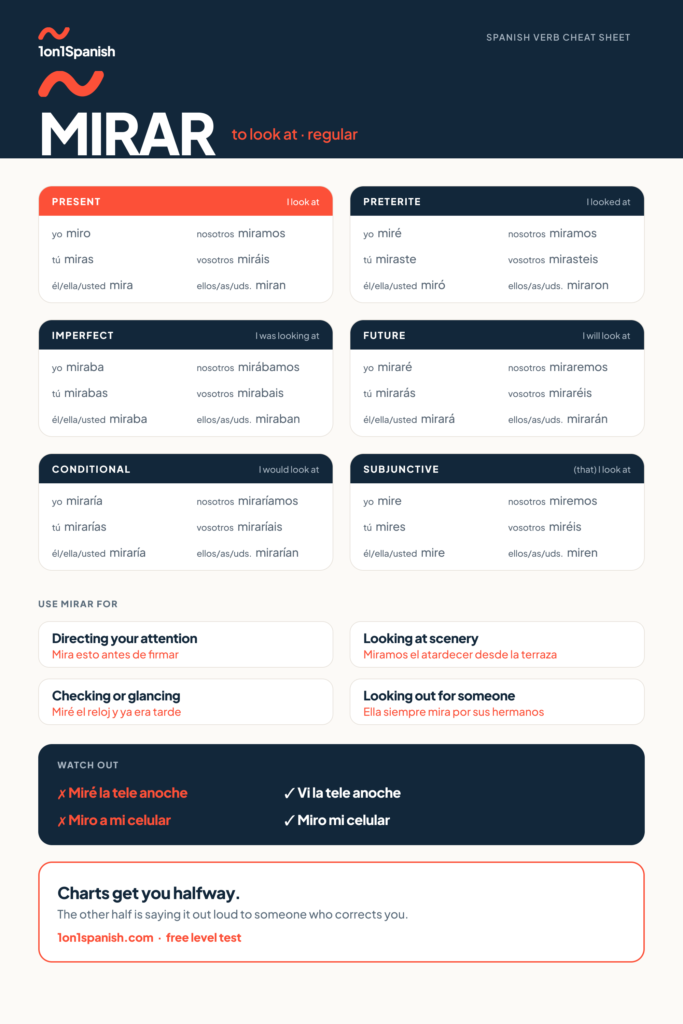
Take the chart with you
The chart is free to view and share. Drop your email and we’ll send the print-ready US Letter PDF — the version you stick on the fridge.
Practice
Practice mirar with a real teacher
Charts get you halfway. The other half is saying it out loud to someone who corrects you on the spot. At 1on1Spanish you get 25-minute private lessons with a qualified native teacher, exercises built from the mistakes you make in class, and AI practice between lessons.
First month $1. No contracts, cancel anytime.
Everything on this page is free to use. If you want feedback on your own Spanish, learn Spanish online with us.
Take your free level testBuilt on RingTeacher's method — 700,000+ classes delivered since 2017, teaching English to Spanish speakers. Now in the other direction.
Frequently asked questions
Is mirar regular or irregular in Spanish?
Fully regular. Mirar follows the standard -ar pattern in every tense — present, preterite, imperfect, future, conditional and both subjunctives — with no stem change and no spelling change. The difficulty with this verb isn’t the forms; it’s knowing when to use it instead of ver.
What’s the difference between mirar and ver?
Mirar is deliberate: you choose to direct your eyes somewhere, like mira esto (look at this). Ver is passive perception, or the fixed use for screens: you see something whether you meant to or not, and you always ver a movie or a game, never mirar one. English splits “look at” and “see” the same way, except for the screen exception.
How do you say “look at me” in Spanish?
Mírame, with the pronoun attached to the end of the command — a single word. It’s what a parent says to a distracted kid, or what anyone says to make sure they have someone’s attention. Mírame cuando te hablo is “look at me when I’m talking to you”.
What is the past tense of mirar in Spanish?
Two forms depending on the shape of the action. The preterite — miré, miraste, miró, miramos, mirasteis, miraron — is for a single, completed look: miré el contrato dos veces. The imperfect — miraba, mirabas, miraba, mirábamos, mirabais, miraban — is for a repeated or ongoing habit: de niño, miraba las nubes desde mi ventana.
Do I need the subjunctive of mirar in everyday conversation?
Yes, mostly with requests and wishes. Mire appears after quiero que (quiero que mires esto), after espero que (espero que mires bien antes de cruzar), and in formal commands with usted (mire, por favor). It’s common whenever you’re directing someone’s attention toward something.