
Poder conjugation in Spanish: every tense you need, with examples
Poder means “can”, “may” and “to be able to”, and it is the verb you reach for to ask permission, offer help or admit you’re stuck. It is an o→ue stem-changing verb in the present (puedo, puedes), with the strong preterite pude and the short future stem podr-. The tables are below, along with the one distinction that changes the meaning of a whole sentence: pude against podía. 1on1Spanish teaches this in 25-minute one-on-one lessons with qualified native teachers, online across the United States.
Reviewed by María Jiménez — Licenciada en Filología Hispánica (BA in Hispanic Philology) · Updated Aug 2026
What poder means
Poder + infinitive covers three ideas that English splits between “can” and “may”: physical or practical ability (No puedo levantar esto), permission (¿Puedo pasar?), and possibility (Puede llover esta tarde).
Unlike English “can”, it is a full verb with every tense you need, so you can say podré, he podido and pudiera, none of which English can do with “can”. As a noun, el poder means power.
It belongs to the small group of Spanish verbs that carry a second verb behind them, so every form you learn here works with whatever infinitive you put next to it.
The irregular parts: the present changes o to ue in all forms except podemos and podéis, the preterite runs on pud-, the future and conditional use podr-, and the gerund is pudiendo, with the same vowel change. The participle podido is regular.
Poder conjugation: present tense
| Form | Example | |
|---|---|---|
| yo | puedo | No puedo el jueves. (I can’t do Thursday.) |
| tú | puedes | ¿Puedes llamarme luego? (Can you call me later?) |
| él / ella / usted | puede | ¿Puede repetirlo, por favor? (Could you repeat that, please?) |
| nosotros | podemos | Podemos vernos el sábado. (We can meet on Saturday.) |
| vosotros | podéis | ¿Podéis venir a las siete? (Can you come at seven?) |
| ellos / ellas / ustedes | pueden | Los niños no pueden entrar solos. (The kids can’t go in alone.) |
Poder conjugation: preterite
Strong preterite on the stem pud-, with no written accents. It means you managed to do something, or you failed to.
| Form | |
|---|---|
| yo | pude |
| tú | pudiste |
| él / ella / usted | pudo |
| nosotros | pudimos |
| vosotros | pudisteis |
| ellos / ellas / ustedes | pudieron |
Al final pude cambiar el vuelo. — In the end I managed to change the flight.
Poder conjugation: imperfect
Regular. This is the tense for a general ability in the past, with no result attached.
| Form | |
|---|---|
| yo | podía |
| tú | podías |
| él / ella / usted | podía |
| nosotros | podíamos |
| vosotros | podíais |
| ellos / ellas / ustedes | podían |
Antes podía correr diez kilómetros sin parar. — I used to be able to run ten kilometers straight.
Poder conjugation: future
Short stem podr-, regular endings.
| Form | |
|---|---|
| yo | podré |
| tú | podrás |
| él / ella / usted | podrá |
| nosotros | podremos |
| vosotros | podréis |
| ellos / ellas / ustedes | podrán |
Podremos pagarlo en tres plazos. — We’ll be able to pay it in three installments.
Poder conjugation: conditional
Same short stem podr-. This is the polite register: podría is the Spanish “could you”.
| Form | |
|---|---|
| yo | podría |
| tú | podrías |
| él / ella / usted | podría |
| nosotros | podríamos |
| vosotros | podríais |
| ellos / ellas / ustedes | podrían |
¿Podría hablar con el doctor Ruiz? — Could I speak with Dr. Ruiz?
Poder conjugation: present subjunctive
Same o→ue change as the present indicative, on -a endings.
| Form | |
|---|---|
| yo | pueda |
| tú | puedas |
| él / ella / usted | pueda |
| nosotros | podamos |
| vosotros | podáis |
| ellos / ellas / ustedes | puedan |
Ven cuando puedas. — Come whenever you can. More on this mood in the Spanish subjunctive.
Poder conjugation: imperfect subjunctive
From the preterite stem pud-. Both sets are correct; the -ra forms dominate in speech.
| Form (-ra) | Form (-se) | |
|---|---|---|
| yo | pudiera | pudiese |
| tú | pudieras | pudieses |
| él / ella / usted | pudiera | pudiese |
| nosotros | pudiéramos | pudiésemos |
| vosotros | pudierais | pudieseis |
| ellos / ellas / ustedes | pudieran | pudiesen |
Si pudiera, me tomaría el día libre. — If I could, I’d take the day off.
Poder commands (imperative)
Poder barely exists in the imperative: ordering someone to be able to do something makes little sense. The forms are built regularly, but you will rarely hear them outside set phrases.
| Affirmative | Negative | |
|---|---|---|
| tú | puede | no puedas |
| usted | pueda | no pueda |
| nosotros | podamos | no podamos |
| vosotros | poded | no podáis |
| ustedes | puedan | no puedan |
In practice, requests use the conditional or the present question form instead: ¿Podrías ayudarme? or ¿Me ayudas?
Participle, gerund and compound tenses
Participle podido, gerund pudiendo — note the stem change in the gerund. Compounds take haber:
No he podido dormir (present perfect) · No había podido avisarte (past perfect) · Habrá podido llegar a tiempo (future perfect).
When to use poder
Ability
What you’re physically or practically capable of: No puedo abrir el bote. ¿Puedes leer esto sin lentes?
Permission
¿Puedo estacionar aquí? Aquí no se puede fumar. In formal settings, podría softens it further.
Availability
Extremely common when arranging things, with no second verb at all: No puedo el martes. ¿Puedes a las cinco?
Possibility
Puede que + subjunctive, or puede ser: Puede que llueva. Puede ser, no lo sé.
Offering and requesting
¿Te puedo ayudar? ¿Me puede traer la cuenta? Restaurants, clinics and service desks run on this pattern.
Poder vs saber
English uses “can” for both, but Spanish separates learned skill from present possibility. Getting this wrong changes what you’re claiming about yourself.
| With poder | With saber |
|---|---|
| No puedo nadar hoy — I can’t swim today (injured, no pool) | No sé nadar — I don’t know how to swim |
| ¿Puedes manejar? — Are you able to drive right now? | ¿Sabes manejar? — Do you know how to drive? |
| No puedo cocinar esta noche — I can’t cook tonight | No sé cocinar — I don’t know how to cook |
Common mistakes English speakers make with poder
Poder is followed directly by the infinitive, with no preposition in between.
Knowing a language is saber. No puedo español says nothing intelligible in Spanish.
The preterite reports a specific failed attempt; the imperfect only says the option wasn’t available in general.
Puede que always takes the subjunctive, because it expresses possibility rather than fact.
Translating “can I have” literally sounds strange in a Spanish restaurant. Native speakers ask for the action, not for possession.
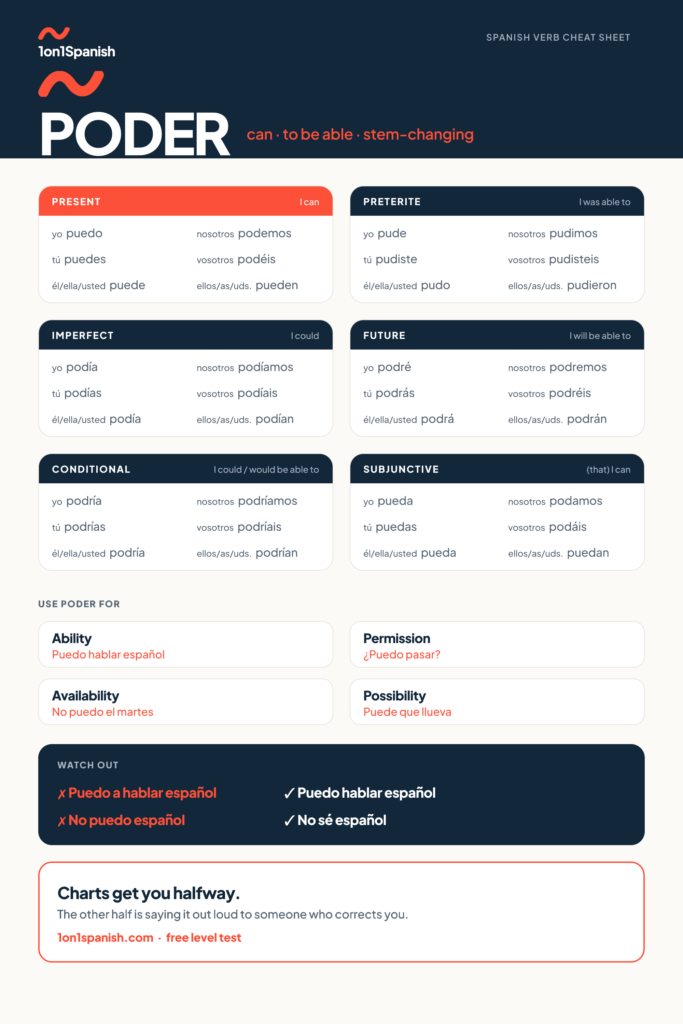
Take the chart with you
The chart is free to view and share. Drop your email and we’ll send the print-ready US Letter PDF — the version you stick on the fridge.
Practice
Practice poder with a real teacher
Charts get you halfway. The other half is saying it out loud to someone who corrects you on the spot. At 1on1Spanish you get 25-minute private lessons with a qualified native teacher, exercises built from the mistakes you make in class, and AI practice between lessons.
First month $1. No contracts, cancel anytime.
Asking for things politely is pure practice, and it’s the core of conversational Spanish.
When you are ready to speak it out loud, try online Spanish lessons with a native teacher.
Take your free level testBuilt on RingTeacher's method — 700,000+ classes delivered since 2017, teaching English to Spanish speakers. Now in the other direction.
Frequently asked questions
Is poder regular or irregular in Spanish?
Poder is an o→ue stem-changing verb with three extra irregularities. The present becomes puedo, puedes, puede, podemos, podéis, pueden. The preterite uses the strong stem pud-. The future and conditional shorten to podr-. The gerund is pudiendo, not podiendo. Only the imperfect (podía) follows the regular pattern.
What’s the difference between poder and saber?
Saber is knowing how to do something you learned: sé nadar, sé manejar, sé español. Poder is being able to do it right now, given the circumstances: hoy no puedo nadar because the pool is closed. Saying no puedo español instead of no sé español is a common English-speaker slip and it doesn’t communicate anything.
What’s the difference between pude and podía?
Pude reports one specific occasion and its outcome: Pude entrar means I got in. No pude entrar means I tried and failed. Podía describes an ability or permission that existed over a stretch of time, with no result attached: De niño podía entrar gratis means I was allowed in for free back then, not that I did on any given day.
How do you politely ask for something with poder in Spanish?
Use the conditional: ¿Podría ayudarme? ¿Podría darme un momento? It’s the standard polite register with strangers, at a clinic, or on the phone. With people you know, the present is enough: ¿Puedes pasarme el agua? Adding por favor at the end works in both registers and is never out of place.
Do I need the subjunctive of poder in everyday conversation?
Yes, more than you’d expect. Pueda appears after cuando for a future moment (cuando puedas), after puede que for possibility (puede que pueda ir), and in negatives and doubts (no creo que pueda). Pudiera shows up in every hypothetical sentence starting with si, which is how most polite excuses are built.