
Tocar conjugation in Spanish: every tense you need, with examples
Tocar means “to touch”, and it stretches to cover playing an instrument, knocking on a door, and one construction with no direct English equivalent: me toca a mí, “it’s my turn”. On paper it carries one spelling change — the c becomes qu any time the ending starts with e — which shows up in toqué and across the subjunctive. Every tense is below, along with the mistake almost every English speaker makes with musical instruments. 1on1Spanish teaches this in 25-minute one-on-one lessons with qualified native teachers, online across the United States.
Reviewed by María Jiménez — Licenciada en Filología Hispánica (BA in Hispanic Philology) · Updated Sep 2026
What tocar means
Tocar is physical touch in the most literal sense: no toques la estufa, está caliente. It’s also how Spanish says “to play” an instrument: toco la guitarra desde los quince años. English uses “play” for both games and instruments; Spanish splits them — jugar for games, tocar for instruments.
It covers knocking, in everyday Latin American Spanish: tocaron la puerta a las ocho de la mañana. And in impersonal constructions, it means “it’s [someone’s] turn”: me toca a mí pagar esta vez, built the same way as gustar — with an indirect object pronoun in front.
Grammatically it’s regular with a spelling change (c→qu before e). The change appears in the preterite yo form and the whole present subjunctive, because Spanish never writes a c before e or i to keep the hard “k” sound. Participle tocado, gerund tocando, both regular.
Tocar conjugation: present tense
Fully regular here — the endings start with o, a or nothing, so the c stays a c.
| Form | Example | |
|---|---|---|
| yo | toco | Toco el piano todos los domingos. (I play piano every Sunday.) |
| tú | tocas | ¿Tocas algún instrumento? (Do you play an instrument?) |
| él / ella / usted | toca | Alguien toca la puerta. (Someone’s knocking on the door.) |
| nosotros | tocamos | Tocamos en una banda los fines de semana. (We play in a band on weekends.) |
| vosotros | tocáis | ¿Tocáis en el evento de la empresa? (Are you playing at the company event?) |
| ellos / ellas / ustedes | tocan | Mis hijos tocan el violín. (My kids play the violin.) |
Tocar conjugation: preterite
The yo form needs the spelling change, because the ending starts with e.
| Form | |
|---|---|
| yo | toqué |
| tú | tocaste |
| él / ella / usted | tocó |
| nosotros | tocamos |
| vosotros | tocasteis |
| ellos / ellas / ustedes | tocaron |
Toqué la puerta tres veces y nadie salió. — I knocked on the door three times and nobody came out.
Tocar conjugation: imperfect
Fully regular, no spelling change.
| Form | |
|---|---|
| yo | tocaba |
| tú | tocabas |
| él / ella / usted | tocaba |
| nosotros | tocábamos |
| vosotros | tocabais |
| ellos / ellas / ustedes | tocaban |
De niño, tocaba la trompeta en la banda de la escuela. — As a kid, I played trumpet in the school band.
Tocar conjugation: future
Regular endings on the infinitive.
| Form | |
|---|---|
| yo | tocaré |
| tú | tocarás |
| él / ella / usted | tocará |
| nosotros | tocaremos |
| vosotros | tocaréis |
| ellos / ellas / ustedes | tocarán |
El próximo mes te tocará viajar a ti. — Next month it’ll be your turn to travel.
Tocar conjugation: conditional
| Form | |
|---|---|
| yo | tocaría |
| tú | tocarías |
| él / ella / usted | tocaría |
| nosotros | tocaríamos |
| vosotros | tocaríais |
| ellos / ellas / ustedes | tocarían |
Yo tocaría el timbre antes de entrar. — I’d ring the bell before going in.
Tocar conjugation: present subjunctive
Every form takes the spelling change, because every -ar subjunctive ending starts with e.
| Form | |
|---|---|
| yo | toque |
| tú | toques |
| él / ella / usted | toque |
| nosotros | toquemos |
| vosotros | toquéis |
| ellos / ellas / ustedes | toquen |
Espero que toque bien en el concierto. — I hope he plays well at the concert.
Tocar conjugation: imperfect subjunctive
Built on the preterite stem tocaron-. No spelling change here — the endings start with a.
| Form (-ra) | Form (-se) | |
|---|---|---|
| yo | tocara | tocase |
| tú | tocaras | tocases |
| él / ella / usted | tocara | tocase |
| nosotros | tocáramos | tocásemos |
| vosotros | tocarais | tocaseis |
| ellos / ellas / ustedes | tocaran | tocasen |
Si tocara mejor, le pedirían que se uniera a la banda. — If he played better, they’d ask him to join the band.
Tocar commands (imperative)
| Affirmative | Negative | |
|---|---|---|
| tú | toca | no toques |
| usted | toque | no toque |
| nosotros | toquemos | no toquemos |
| vosotros | tocad | no toquéis |
| ustedes | toquen | no toquen |
No toques eso, está recién pintado. — Don’t touch that, it’s freshly painted.
Participle, gerund and compound tenses
Participle tocado, gerund tocando. Both regular, no spelling change. Compounds take haber:
He tocado en esta banda desde 2018 (present perfect) · Nunca había tocado un piano de cola (past perfect) · Para diciembre habré tocado en tres bodas (future perfect).
When to use tocar
Touching something physically
No toques el cuadro, por favor. This is the literal, base meaning, and it’s the one museums and parents use most.
Playing an instrument
Toco la guitarra en una banda local. Spanish never uses jugar here — that verb is reserved for games and sports.
Knocking on a door
Alguien está tocando la puerta. Standard in Mexico and most of Latin America; Spain leans more on llamar a la puerta, but both are understood everywhere.
Marking whose turn it is
Me toca a mí manejar hoy. Built like gustar: the person goes in an indirect object pronoun (me, te, le, nos, les), and tocar agrees with what’s happening, not with the person.
Common mistakes English speakers make with tocar
English uses one verb, “play”, for both games and instruments. Spanish splits them: jugar for games and sports, tocar for instruments. This is the single most common mix-up with this verb.
Spanish never writes ce with a hard “k” sound. The preterite yo form takes qu: toqué, not tocé.
Like gustar, this construction needs the indirect object pronoun me — dropping it leaves the sentence without a subject that makes sense.
After espero que, the verb needs the subjunctive, and tocar‘s subjunctive keeps the spelling change: toque, not toca.
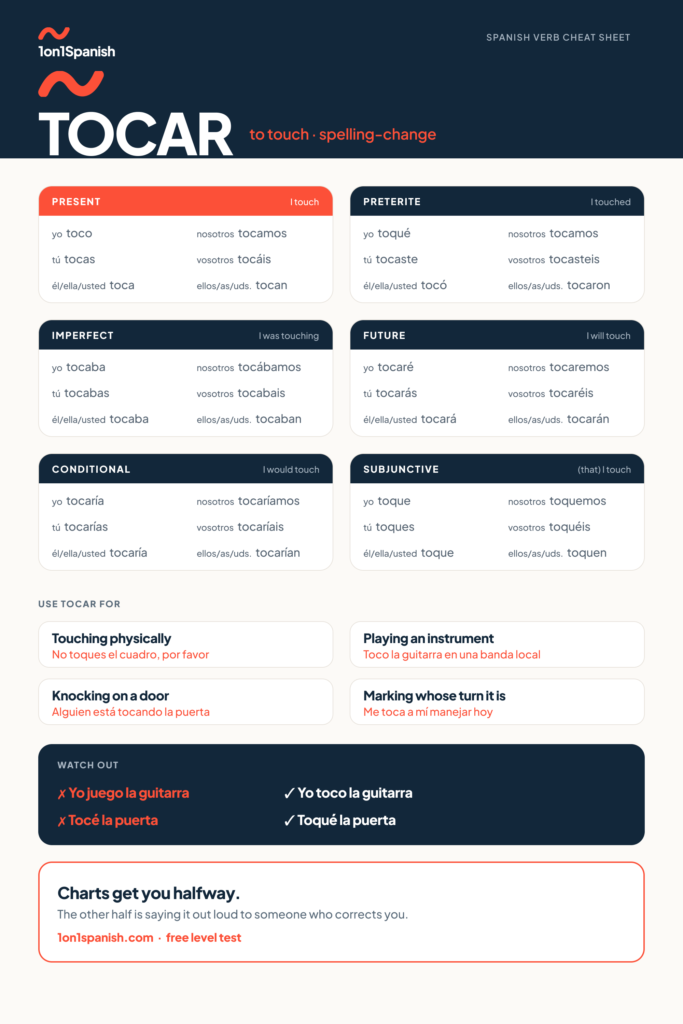
Take the chart with you
The chart is free to view and share. Drop your email and we’ll send the print-ready US Letter PDF — the version you stick on the fridge.
Practice
Practice tocar with a real teacher
Charts get you halfway. The other half is saying it out loud to someone who corrects you on the spot. At 1on1Spanish you get 25-minute private lessons with a qualified native teacher, exercises built from the mistakes you make in class, and AI practice between lessons.
First month $1. No contracts, cancel anytime.
The fastest way to make this stick is to say it to someone. Learn Spanish online with a real teacher.
Take your free level testBuilt on RingTeacher's method — 700,000+ classes delivered since 2017, teaching English to Spanish speakers. Now in the other direction.
Frequently asked questions
Is tocar regular or irregular in Spanish?
Regular in meaning, with one spelling change: the c becomes qu whenever the ending starts with e, to keep the hard “k” sound of the infinitive. That affects the preterite yo form (toqué) and the entire present subjunctive (toque, toques, toquemos, toquéis, toquen). Every other tense follows the standard -ar pattern with no change at all.
What’s the difference between tocar and jugar?
Tocar is for playing an instrument: toco el piano. Jugar is for playing a game or sport: juego fútbol. English uses “play” for both, which is why this pair is one of the first Spanish-specific splits an English speaker has to learn — there’s no way to guess it from the translation.
How do you say “it’s my turn” in Spanish?
Me toca a mí, built the same way as me gusta: an indirect object pronoun plus tocar. Change the pronoun for other people — te toca a ti, le toca a él, nos toca a nosotros — and add what needs doing: te toca a ti lavar los platos.
What is the past tense of tocar in Spanish?
Two, depending on the shape of the action. The preterite — toqué, tocaste, tocó, tocamos, tocasteis, tocaron — is for one finished act: toqué la puerta y nadie salió. The imperfect — tocaba, tocabas, tocaba, tocábamos, tocabais, tocaban — is for a habit or a repeated action: tocaba el violín todos los días de niño.
Do I need the subjunctive of tocar in everyday conversation?
Yes, often after hopes and wishes. Toque appears after espero que (espero que toque bien) and after ojalá (ojalá que nos toque una buena mesa). It’s not advanced Spanish — it’s what comes out naturally when someone wishes you luck before a performance or a raffle.