
Spanish colors: the list, plus the agreement rule
Colors are adjectives in Spanish, and adjectives usually go after the noun and agree with its gender and number: un carro rojo, but una casa roja. That single rule — order plus agreement — is what makes colors sound natural or slightly off, more than the words themselves. At 1on1Spanish we practice colors inside real sentences with qualified native teachers in 25-minute one-on-one lessons.
Reviewed by María Jiménez — Licenciada en Filología Hispánica (BA in Hispanic Philology) · Updated Sep 2026
The core colors
Rojo (red), azul (blue), amarillo (yellow), verde (green), negro (black), blanco (white), gris (gray), morado or púrpura (purple), café or marrón (brown — café is the everyday word in Mexico, marrón the more general Latin American term), naranja (orange), and rosa or rosado (pink, both used; rosado changes for gender, rosa doesn’t).
Most of these end in -o or -a and follow the regular adjective pattern: rojo/roja, negro/negra, blanco/blanca. A smaller group ends in a consonant or -e and stays the same for both genders: azul, verde, gris — un carro azul, una blusa azul, no change either way.
Word order: the color comes after
In English, the color comes first: “a red car.” In Spanish, it comes after: un carro rojo, not un rojo carro. Putting the color before the noun isn’t wrong in every case — poetry and some set phrases do it for effect — but in everyday speech it reads as unnatural, almost like saying “a car red” would in English. The safe rule while learning: noun first, color second, always.
Agreement: the part that actually needs memorizing
A color adjective changes to match the noun it describes, in both gender and number: el carro rojo, la casa roja, los carros rojos, las casas rojas. This is where most learners slip, because English colors never change form — “red” stays “red” whether it describes one car or ten, a truck or a dress. It’s the same rule every Spanish adjective follows, and the full version of how Spanish adjectives agree covers the endings colors share with bonito or grande.
Three colors break the pattern on purpose: naranja, rosa and violeta come from nouns (orange the fruit, rose the flower, violet the flower) and stay invariable in most everyday usage — una camisa naranja, dos camisas naranja, no -s added even in the plural in the most common usage, though naranjas also appears and isn’t considered wrong. Treat them as fixed if you’re not sure: it’s the safer default and what you’ll hear most often. The fruit behind the first one, la naranja, is in our list of fruits in Spanish, where it is a noun and does take the plural.
Light and dark: claro and oscuro
To describe a shade, Spanish adds claro (light) or oscuro (dark) after the color, and the whole expression — color plus claro/oscuro — becomes invariable, which surprises people who just learned the agreement rule: una blusa azul claro, not azul clara, even though blusa is feminine. Once claro or oscuro is added, the shade phrase locks and stops agreeing with the noun. Verde oscuro, rojo claro, gris oscuro — all fixed, regardless of what they describe.
Quick reference
| English | Spanish | Example |
|---|---|---|
| red | rojo/roja | el carro rojo |
| blue | azul | la camisa azul |
| yellow | amarillo/amarilla | el sol amarillo |
| green | verde | la casa verde |
| black | negro/negra | los zapatos negros |
| white | blanco/blanca | la pared blanca |
| gray | gris | el gato gris |
| purple | morado/morada | la flor morada |
| brown | café / marrón | los ojos café |
| orange | naranja | la camisa naranja |
| pink | rosa / rosado(a) | el vestido rosa |
| light blue | azul claro | la puerta azul claro |
| dark green | verde oscuro | el suéter verde oscuro |
The ones that don’t work the way you’d expect
| Detail | What trips people up |
|---|---|
| naranja, rosa, violeta | Invariable in most everyday use — no -a/-o ending to change, even for feminine nouns |
| claro / oscuro | Once added to a color, the whole phrase stops agreeing: azul claro, never azul clara |
| café | Common everyday word for brown in Mexico, doesn’t change for gender or number: los ojos café |
| word order | Color goes after the noun in standard speech: un carro rojo, not un rojo carro |
| rosa vs rosado | Both mean pink; rosa is invariable, rosado/rosada agrees like a regular adjective |
Common mistakes English speakers make
Color adjectives follow the noun in Spanish, the opposite order from English.
Naranja doesn’t change for gender at all — resist the urge to make it agree.
Adding claro or oscuro locks the whole color phrase; it stops agreeing with the noun even though blusa is feminine.
Regular color adjectives do need the plural -s, even when the invariable ones like naranja don’t.
Café stays fixed regardless of the noun’s gender or number, the same as naranja.
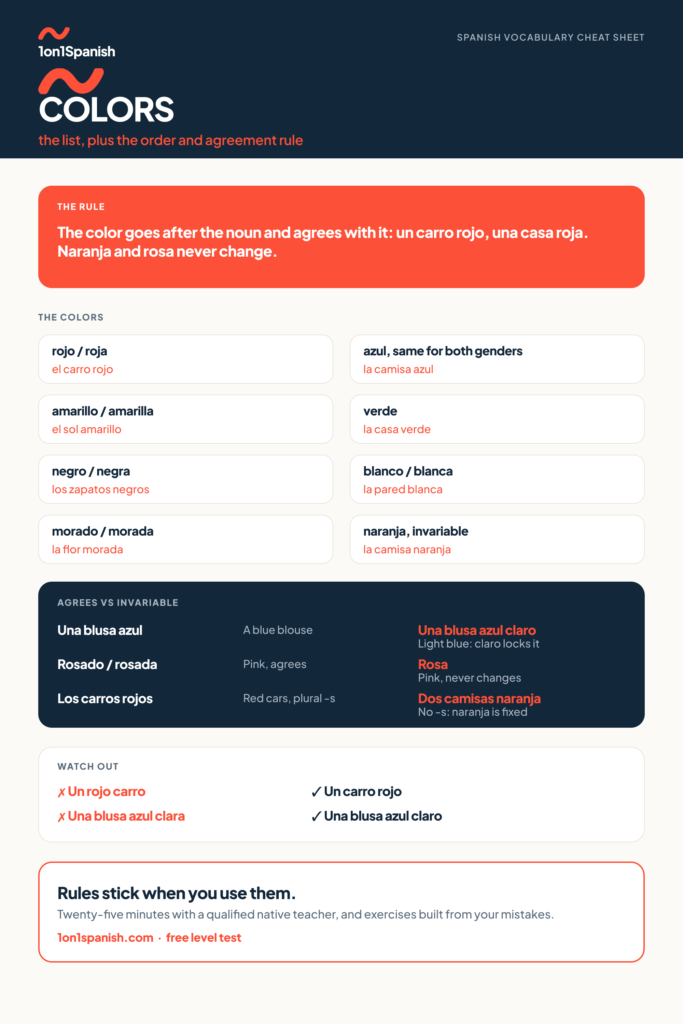
Take the chart with you
The chart is free to view and share. Drop your email and we’ll send the print-ready US Letter PDF — the version you stick on the fridge.
Practice
Practice Spanish colors with a real teacher
Charts get you halfway. The other half is saying it out loud to someone who corrects you on the spot. At 1on1Spanish you get 25-minute private lessons with a qualified native teacher, exercises built from the mistakes you make in class, and AI practice between lessons.
First month $1. No contracts, cancel anytime.
You can go further with someone listening: Learn Spanish with 1on1Spanish, 25 minutes at a time.
Take your free level testBuilt on RingTeacher's method — 700,000+ classes delivered since 2017, teaching English to Spanish speakers. Now in the other direction.
Frequently asked questions
How do you say colors in Spanish?
Rojo (red), azul (blue), amarillo (yellow), verde (green), negro (black), blanco (white), gris (gray), naranja (orange), rosa (pink), morado (purple). Most agree with the noun in gender and number — carro rojo, casa roja — while a handful, like azul and verde, stay the same for both genders because they don’t end in -o or -a.
Do Spanish colors change for gender and number?
Yes, most do. Colors ending in -o switch to -a for feminine nouns (rojo/roja) and add -s for plurals (rojos/rojas). Colors ending in a consonant or -e, like azul, verde and gris, only change for number, not gender: la camisa azul, las camisas azules. A small group — naranja, rosa, violeta — usually doesn’t change at all.
Why don’t naranja and rosa change like other colors?
Because they come from nouns — the orange fruit, the rose flower — not from adjectives built for agreement. In everyday Spanish they stay fixed regardless of the noun: una camisa naranja, dos camisas naranja. You’ll also see naranjas and rosas used as plurals in some regions, but the invariable form is the safer, more common choice.
How do you say light blue or dark green in Spanish?
Add claro (light) or oscuro (dark) after the color: azul claro, verde oscuro. The surprise is that once you add claro or oscuro, the whole phrase stops agreeing with the noun, even if the color alone normally would: una blusa azul claro, not azul clara, despite blusa being feminine.
What’s the everyday word for brown in Mexican Spanish?
Café, the same word as the drink, is the everyday term for brown across Mexico and much of Latin America — los ojos café, el pelo café. Marrón also means brown and is understood everywhere, but it reads slightly more formal or is more associated with Spain. Neither changes for gender or number.