
Fruits in Spanish: names, genders and regional words
Fruit vocabulary looks like the easiest kind of Spanish to learn, until you order melocotón in Mexico City and get a blank look, because the fruit you’re pointing at is a durazno there. Fruit names are some of the most regional words in the language — more than colors, more than numbers — so this page gives you the word that’s used across most of the United States’ Spanish-speaking population, which traces mostly to Mexico, and flags where another country says it differently. At 1on1Spanish you’ll hear real vocabulary from a qualified native teacher in every 25-minute lesson, not just the textbook default.
Reviewed by María Jiménez — Licenciada en Filología Hispánica (BA in Hispanic Philology) · Updated Sep 2026
The everyday fruit bowl
La manzana is apple, la naranja is orange, el plátano is banana in most of Latin America (Spain and parts of the Caribbean say la banana instead — see the risk table below). La uva is grape, almost always plural in conversation: las uvas. La fresa is strawberry, la sandía watermelon, el melón cantaloupe or melon depending on context, la piña pineapple, el mango mango — one of the few fruit names that’s identical in both languages.
El durazno is peach in Mexico and most of Latin America; el melocotón is the word you’ll hear in Spain and occasionally in the Caribbean. La pera is pear, la cereza cherry, el limón lime in Latin America — Spanish flips the expected pairing, since la lima is the less common word here, while in Spain limón means the yellow lemon and lima the green lime, the opposite of common Latin American usage.
The ones people get wrong on purpose or by habit
El aguacate (avocado) causes an argument every semester: is it a fruit or a vegetable? Botanically a fruit, and Spanish treats it that way — it’s just usually grouped with vegetables on a menu. El coco is coconut, la papaya is papaya almost everywhere, though in some Caribbean countries it’s avoided in casual speech because of a vulgar secondary meaning — fruta bomba is the safe alternative in Cuba. El tomate (tomato) is botanically a fruit too, and Spanish doesn’t pretend otherwise the way English casually does. Both of them, along with the rest of what actually lands in the vegetable aisle, are in our Spanish vegetable vocabulary.
Gender: mostly predictable, a few exceptions
Fruit names ending in -a are usually feminine (la manzana, la naranja, la fresa) and those ending in -o are usually masculine (el mango, el limón, el coco). The tree it grows on often takes the opposite pattern and the masculine ending: la naranja (the orange) comes from el naranjo (the orange tree). The clearest exception is la mano — not a fruit, but the reminder that “-o = masculine” isn’t a law, it’s a strong pattern. The full set of noun gender rules, including the endings that reliably break the -o/-a pattern, is on its own page.
Quick reference
| English | Spanish (Latin American default) | Regional variant |
|---|---|---|
| apple | la manzana | — |
| orange | la naranja | — |
| banana | el plátano | la banana (Spain, parts of Caribbean) |
| grape | la uva | — |
| strawberry | la fresa | — |
| watermelon | la sandía | — |
| pineapple | la piña | — |
| mango | el mango | — |
| peach | el durazno | el melocotón (Spain) |
| pear | la pera | — |
| cherry | la cereza | — |
| lime | el limón | la lima (Spain, where limón means lemon) |
| avocado | el aguacate | la palta (Argentina, Chile, Peru) |
| coconut | el coco | — |
| papaya | la papaya | la fruta bomba (Cuba) |
| tomato | el tomate | el jitomate (central Mexico) |
| blackberry | la mora | — |
| raspberry | la frambuesa | — |
| fig | el higo | — |
| passion fruit | el maracuyá | la parchita (Venezuela) |
Where the word actually changes
This is the real risk with fruit vocabulary: the same fruit, a different word, and no warning before you say the wrong one to the wrong person. The same split runs through meals and food in Spanish, where lunch itself changes name between Mexico and the rest of Latin America.
| Word | The situation |
|---|---|
| durazno / melocotón | Durazno is what you’ll hear from most teachers here, since Mexican Spanish is the majority variety in the US. Melocotón isn’t wrong — it’s Spain’s word — but using it with a Mexican audience marks you as having learned from a European source |
| plátano / banana / guineo | Plátano covers both the sweet banana and the starchy plantain in much of Latin America, which can be confusing; some countries use banana for the fruit and reserve plátano for the plantain. Guineo shows up in the Caribbean and Central America |
| aguacate / palta | Aguacate everywhere north of Peru; palta takes over in Argentina, Chile and Peru. Neither is more correct — they’re regional defaults |
| jitomate / tomate | Tomate is universal and always understood. Jitomate is a Nahuatl-derived regionalism specific to central Mexico, worth recognizing even if you don’t use it |
Common mistakes English speakers make
In much of Latin America, plátano alone usually means the sweet yellow banana; plátano macho or plátano verde specifies the starchy cooking plantain. Assuming it’s always the starchy one confuses grocery lists and recipes.
Not wrong Spanish — just the wrong region for who you’re talking to.
The tree is often the opposite gender from its fruit; don’t assume they match.
A Mexican recipe says aguacate; a Chilean or Argentine one says palta for the exact same fruit — neither is a typo.
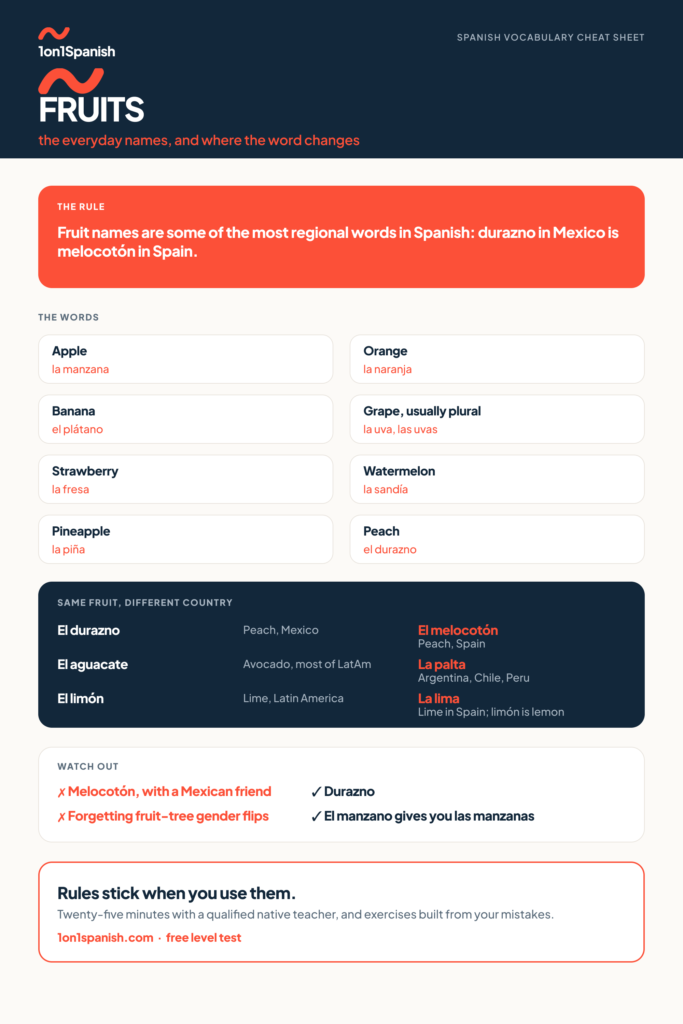
Take the chart with you
The chart is free to view and share. Drop your email and we’ll send the print-ready US Letter PDF — the version you stick on the fridge.
Practice
Practice fruits in Spanish with a real teacher
Charts get you halfway. The other half is saying it out loud to someone who corrects you on the spot. At 1on1Spanish you get 25-minute private lessons with a qualified native teacher, exercises built from the mistakes you make in class, and AI practice between lessons.
First month $1. No contracts, cancel anytime.
Grammar you can read. Speaking you cannot. Learn Spanish online and practice it live.
Take your free level testBuilt on RingTeacher's method — 700,000+ classes delivered since 2017, teaching English to Spanish speakers. Now in the other direction.
Frequently asked questions
What is the word for banana in Spanish?
Plátano is the word you’ll hear most often, especially from teachers and speakers whose Spanish traces back to Mexico or Central America — the majority variety in the United States. In Spain and parts of the Caribbean, banana is common instead. Complicating things further, plátano can also mean the starchy cooking plantain, so context or a follow-up question sometimes matters.
Is durazno or melocotón correct for peach?
Both are correct Spanish; they’re regional, not right versus wrong. Durazno is what you’ll hear across most of Latin America, including Mexico. Melocotón is Spain’s word for the same fruit. If you’re learning the variety spoken by most Hispanic communities in the US, durazno is the one to default to.
Why does the same fruit have different names in different countries?
Spanish spread across a huge geographic area over centuries, and local vocabulary — sometimes from Indigenous languages like Nahuatl or Quechua, sometimes just regional drift — filled in gaps for foods that arrived at different times through different ports. Avocado, for example, keeps its Nahuatl-derived name aguacate in most of Latin America but shifts to the Quechua-derived palta in Argentina, Chile and Peru.
Is aguacate a fruit in Spanish, or a vegetable?
Botanically, and grammatically, a fruit — Spanish doesn’t have a separate category for it. It’s just usually grouped with vegetables on a menu or a grocery list because of how it’s eaten, the same casual mismatch English has with tomatoes.
How do I know the gender of a fruit name in Spanish?
Most fruit names ending in -a are feminine (la manzana, la fresa) and most ending in -o are masculine (el mango, el coco), but the tree the fruit grows on often takes the opposite ending and gender: la naranja comes from el naranjo. It’s a strong pattern, not an absolute rule, so a handful of names — like la mano, not a fruit but a reminder — break it.