
Spanish directions vocabulary: derecho vs derecha
Giving or understanding directions in Spanish depends on one pair of words that look and sound almost identical and mean two completely different things: derecho (straight ahead) and derecha (right, as opposed to left). Get them backward and you send someone the wrong way at every corner. At 1on1Spanish we practice directions out loud with qualified native teachers in 25-minute one-on-one lessons, with a stranger on the street, not a script.
Reviewed by María Jiménez — Licenciada en Filología Hispánica (BA in Hispanic Philology) · Updated Sep 2026
Derecho vs. derecha: the mix-up that actually costs you
Derecho means straight ahead: siga derecho (go straight), todo derecho (straight the whole way). Derecha means the right side: a la derecha (to the right), doble a la derecha (turn right). They come from the same root and differ by one letter, and confusing them doesn’t just sound wrong — it sends a real person in the wrong direction, unlike most vocabulary mistakes, which just sound off. The safe way to keep them apart while learning: derecho by itself, no article, means “straight.” A la derecha / a la izquierda, with the article, means a side.
Izquierda (left) doesn’t have this problem — there’s no competing word that sounds similar — so most of the confusion concentrates entirely on the derecho/derecha pair.
The imperative: how directions actually get given
Directions in Spanish are almost always commands, using the imperative form of the verb, and which form you use depends on how you’re addressing the person. With a stranger — the default when asking for or giving directions to someone you don’t know — Spanish uses usted, the formal “you”: siga (continue/go), doble or gire (turn), cruce (cross), camine (walk). Siga derecho dos cuadras y doble a la izquierda (Go straight two blocks and turn left). The forms above are all built the same way, and our guide to Spanish imperative commands shows how to make the usted version of any verb, not just these four.
With someone you know well, the informal command shifts: sigue, dobla, cruza, camina — same meaning, different form. Defaulting to usted with a stranger on the street is the safer choice; it’s respectful and never wrong, while using the informal command with someone you just met can land as too familiar, depending on the country and context.
The pieces you build a direction with
Beyond the core verbs, directions lean on a small set of landmarks and connectors: la cuadra (city block — camine dos cuadras, walk two blocks), la esquina (corner — en la esquina, at the corner), el semáforo (traffic light), la calle (street), la avenida (avenue), enfrente de (in front of, facing), al lado de (next to), detrás de (behind), entre (between). Está enfrente del banco, al lado de la farmacia (It’s across from the bank, next to the pharmacy) is a typical, complete answer. Those location phrases, enfrente de, al lado de, entre, are the everyday end of Spanish prepositions, and they follow the same de pattern outside of directions too.
Quick reference
| English | Spanish | Example |
|---|---|---|
| straight ahead | derecho | Siga derecho. |
| right (side) | a la derecha | Doble a la derecha. |
| left (side) | a la izquierda | Doble a la izquierda. |
| block | la cuadra | Camine dos cuadras. |
| corner | la esquina | Está en la esquina. |
| traffic light | el semáforo | Doble en el semáforo. |
| in front of | enfrente de | Enfrente del banco. |
| next to | al lado de | Al lado de la farmacia. |
| behind | detrás de | Detrás del edificio. |
| between | entre | Entre la calle 5 y la 6. |
The ones that don’t work the way you’d expect
| Detail | What trips people up |
|---|---|
| derecho vs derecha | derecho (straight) has no article; a la derecha (right side) always does |
| usted for strangers | The default form for directions with someone you don’t know — safer than the informal |
| siga vs sigue | siga (usted) vs sigue (tú) — same verb, different level of formality |
| cuadra | Not always literally a US city block — length varies by country, but it’s the standard unit for walking directions |
| todo derecho | An intensified version of derecho, meaning “straight the entire way,” not a different direction |
Common mistakes English speakers make
Derecha takes the article and refers to the side; derecho alone means straight and never follows a la.
Adding a la before derecho turns “straight” into something closer to “toward the right,” reversing the instruction.
The informal command can come across as overly familiar with a stranger.
Bloque is understood but cuadra is the standard word for a city block in directions across Latin America.
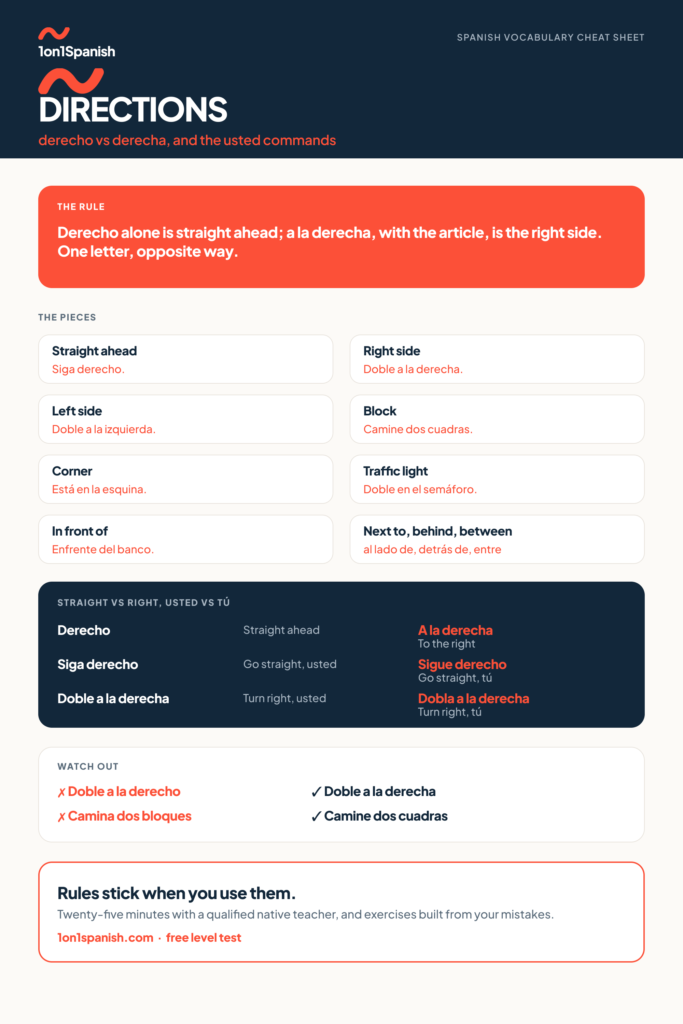
Take the chart with you
The chart is free to view and share. Drop your email and we’ll send the print-ready US Letter PDF — the version you stick on the fridge.
Practice
Practice Spanish directions with a real teacher
Charts get you halfway. The other half is saying it out loud to someone who corrects you on the spot. At 1on1Spanish you get 25-minute private lessons with a qualified native teacher, exercises built from the mistakes you make in class, and AI practice between lessons.
First month $1. No contracts, cancel anytime.
Guides help. A teacher hears what a guide cannot — Learn Spanish online with a real teacher.
Take your free level testBuilt on RingTeacher's method — 700,000+ classes delivered since 2017, teaching English to Spanish speakers. Now in the other direction.
Frequently asked questions
What’s the difference between derecho and derecha in Spanish?
Derecho, without an article, means straight ahead: siga derecho, go straight. Derecha, almost always with the article — a la derecha — means the right side, as opposed to left: doble a la derecha, turn right. They come from the same root, sound very similar, and mixing them up sends a real person the wrong way, which makes this the highest-stakes vocabulary pair in the topic.
How do you ask for directions politely in Spanish?
With usted, the formal “you,” since directions are usually exchanged between strangers: Disculpe, ¿cómo llego a la estación? (Excuse me, how do I get to the station?). Commands given back also use the usted form — siga, doble, cruce — which is the safe, respectful default with someone you don’t know.
How do you say “turn right” and “turn left” in Spanish?
Doble a la derecha (turn right) and doble a la izquierda (turn left), using the usted command form of doblar. Gire works the same way and is common in some countries. With someone you know well, the informal equivalents are dobla a la derecha and dobla a la izquierda.
What does “siga derecho” mean?
“Go straight” or “continue straight ahead.” Siga is the usted command form of seguir (to continue), and derecho here means straight, not right — a common point of confusion, since derecho looks related to derecha (right) but functions completely differently in this phrase.
What is a cuadra in Spanish directions?
La cuadra is a city block, the standard unit used in walking or driving directions across Latin America: camine tres cuadras (walk three blocks). The exact length varies by city and country, the same way a “block” isn’t a fixed measurement in English either — it’s a practical unit, not a precise one.