
House vocabulary in Spanish: the words that change
Talking about a house in Spanish means learning some words twice: the same room or piece of furniture often has two, sometimes three, completely different names depending on the country. This list starts with Mexican Spanish, the variety spoken by the largest Hispanic community in the United States, and flags the alternatives you’ll hear elsewhere. At 1on1Spanish we teach house vocabulary with qualified native teachers in 25-minute one-on-one lessons.
Reviewed by María Jiménez — Licenciada en Filología Hispánica (BA in Hispanic Philology) · Updated Sep 2026
The house itself: apartment, floor, and what to call them
El apartamento is understood everywhere, but el departamento — often shortened to el depa in casual Mexican speech — is the everyday word in Mexico. Spain prefers el piso, which in Mexican Spanish instead means a building floor or story: vivo en el segundo piso de mi edificio (I live on the second floor of my building), not the apartment itself. La casa is a house, standalone, no ambiguity there.
That segundo in el segundo piso is an ordinal, and floors are one of the few places you’ll use one past the first few: el primer piso, el tercer piso, but el piso doce once you get high enough. The short forms and where they stop are in our guide to Spanish ordinal numbers.
Rooms: recámara, cuarto, habitación, dormitorio
This is where the topic gets genuinely regional. A bedroom has at least three common names: la recámara (the standard word in Mexico), el cuarto (used across most of Latin America, also the general word for “room” of any kind, so context matters), la habitación (common in Spain and understood everywhere, also more formal), and el dormitorio (also widely understood, slightly more formal or written). None of these is wrong; they’re regional defaults, and Mexican Spanish points to recámara or cuarto as the words you’ll hear most in the United States.
Other rooms are steadier across regions: la cocina (kitchen), la sala (living room, also el salón in some countries), el baño (bathroom), el comedor (dining room), el patio (yard or patio), el garaje (garage).
Furniture and fixtures
La cama (bed), la mesa (table), la silla (chair), el sofá (sofa/couch), el refrigerador (refrigerator — the standard everyday word across Latin America; nevera is more common in Spain and parts of the Caribbean), la estufa (stove), el clóset (closet, adapted from English and common in Mexico) or el armario (wardrobe/closet elsewhere), las cortinas (curtains), la lámpara (lamp), el espejo (mirror).
Learn each of these with its article attached. El refrigerador and la nevera name the same appliance with opposite genders, so the word carries the gender with it, and every adjective you add later has to match. The endings that predict it are in our guide to the gender of Spanish nouns.
Alberca vs. piscina: the pool word that flags where you learned Spanish
La alberca is the word for swimming pool in Mexico; la piscina is used across most of the rest of Latin America and Spain. Both are correctly understood everywhere, but which one you reach for automatically tells a native speaker where your Spanish comes from — the same way “soda” versus “pop” does in English. For a site teaching Mexican-first Spanish, alberca is the primary form, with piscina noted as the word you’ll hear traveling elsewhere.
Quick reference (Mexican Spanish first)
| English | Mexican Spanish | Also heard as |
|---|---|---|
| apartment | el departamento (el depa) | el apartamento, el piso (Spain) |
| bedroom | la recámara | el cuarto, la habitación, el dormitorio |
| kitchen | la cocina | — |
| living room | la sala | el salón |
| bathroom | el baño | — |
| swimming pool | la alberca | la piscina |
| refrigerator | el refrigerador | la nevera (Spain, Caribbean) |
| closet | el clóset | el armario |
| floor (of a building) | el piso | — |
| bed | la cama | — |
The ones that don’t work the way you’d expect
| Detail | What trips people up |
|---|---|
| piso | Means “floor/story” in Mexico, but “apartment” in Spain — same word, different meaning by country |
| cuarto | Can mean “bedroom” specifically or “room” generally — context decides which |
| refrigerador | The regular Latin American word; switching to nevera also switches the gender pattern to remember (el refrigerador, la nevera) |
| depa | Casual, spoken shortening of departamento — fine with friends, less so in writing |
| alberca vs piscina | Not a mistake either way, but signals which region’s Spanish you learned |
Common mistakes English speakers make
In Mexican Spanish, piso is the floor level, not the unit itself — the two ideas need separate words.
Swapping one regional word for another also means swapping the article that goes with it.
El cuarto de baño is the bathroom, not a bedroom — the word alone isn’t specific.
Neither one is more standard Spanish than the other — they mark geography, not correctness.
Loanwords like clóset are standard, everyday Mexican Spanish, not a mistake to avoid.
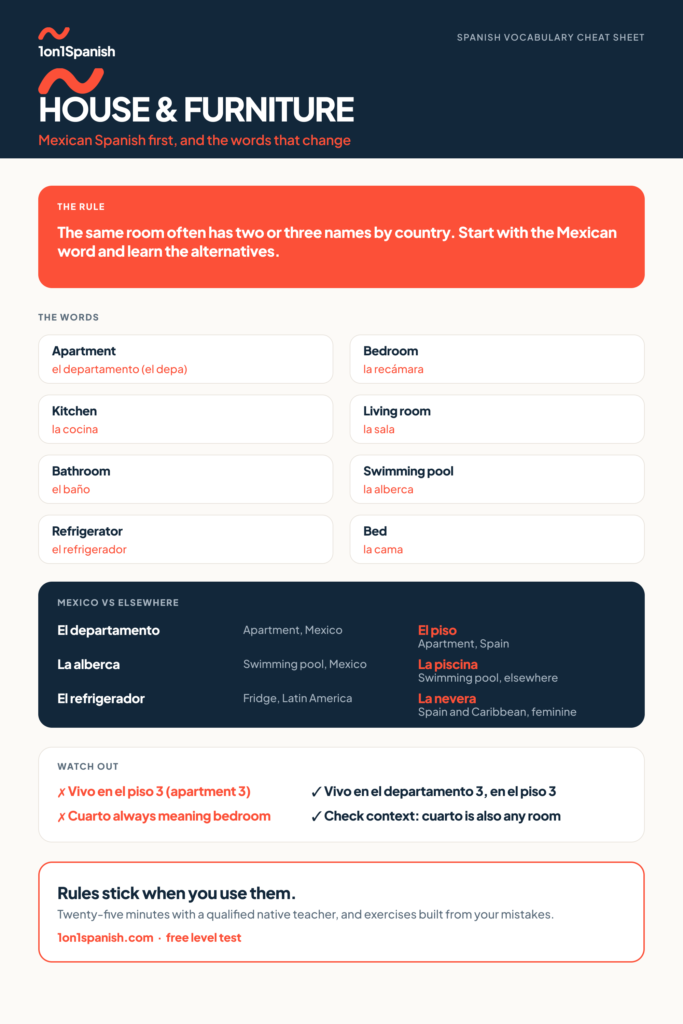
Take the chart with you
The chart is free to view and share. Drop your email and we’ll send the print-ready US Letter PDF — the version you stick on the fridge.
Practice
Practice house vocabulary in Spanish with a real teacher
Charts get you halfway. The other half is saying it out loud to someone who corrects you on the spot. At 1on1Spanish you get 25-minute private lessons with a qualified native teacher, exercises built from the mistakes you make in class, and AI practice between lessons.
First month $1. No contracts, cancel anytime.
The fastest way to make this stick is to say it to someone. Learn Spanish online with a real teacher.
Take your free level testBuilt on RingTeacher's method — 700,000+ classes delivered since 2017, teaching English to Spanish speakers. Now in the other direction.
Frequently asked questions
What is the Mexican Spanish word for apartment?
El departamento, often shortened to el depa in casual speech. El apartamento is also understood everywhere and used more in some other countries. In Spain, the word for apartment shifts to el piso, which in Mexican Spanish instead refers to a building’s floor level, not the unit itself — a common source of confusion.
What are the different words for bedroom in Spanish?
At least three common ones: la recámara (the standard word in Mexico), el cuarto (widely used across Latin America, though it can also just mean “room” generally), and la habitación (common in Spain, understood everywhere, slightly more formal). None is incorrect — they’re regional defaults, with recámara and cuarto the ones you’ll hear most from Mexican Spanish speakers in the US.
Is it alberca or piscina for swimming pool?
Both mean swimming pool and both are correct. Alberca is the word used in Mexico; piscina is used across most of the rest of Latin America and in Spain. Which one you use naturally signals where your Spanish comes from, similar to regional word choices in English, without either one being more “correct” Spanish.
What’s the word for refrigerator in Spanish?
El refrigerador is the standard, everyday word across Mexico and most of Latin America. La nevera means the same thing and is more common in Spain and parts of the Caribbean. They take different genders — el refrigerador, la nevera — so the article has to change along with the word.
Why does piso mean different things in different countries?
In Mexico, piso refers to a building’s floor or story — vivo en el segundo piso means “I live on the second floor.” In Spain, piso commonly means the apartment or flat itself, not just the level it’s on. Both uses come from the same root idea of a “level” or “unit,” but they diverged regionally, so context and country matter when you hear the word.