
Spanish ordinal numbers: 1st to 10th, and beyond
Ordinal numbers behave like adjectives in Spanish, which means they agree with the noun they describe and two of them — primero and tercero — shorten before a masculine singular noun. Past ten, native speakers mostly stop using ordinals altogether and switch to the plain number, which is the part textbooks rarely mention. At 1on1Spanish we teach ordinals the way people actually use them, with qualified native teachers in 25-minute one-on-one lessons.
Reviewed by María Jiménez — Licenciada en Filología Hispánica (BA in Hispanic Philology) · Updated Sep 2026
First to tenth
Primero, segundo, tercero, cuarto, quinto, sexto, séptimo, octavo, noveno, décimo.
Each one is an adjective, so it changes for gender and number: primero becomes primera for a feminine noun (la primera vez, the first time) and primeros/primeras for plurals (los primeros días, the first days). Séptimo and noveno are the two most often mispronounced — séptimo keeps the written accent on the first syllable, and noveno, not nono, is the form used across Latin America today.
There’s nothing special about ordinals here: the ending follows the noun the same way it does for any adjective in Spanish, and the pattern is laid out in our guide to how adjectives agree in Spanish.
Primero and tercero: the ones that shorten
This is the detail that separates someone who memorized a list from someone who speaks the language. Primero and tercero drop their final -o to become primer and tercer right before a masculine singular noun: el primer día (the first day), not el primero día. Put anything else between the ordinal and the noun, or use it with a feminine or plural noun, and the full form comes back: la primera clase, los primeros meses, es el primero de la fila (he’s first in line, standing alone, no noun after it).
Primer and tercer are not the only words that do this. Bueno becomes buen and grande becomes gran under similar conditions, and the short list of adjectives that shorten is in our Spanish adjectives guide.
Tercer works the same way: el tercer piso (the third floor), but la tercera puerta (the third door) and es el tercero (he’s third) when nothing follows.
Past ten, most people just say the number
Spanish has ordinals all the way up — undécimo, duodécimo, decimotercero — but almost nobody uses them in daily speech past décimo. A Mexican coworker describing a building doesn’t say vivo en el decimosegundo piso; they say vivo en el piso doce — “I live on floor twelve,” cardinal number after the noun, no ordinal at all. This pattern holds for floors, chapters, race positions, anniversaries: past ten, reach for the plain number placed after the noun, and you’ll sound more natural than someone reciting decimoquinto.
That means past ten, what you need is not more ordinals but a solid command of the cardinal numbers from 1 to 100: el piso doce, el capítulo veintitrés, el aniversario cuarenta.
Two contexts keep ordinals alive past ten anyway: kings and popes, always ordinal in formal and historical Spanish — Juan Carlos I is read Juan Carlos Primero, Felipe VI is Felipe Sexto — and centuries, written in Roman numerals and read as ordinals through décimo and cardinals after: el siglo XX is el siglo veinte (cardinal), while el siglo IX is el siglo noveno (ordinal), because the crossover point is ten.
Quick reference
| # | Spanish | Shortened form |
|---|---|---|
| 1st | primero | primer (before masc. sing. noun) |
| 2nd | segundo | — |
| 3rd | tercero | tercer (before masc. sing. noun) |
| 4th | cuarto | — |
| 5th | quinto | — |
| 6th | sexto | — |
| 7th | séptimo | — |
| 8th | octavo | — |
| 9th | noveno | — |
| 10th | décimo | — |
The ones that don’t work the way you’d expect
| Detail | What trips people up |
|---|---|
| primero / primer | Only shortens directly before a masculine singular noun: el primer paso, but el paso primero keeps the full form |
| tercero / tercer | Same rule as primero: el tercer intento, but es el tercero on its own |
| past ten | Almost never used in speech — el piso doce, not el decimosegundo piso |
| centuries | Read as ordinals only through the 10th; siglo XI onward is read as a cardinal number |
| kings and popes | Stay ordinal past ten in formal Spanish: Alfonso XIII is Alfonso Trece, still ordinal in meaning even though it sounds like the cardinal |
Common mistakes English speakers make
Before a masculine singular noun, primero drops the -o. This is the single most common ordinal mistake, because English “first floor” has nothing to shorten.
Same rule, same trap — tercero shortens to tercer under the identical condition.
Technically correct, but no native speaker says it. Past ten, the cardinal number after the noun is what you’ll actually hear.
Centuries above ten use the cardinal number, not a rare ordinal form few native speakers would even recognize on sight.
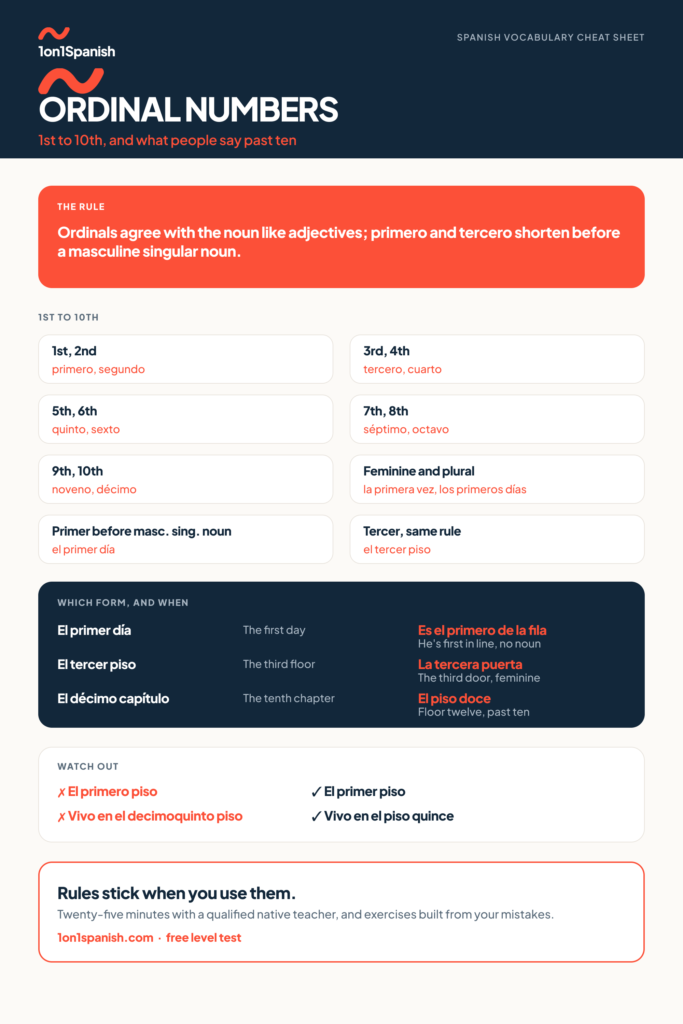
Take the chart with you
The chart is free to view and share. Drop your email and we’ll send the print-ready US Letter PDF — the version you stick on the fridge.
Practice
Practice Spanish ordinal numbers with a real teacher
Charts get you halfway. The other half is saying it out loud to someone who corrects you on the spot. At 1on1Spanish you get 25-minute private lessons with a qualified native teacher, exercises built from the mistakes you make in class, and AI practice between lessons.
First month $1. No contracts, cancel anytime.
These guides are free. When you want someone correcting you out loud, learn Spanish online with a qualified native teacher.
Take your free level testBuilt on RingTeacher's method — 700,000+ classes delivered since 2017, teaching English to Spanish speakers. Now in the other direction.
Frequently asked questions
What are the Spanish ordinal numbers 1 through 10?
Primero, segundo, tercero, cuarto, quinto, sexto, séptimo, octavo, noveno, décimo. Like other Spanish adjectives, they agree with the noun in gender and number: primero becomes primera before a feminine noun. Two of them, primero and tercero, also shorten to primer and tercer right before a masculine singular noun.
When does primero become primer?
Only directly in front of a masculine singular noun: el primer día, el primer paso. If anything comes between the ordinal and the noun, or if the noun is feminine or plural, the full form primero returns: el paso primero, la primera semana, los primeros años. Standing alone with no noun, it’s also primero: llegó primero, he arrived first.
Do Spanish speakers use ordinal numbers past ten?
Rarely, in everyday speech. Ordinals technically exist up to any number, but past décimo (tenth), native speakers switch to the plain cardinal number placed after the noun: el piso doce (floor twelve), not el duodécimo piso. Ordinals past ten survive mainly in formal writing, legal text, and titles for kings and popes.
How are ordinal numbers used with kings and centuries?
Royal names stay ordinal even past ten, though they’re written as Roman numerals and read as ordinal numbers: Felipe VI is spoken Felipe Sexto, Alfonso XIII is Alfonso Trece — still functioning as an ordinal despite matching the cardinal word. Centuries follow a different cutoff: el siglo IX reads as ordinal (noveno), but el siglo XX reads as a plain cardinal number, veinte.
What’s the difference between spanish ordinal numbers and cardinal numbers?
Cardinal numbers count — uno, dos, tres — and ordinal numbers rank — primero, segundo, tercero. Cardinals don’t change form based on gender; ordinals do, because they act as adjectives. In practice, Spanish leans on cardinals more than English does: past ten, a floor, a chapter, or a place in line is almost always given with the cardinal number, not the ordinal.