
Nationalities in Spanish: gentilicios and gender
A nationality word in Spanish — a gentilicio — is an adjective, not a proper noun the way it is in English. That single difference explains almost every mistake English speakers make with it: the wrong capital letter, the missing feminine form, and the assumption that americano means the same thing it does in English. At 1on1Spanish we practice this exact vocabulary with qualified native teachers in 25-minute one-on-one lessons.
Reviewed by María Jiménez — Licenciada en Filología Hispánica (BA in Hispanic Philology) · Updated Sep 2026
Lowercase, because it’s an adjective
English capitalizes nationalities: “I’m American,” “she’s Mexican.” Spanish doesn’t — soy estadounidense, ella es mexicana, both lowercase, because a gentilicio is a regular adjective, grammatically no different from alto or simpático. Capitalizing it isn’t a serious error, but it’s an immediate, visible sign that a sentence was translated from English rather than written in Spanish. The rule is simple once it’s named: nationalities only get a capital letter at the start of a sentence, the same as colors, months, or any other common adjective.
The same lowercase rule covers months, days of the week and languages, so hablo español and nací en enero follow it too. If you want the whole list in one place, our guide to what Spanish capitalizes has it, including the cases where English and Spanish agree.
Gender and number: it agrees like any adjective
Because gentilicios are adjectives, they change for gender and number, the same way rojo becomes roja. Mexicano/mexicana, colombiano/colombiana, español/española, alemán/alemana — most nationalities ending in a consonant add -a for the feminine form, which is easy to miss coming from English, where “German” and “Mexican” never change regardless of who they describe.
The mechanics are exactly the ones in our adjective agreement guide: the ending matches the noun, and nationalities are the group where a consonant ending does take a feminine -a, which ordinary adjectives like fácil or azul never do.
A meaningful group doesn’t change at all: nationalities ending in -ense or -a are invariable for gender. Estadounidense (American, from the United States) is the clearest example — un hombre estadounidense, una mujer estadounidense, identical form either way. Canadiense and costarricense work the same way. The plural still applies normally: los estadounidenses, las mexicanas.
Americano doesn’t mean what it looks like
This is the false friend that causes the most confusion. In English, “American” defaults to meaning “from the United States.” In Spanish, americano is broader: it technically refers to anyone from the Americas — North, Central, or South — because América names the whole continent in Spanish, not just the US. Using americano to mean specifically “from the United States” can sound imprecise or even presumptuous to someone from, say, Argentina or Canada, who is also, strictly speaking, americano.
The precise, standard word for “from the United States” is estadounidense. It’s the word this site uses, and the one that avoids any ambiguity: soy estadounidense says exactly what “I’m American” means in everyday English, without claiming the whole continent.
Quick reference
| Country | Nationality (m.) | Nationality (f.) |
|---|---|---|
| United States | estadounidense | estadounidense |
| Mexico | mexicano | mexicana |
| Spain | español | española |
| Colombia | colombiano | colombiana |
| Argentina | argentino | argentina |
| Germany | alemán | alemana |
| Canada | canadiense | canadiense |
| Costa Rica | costarricense | costarricense |
| Peru | peruano | peruana |
| Cuba | cubano | cubana |
The ones that don’t work the way you’d expect
| Detail | What trips people up |
|---|---|
| lowercase | Nationalities are adjectives, so they’re never capitalized mid-sentence |
| -ense endings | Invariable for gender: estadounidense, canadiense, costarricense stay the same |
| alemán → alemana | Loses the accent when the feminine -a is added: alemán, but alemana |
| americano | Means “from the Americas” broadly, not specifically “from the US” |
| americano vs estadounidense | estadounidense is the precise, unambiguous word for “from the United States” |
Common mistakes English speakers make
Nationalities are lowercase mid-sentence in Spanish, the same as months and days of the week.
Feminine nouns need the agreeing form — alemán is masculine, alemana is feminine, and the accent drops when the -a is added.
Americano technically includes the whole continent; estadounidense says specifically “from the United States” without ambiguity.
The article still needs to agree even when the nationality itself doesn’t change — estadounidense is invariable, but una/un isn’t.
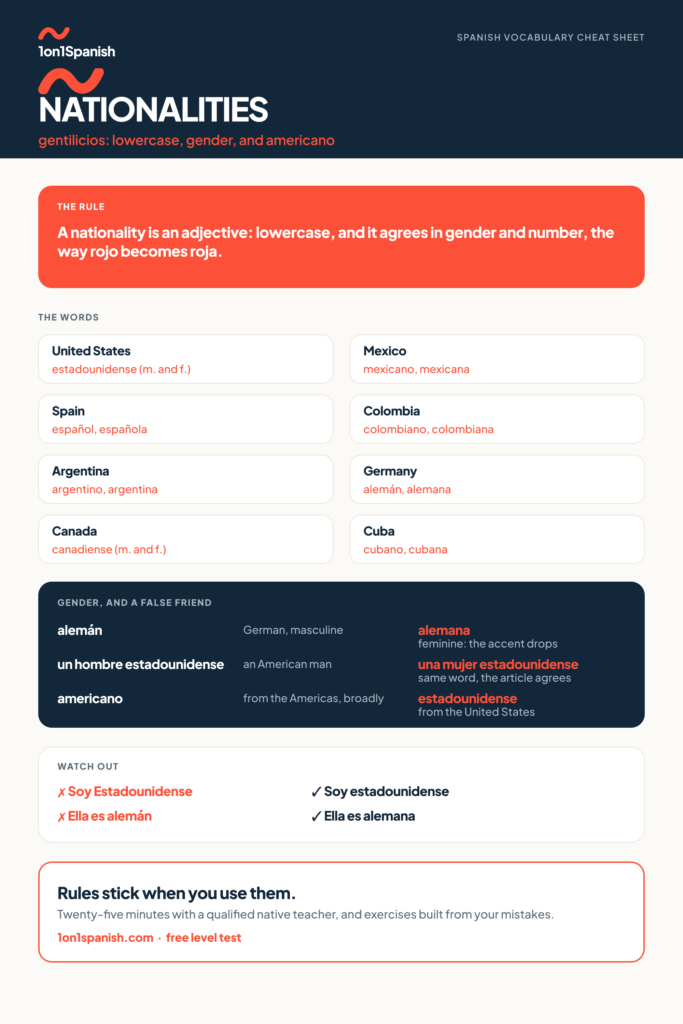
Take the chart with you
The chart is free to view and share. Drop your email and we’ll send the print-ready US Letter PDF — the version you stick on the fridge.
Practice
Practice nationalities in Spanish with a real teacher
Charts get you halfway. The other half is saying it out loud to someone who corrects you on the spot. At 1on1Spanish you get 25-minute private lessons with a qualified native teacher, exercises built from the mistakes you make in class, and AI practice between lessons.
First month $1. No contracts, cancel anytime.
You can go further with someone listening: Learn Spanish with 1on1Spanish, 25 minutes at a time.
Take your free level testBuilt on RingTeacher's method — 700,000+ classes delivered since 2017, teaching English to Spanish speakers. Now in the other direction.
Frequently asked questions
Are nationalities capitalized in Spanish?
No. Unlike English, Spanish treats nationalities as regular adjectives, not proper nouns, so they’re lowercase mid-sentence: soy mexicano, ella es española. They only get a capital letter if they happen to start a sentence, the same rule that applies to months and days of the week.
Do Spanish nationalities have a feminine form?
Most do. Nationalities ending in a consonant typically add -a for the feminine: español/ española, alemán/alemana, japonés/japonesa. A separate group ending in -ense, like estadounidense and canadiense, doesn’t change at all between masculine and feminine — the article around them still does, though: un/una estadounidense.
Does americano mean the same thing as “American” in English?
Not exactly. In Spanish, americano technically refers to anyone from the Americas — the whole continent, including Canada, Mexico, and South America — not specifically someone from the United States the way “American” defaults to in English. The precise, unambiguous word for “from the United States” is estadounidense.
What is the Spanish word for someone from the United States?
Estadounidense, an invariable adjective that doesn’t change for gender: un hombre estadounidense, una mujer estadounidense. It’s the standard, precise term, and it avoids the ambiguity of americano, which can technically apply to anyone from the Americas — from a Canadian to a Brazilian — not just someone from the United States.
How do you say a nationality in the plural in Spanish?
Add -s or -es the way any regular adjective would: los mexicanos, las españolas, los estadounidenses. If the group includes people of more than one gender, Spanish defaults to the masculine plural form, the same pattern used for hermanos (siblings) and other mixed-gender groups — so los mexicanos can describe a room full of men, or a mixed group of men and women, depending on context.