
Spanish capitalization rules: what stays lowercase
Spanish capitalizes far less than English. Days of the week, months, languages, nationalities and religions all stay lowercase in Spanish even though English capitalizes every one of them, and book or movie titles only capitalize their first word instead of every major word in the title. Writing Lunes or Español with a capital letter is one of the fastest tells of an English-first writer, even after years of speaking the language well. At 1on1Spanish we correct this in 25-minute one-on-one lessons with qualified native teachers, online across the United States.
Below is the full list of what English capitalizes and Spanish doesn’t, plus the title rule that surprises people the most.
Reviewed by María Jiménez — Licenciada en Filología Hispánica (BA in Hispanic Philology) · Updated Sep 2026
What stays lowercase in Spanish
These five categories are capitalized in English by default and lowercase in Spanish by default, with no exceptions for standard writing:
- Days of the week: lunes, martes, miércoles — never Lunes.
- Months: enero, febrero, marzo — never Enero.
- Languages: hablo español, estudio inglés — the language name stays lowercase even as the first word of a sentence about it.
- Nationalities and other gentilicios, used as adjectives: soy mexicano, una ciudad francesa. The country itself keeps its capital — México, Francia — but the adjective built from it doesn’t.
- Religions and their adjectives: el cristianismo, soy católico, una escuela judía.
Seasons follow the same pattern — invierno, verano — though this list is shorter than the other four and rarely trips people up on its own.
If you want the full sets to practice on, the Spanish days of the week and the Spanish months pages give you every one of these words, and the same lowercase habit runs through the countries and nationalities in Spanish list.
What still gets a capital letter
Proper nouns behave the same way they do in English: people’s names, place names, and the names of specific institutions or holidays keep their capital. México, Navidad, María and la Universidad Nacional all capitalize normally. The rule only changes for words that describe or derive from a proper noun — the adjective, not the noun itself.
Book, movie and song titles: only the first word
This is the rule with the most consequence for anyone writing in Spanish, because it applies every single time a title gets mentioned. English capitalizes every major word in a title: The Old Man and the Sea. Spanish capitalizes only the first word and any proper nouns inside it, and leaves everything else lowercase: El viejo y el mar. The same goes for movies — Cien años de soledad, not Cien Años De Soledad — and for song and article titles in general.
| English title style | Spanish title style |
|---|---|
| The Old Man and the Sea | El viejo y el mar |
| One Hundred Years of Solitude | Cien años de soledad |
| Beauty and the Beast | La bella y la bestia |
Common mistakes English speakers make
Capitalizing the language and the day out of habit is the single most frequent capitalization error, and it shows up even in writing that’s otherwise fluent.
México keeps its capital as a country name, but mexicano as a nationality adjective doesn’t inherit it — the same split applies to every country-adjective pair.
Capitalizing every word of a title the way English does is understandable and still wrong: only El, the first word, and any proper noun inside the title get a capital letter.
Language names lose their capital in Spanish in every position, not just at the start of a sentence — mid-sentence is where this mistake shows up most, because there’s no capital-letter reflex from starting a new sentence to interfere.
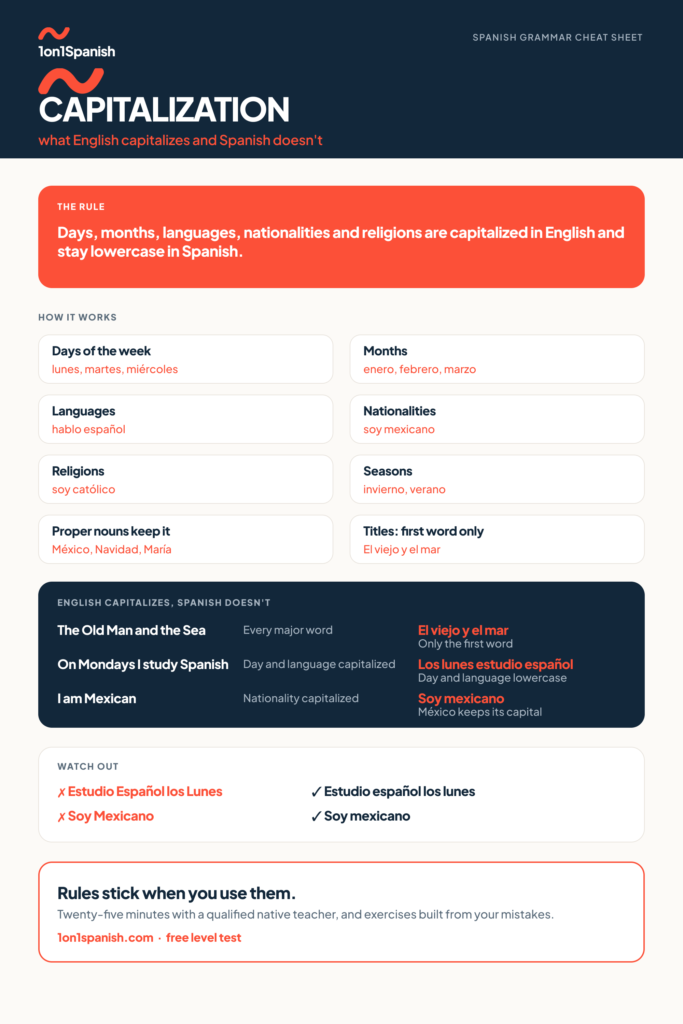
Take the chart with you
The chart is free to view and share. Drop your email and we’ll send the print-ready US Letter PDF — the version you stick on the fridge.
Practice
Practice Spanish capitalization rules with a real teacher
Charts get you halfway. The other half is saying it out loud to someone who corrects you on the spot. At 1on1Spanish you get 25-minute private lessons with a qualified native teacher, exercises built from the mistakes you make in class, and AI practice between lessons.
First month $1. No contracts, cancel anytime.
You can go further with someone listening: Learn Spanish with 1on1Spanish, 25 minutes at a time.
Take your free level testBuilt on RingTeacher's method — 700,000+ classes delivered since 2017, teaching English to Spanish speakers. Now in the other direction.
Frequently asked questions
Are days and months capitalized in Spanish?
No. Lunes, martes, enero, febrero and the rest all stay lowercase in Spanish, even at the start of a sentence about them, unless they happen to be the first word of the sentence itself, in which case only that opening letter capitalizes — the same rule that applies to any lowercase word starting a sentence.
Is the language name capitalized in Spanish?
No. Español, inglés, francés stay lowercase in every position: Hablo español, estudio inglés, un libro en francés. This holds even at the start of a topic sentence about the language itself, not just mid-sentence. It’s one of the most common carryover mistakes from English, where language names always capitalize, no matter where they fall in the sentence.
Do nationalities get a capital letter in Spanish?
No, not as adjectives. Soy mexicano, una comida italiana, un carro japonés all stay lowercase. The country name itself keeps its capital — México, Italia, Japón — but the adjective built from it doesn’t inherit that capital, even when it’s the very first word of the sentence describing someone’s nationality. Only the proper noun the adjective comes from stays capitalized.
How do you capitalize a book or movie title in Spanish?
Only the first word and any proper nouns inside the title get a capital letter; everything else stays lowercase. Cien años de soledad, not Cien Años De Soledad. This is the opposite of English style, which capitalizes every major word in a title.
What’s the most common capitalization mistake English speakers make in Spanish?
Capitalizing days, months and language names out of pure habit, since English capitalizes all three. Estudio Español los Lunes looks natural to an English-first writer and is wrong on two counts at once — it’s a fast way to spot non-native writing even when the grammar underneath is otherwise solid.