
Spanish numbers 1-20: the first ones to memorize
You don’t need the whole system on day one. You need these twenty numbers, said clearly enough that a native speaker doesn’t have to guess — for a table for two, a kid’s age, a floor number, a price under twenty dollars. 1on1Spanish drills numbers out loud in 25-minute one-on-one lessons with qualified native teachers, online across the United States.
Reviewed by María Jiménez — Licenciada en Filología Hispánica (BA in Hispanic Philology) · Updated Sep 2026
0 to 10: the ones you’ll use constantly
Cero, uno, dos, tres, cuatro, cinco, seis, siete, ocho, nueve, diez.
These are the numbers you’ll say the most, and most of them have no trap. The one exception is uno: alone, counting, it stays uno — ¿Cuántos hijos tienes? Uno. In front of a noun it changes depending on gender, which matters the moment you order un café but una cerveza.
11 to 15: still one word, no pattern yet
Once, doce, trece, catorce, quince.
Five more words with no internal logic, the same way English keeps “eleven” and “twelve” instead of “oneteen” and “twoteen.” Doce has a second job: las doce is noon or midnight, so a Mexican coworker who says nos vemos a las doce means lunchtime, not literally the number twelve written somewhere.
16 to 19: where the fusion starts
Dieciséis, diecisiete, dieciocho, diecinueve.
These used to be written diez y seis, “ten and six,” and the spelling fused into one word. Only dieciséis carries a written accent, on the é, because that’s where the stress falls once the words glue together. Say them slowly the first few times: dieci- plus the unit is the whole trick.
20: the number that opens the next pattern
Veinte stands alone, but from here the pattern keeps fusing for one more stretch: veintiuno, veintidós, veintitrés, and so on to veintinueve, all one word. Three of them — veintidós, veintitrés, veintiséis — take a written accent for the same reason as dieciséis: stress on the last syllable. From 30 onward the words separate again into three parts, which is where Spanish numbers 1-100 picks up the rest of the system.
Quick reference: 1 to 20
| # | Spanish | # | Spanish |
|---|---|---|---|
| 0 | cero | 11 | once |
| 1 | uno | 12 | doce |
| 2 | dos | 13 | trece |
| 3 | tres | 14 | catorce |
| 4 | cuatro | 15 | quince |
| 5 | cinco | 16 | dieciséis |
| 6 | seis | 17 | diecisiete |
| 7 | siete | 18 | dieciocho |
| 8 | ocho | 19 | diecinueve |
| 9 | nueve | 20 | veinte |
| 10 | diez |
The ones that don’t work the way you’d expect
Twenty numbers, and still enough here to catch you off guard the first time you use them out loud.
| Number | What trips people up |
|---|---|
| uno | Drops the -o before a masculine noun (un dólar) and becomes una before a feminine one (una hora). Standing alone it’s always uno |
| doce | Las doce means noon or midnight — not the number by itself, a time |
| quince | Beyond “fifteen,” it’s the word for a girl’s fifteenth-birthday celebration: una quinceañera |
| dieciséis | The only number in this range with a written accent |
| veintiuno | Loses the -o before a masculine noun and becomes veintiún, with an accent: veintiún años |
Common mistakes English speakers make
The separated spelling was correct centuries ago. Today it’s one fused word, and writing it as two looks like a typo to a native reader.
Age is something you have in Spanish, with the verb tener, not something you are. Soy diecinueve means nothing to a native speaker.
Before a masculine noun, veintiuno loses its -o and gains an accent on the u. It’s veintiún años, not veintiuno años.
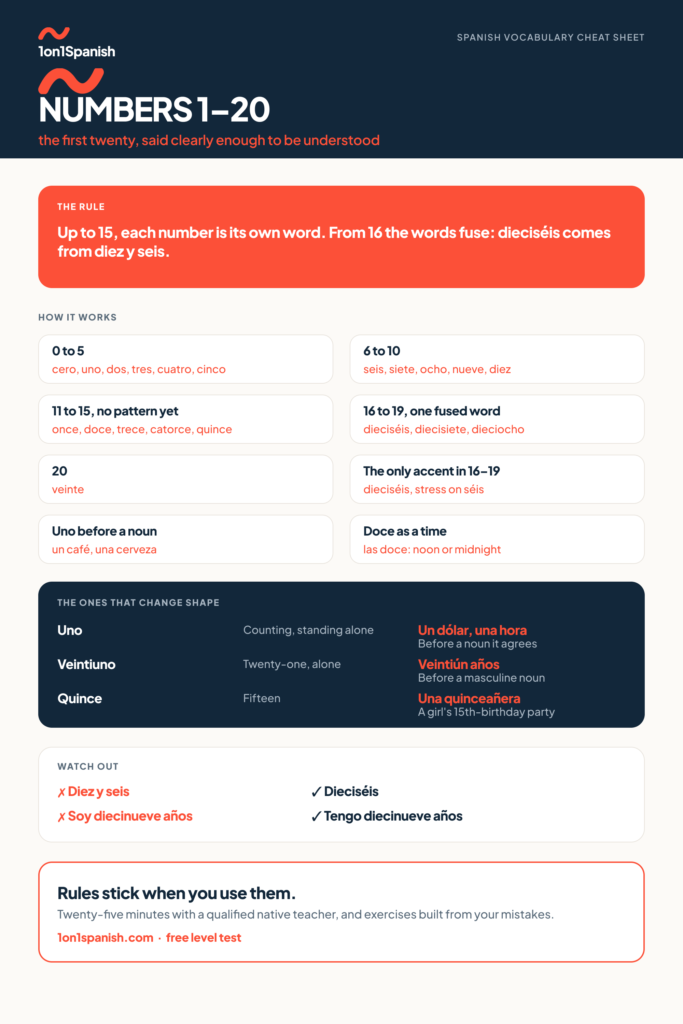
Take the chart with you
The chart is free to view and share. Drop your email and we’ll send the print-ready US Letter PDF — the version you stick on the fridge.
Practice
Practice Spanish numbers with a real teacher
Charts get you halfway. The other half is saying it out loud to someone who corrects you on the spot. At 1on1Spanish you get 25-minute private lessons with a qualified native teacher, exercises built from the mistakes you make in class, and AI practice between lessons.
First month $1. No contracts, cancel anytime.
Reading about it only gets you so far. Learn Spanish online in 25-minute conversations and use it.
Take your free level testBuilt on RingTeacher's method — 700,000+ classes delivered since 2017, teaching English to Spanish speakers. Now in the other direction.
Frequently asked questions
How do I say the numbers 1 to 20 in Spanish?
Uno, dos, tres, cuatro, cinco, seis, siete, ocho, nueve, diez, once, doce, trece, catorce, quince, dieciséis, diecisiete, dieciocho, diecinueve, veinte. The first fifteen are memorized one by one, like English “one” through “twelve.” From sixteen on, the numbers fuse into a single word: dieciséis comes from diez y seis, “ten and six.”
Why is dieciséis spelled as one word but written differently from diecisiete?
Dieciséis carries a written accent on the é because the stress falls on the last syllable once the word fuses; diecisiete, dieciocho and diecinueve don’t need one because Spanish stress rules already put the emphasis where it naturally falls. It’s the only accented number in the 16-19 range.
What comes after 20 in Spanish?
Veintiuno, veintidós, veintitrés and so on through veintinueve, all written as one word the same way 16-19 are. After that the pattern changes: 30 and up separate into three words, like treinta y uno. The full sequence through 100 is in our Spanish numbers 1-100 guide.
How do I say my age using these numbers?
With tener, not ser: Tengo dieciocho años, not Soy dieciocho. Spanish treats age as something you have, so the literal translation is “I have eighteen years,” and the word años is required — Tengo dieciocho on its own sounds unfinished. Ask someone’s age with ¿Cuántos años tienes?
Is quince only used for the number fifteen?
No. Beyond counting, quince names a Latin American coming-of-age celebration for a girl’s fifteenth birthday, la quinceañera, one of the most culturally loaded uses of any number in the language. Hear a Mexican family mention la quinceañera de mi hija and they’re talking about the party, not the count.