
Spanish numbers 1-100: the full list and how they work
Spanish numbers are built from fifteen words you memorize and one pattern you apply to everything else: learn 1 to 15, then tens plus units — treinta y cinco, sesenta y ocho — with 16 to 29 written as a single word. That’s the whole system up to 100. The part that takes practice isn’t the list, it’s saying a price or a phone number at native speed. 1on1Spanish drills numbers out loud in 25-minute one-on-one lessons with qualified native teachers, online across the United States.
Reviewed by María Jiménez — Licenciada en Filología Hispánica (BA in Hispanic Philology) · Updated Sep 2026
0 to 15: pure memorization
Cero, uno, dos, tres, cuatro, cinco, seis, siete, ocho, nueve, diez, once, doce, trece, catorce, quince.
Sixteen words with no internal logic, exactly like English one through twelve. Notice that Spanish keeps unique words two steps further than English does: once, doce, trece, catorce and quince are all irreplaceable, and quince has a life of its own in quinceañera and quince días, which means “two weeks”, not fifteen days of anything.
If you want to drill just this first block before moving on, our Spanish numbers 1-20 page goes slower, with the pronunciation of each word written out.
16 to 19: the fusion starts
Dieciséis, diecisiete, dieciocho, diecinueve.
These were once written diez y seis, “ten and six”, and the modern spelling glued them together. The logic is visible if you read them slowly: dieci- is diez, then the unit. Only dieciséis carries an accent, on the é, because the fused word stresses the last syllable.
20 to 29: one word, three accents
Veinte, veintiuno, veintidós, veintitrés, veinticuatro, veinticinco, veintiséis, veintisiete, veintiocho, veintinueve.
Same fusion, this time from veinte y. Three of them take a written accent (veintidós, veintitrés, veintiséis) for the same reason as dieciséis: the stress lands on the final syllable. Writing veintidos without the accent is the most common spelling error Americans make in this range, and it’s the one a teacher will flag first.
The rule behind those three accents is the general one: a word ending in a vowel, -n or -s is stressed on the next-to-last syllable unless a written accent says otherwise, and veintidós is stressed on the last. That’s the whole logic of Spanish accent marks and stress, and it explains far more than numbers.
30 to 99: back to three words
From 30 onward the numbers separate again, and the pattern never changes: tens + y + unit.
The tens are treinta, cuarenta, cincuenta, sesenta, setenta, ochenta, noventa. Then treinta y uno, cuarenta y siete, ochenta y nueve. No accents, no fusion, no exceptions between 31 and 99.
Two of the tens sound almost identical and get confused constantly: sesenta (60) and setenta (70). One s, one t, twenty years of difference when you’re giving your age.
100: cien or ciento
Cien is the word for exactly 100, standing alone or in front of a noun: cien dólares, cien personas, cien por cien.
Ciento is what you use when something follows: ciento uno, ciento veinte, ciento cincuenta y tres. And it never takes y right after it: ciento uno, never ciento y uno, even though treinta y uno does take one.
Neither form takes an article: cien dólares, not un cien dólares.
The full list, 1 to 100
| # | Spanish | # | Spanish | # | Spanish | # | Spanish |
|---|---|---|---|---|---|---|---|
| 1 | uno | 26 | veintiséis | 51 | cincuenta y uno | 76 | setenta y seis |
| 2 | dos | 27 | veintisiete | 52 | cincuenta y dos | 77 | setenta y siete |
| 3 | tres | 28 | veintiocho | 53 | cincuenta y tres | 78 | setenta y ocho |
| 4 | cuatro | 29 | veintinueve | 54 | cincuenta y cuatro | 79 | setenta y nueve |
| 5 | cinco | 30 | treinta | 55 | cincuenta y cinco | 80 | ochenta |
| 6 | seis | 31 | treinta y uno | 56 | cincuenta y seis | 81 | ochenta y uno |
| 7 | siete | 32 | treinta y dos | 57 | cincuenta y siete | 82 | ochenta y dos |
| 8 | ocho | 33 | treinta y tres | 58 | cincuenta y ocho | 83 | ochenta y tres |
| 9 | nueve | 34 | treinta y cuatro | 59 | cincuenta y nueve | 84 | ochenta y cuatro |
| 10 | diez | 35 | treinta y cinco | 60 | sesenta | 85 | ochenta y cinco |
| 11 | once | 36 | treinta y seis | 61 | sesenta y uno | 86 | ochenta y seis |
| 12 | doce | 37 | treinta y siete | 62 | sesenta y dos | 87 | ochenta y siete |
| 13 | trece | 38 | treinta y ocho | 63 | sesenta y tres | 88 | ochenta y ocho |
| 14 | catorce | 39 | treinta y nueve | 64 | sesenta y cuatro | 89 | ochenta y nueve |
| 15 | quince | 40 | cuarenta | 65 | sesenta y cinco | 90 | noventa |
| 16 | dieciséis | 41 | cuarenta y uno | 66 | sesenta y seis | 91 | noventa y uno |
| 17 | diecisiete | 42 | cuarenta y dos | 67 | sesenta y siete | 92 | noventa y dos |
| 18 | dieciocho | 43 | cuarenta y tres | 68 | sesenta y ocho | 93 | noventa y tres |
| 19 | diecinueve | 44 | cuarenta y cuatro | 69 | sesenta y nueve | 94 | noventa y cuatro |
| 20 | veinte | 45 | cuarenta y cinco | 70 | setenta | 95 | noventa y cinco |
| 21 | veintiuno | 46 | cuarenta y seis | 71 | setenta y uno | 96 | noventa y seis |
| 22 | veintidós | 47 | cuarenta y siete | 72 | setenta y dos | 97 | noventa y siete |
| 23 | veintitrés | 48 | cuarenta y ocho | 73 | setenta y tres | 98 | noventa y ocho |
| 24 | veinticuatro | 49 | cuarenta y nueve | 74 | setenta y cuatro | 99 | noventa y nueve |
| 25 | veinticinco | 50 | cincuenta | 75 | setenta y cinco | 100 | cien |
Cero is zero. It’s not in the list because nobody counts from it, but you need it for phone numbers and temperatures.
The uses that go wrong out loud
Reciting the list is the easy part. These five situations are where the numbers actually get used, and where the mistakes happen.
Uno drops its -o before a masculine noun. Un dólar, veintiún años, treinta y un días. Before a feminine noun it becomes una: una hora, veintiuna personas. Standing alone, counting, it stays uno: ¿Cuántos quieres? Uno. Note that veintiún takes an accent when it sheds the -o.
Prices are read as full numbers, with the currency last. $89 is ochenta y nueve dólares. $99.50 is noventa y nueve dólares con cincuenta, or in speech often noventa y nueve cincuenta. Spanish does not chop prices into digits the way English sometimes does.
Phone numbers go in pairs, not digit by digit. A Spanish speaker reads 55 40 78 as cincuenta y cinco, cuarenta, setenta y ocho. American ten-digit numbers usually get read three-three-four, but the pairs habit is what you’ll hear from a native speaker giving you theirs, and it’s why phone numbers sound impossibly fast at first.
Years are one whole number, never split in halves. 1987 is mil novecientos ochenta y siete. 2025 is dos mil veinticinco. English says “nineteen eighty-seven”; Spanish never does that, so the habit of splitting the year in two is a giveaway.
Age uses tener, not ser. Tengo treinta y ocho años, literally “I have thirty-eight years”. Soy treinta y ocho means nothing. And años is not optional — Tengo treinta y ocho on its own sounds unfinished.
Age is one of a whole family of things you “have” in Spanish, alongside hunger, thirst and cold, so it’s worth knowing the tener conjugation cold. Tengo, tienes, tiene will do most of the work in a first conversation.
Common mistakes English speakers make
Age is something you have in Spanish. This is the single most frequent number error in a first conversation.
From 16 to 29 the number is one fused word. The separated spelling is centuries out of date.
Cien and mil never take an indefinite article.
The y only appears between tens and units, not after ciento. It belongs in treinta y cinco, not in ciento cinco.
Before a masculine noun, uno loses its -o and gains an accent.
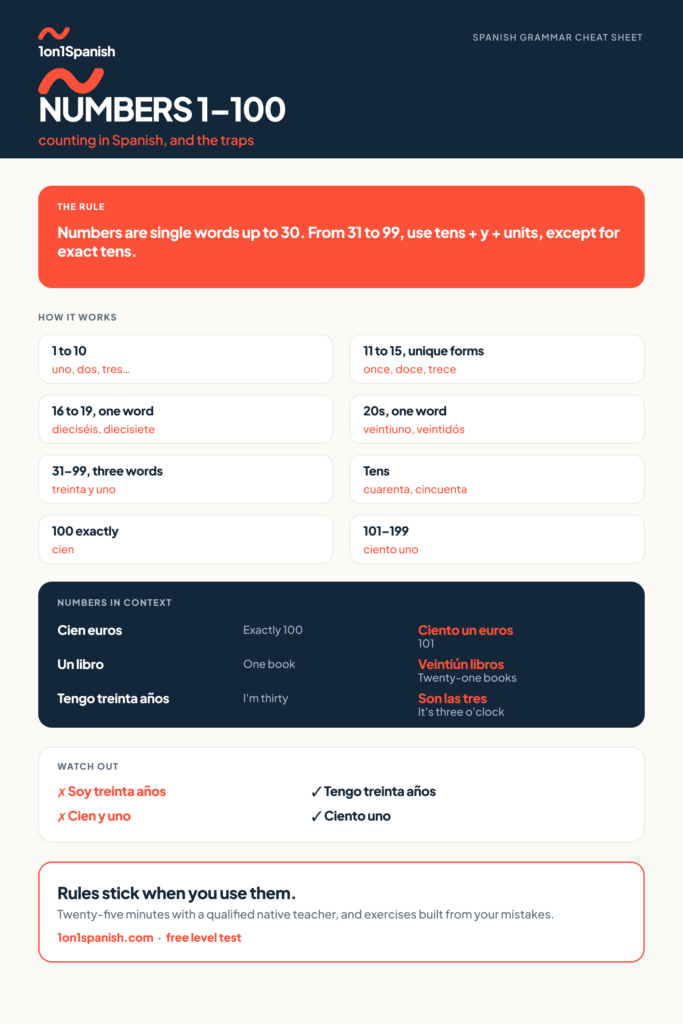
Take the chart with you
The chart is free to view and share. Drop your email and we’ll send the print-ready US Letter PDF — the version you stick on the fridge.
Practice
Practice Spanish numbers with a real teacher
Charts get you halfway. The other half is saying it out loud to someone who corrects you on the spot. At 1on1Spanish you get 25-minute private lessons with a qualified native teacher, exercises built from the mistakes you make in class, and AI practice between lessons.
First month $1. No contracts, cancel anytime.
The fastest way to make this stick is to say it to someone. Learn Spanish online with a real teacher.
Take your free level testBuilt on RingTeacher's method — 700,000+ classes delivered since 2017, teaching English to Spanish speakers. Now in the other direction.
Frequently asked questions
What’s the difference between cien and ciento in Spanish?
Cien is exactly 100, alone or before a noun: cien euros, cien años. Ciento is used when another number follows: ciento uno, ciento cuarenta y dos. There’s no y after ciento — it’s ciento cinco, not ciento y cinco. Neither takes an article, so cien dólares is correct and un cien dólares is not.
How do you say your age in Spanish?
With tener, not ser: Tengo cuarenta años. Spanish treats age as something you have, so the literal translation is “I have forty years”. The word años has to be there; Tengo cuarenta sounds like an unfinished sentence. To ask, you say ¿Cuántos años tienes? informally or ¿Cuántos años tiene? formally.
Why are 16 to 29 written as one word in Spanish?
They come from diez y seis and veinte y dos, and the spelling fused over time the way English “sixteen” fused from “six and ten”. From 31 onward the fusion never happened, so the numbers stay in three words: treinta y uno. That inconsistency is historical, not logical, and it’s simply memorized. Dieciséis, veintidós, veintitrés and veintiséis take written accents.
How do Spanish speakers read phone numbers?
Usually in pairs rather than digit by digit: 62 45 90 is sesenta y dos, cuarenta y cinco, noventa. That habit is why a phone number sounds fast even when the numbers themselves are familiar. American numbers are often read three-three-four instead, but if you’re taking a number down from a native speaker, expect pairs and ask them to repeat más despacio.
Do you say years in Spanish the way you do in English?
No. English splits a year into two halves, “nineteen eighty-seven”, and Spanish reads it as one whole number: mil novecientos ochenta y siete. The same applies to this century: 2025 is dos mil veinticinco, never veinte veinticinco.