
Jobs involving Spanish: professions vocabulary and where it pays off
Two different questions land on this page, and both matter. One is “how do I say what I do for a living in Spanish” — the profession vocabulary itself, plus a grammar rule almost every English speaker breaks without noticing. The other is “where does knowing Spanish actually get me hired” — which industries in the United States pay for it and how. This page covers both. At 1on1Spanish you build the confidence to talk about your career, or interview for one, with a qualified native teacher in 25-minute one-on-one lessons.
Reviewed by María Jiménez — Licenciada en Filología Hispánica (BA in Hispanic Philology) · Updated Sep 2026
Common professions
El profesor / la profesora is teacher, el médico / la médica doctor, el enfermero / la enfermera nurse, el abogado / la abogada lawyer, el ingeniero / la ingeniera engineer, el contador / la contadora accountant, el programador / la programadora programmer, el vendedor / la vendedora salesperson, el mesero / la mesera waiter or waitress, el plomero / la plomera plumber, el electricista electrician (same form for both genders), el policía / la policía police officer — this last one keeps the same word for both genders, though la mujer policía also appears in some regions.
The article rule almost everyone breaks
Here’s the sentence every English speaker gets wrong at least once: “I am a teacher” becomes soy profesora, not soy una profesora. Spanish drops the indefinite article after ser when stating a profession — the same way it works with nationality or religion. Soy médico, es abogada, somos ingenieros. The article comes back the moment you add a description: soy una profesora excelente, es un abogado muy conocido. Without an adjective, the article is extra weight the sentence doesn’t need.
This is one rule inside a bigger system. When un and una appear, when they don’t, and why el and la show up in places English leaves bare are all in our guide to Spanish articles.
The feminine forms that trip people up
Spanish has been actively updating profession vocabulary to reflect that more women hold roles that used to default to the masculine form. La jueza (female judge) is now standard, alongside the older, still-heard la juez. La médica (female doctor) has fully replaced the outdated practice of using la médico by default. La presidenta is standard for a female president — you’ll hear this constantly in the news across Latin America. Some words genuinely don’t change: el/la estudiante, el/la gerente (manager), el/la periodista (journalist) use the same form for both genders, with only the article signaling gender.
Most of these feminine forms follow the general rules for how noun gender works in Spanish: -o to -a, and a consonant ending like -or or -és adding -a. The words that stay the same for both, like estudiante and gerente, are the ones you have to learn by article.
Where Spanish gets you hired in the US
Beyond vocabulary, which jobs actually use Spanish is its own question in the United States, where Spanish is the most widely spoken language after English. Healthcare is the biggest one: bilingual nurses, medical interpreters and front-desk staff are in constant demand, often with a pay differential. Education needs bilingual teachers and aides, especially in states with large dual-language programs. Customer service and call centers hire specifically for Spanish fluency, sometimes as the primary qualification.
Legal and court interpretation is its own licensed career path — el intérprete / la intérprete — with formal certification requirements. Social work, government services and real estate round out the list, anywhere direct communication with a Spanish-speaking client or patient replaces the need for a translator.
Quick reference
| English | Spanish (masculine / feminine) |
|---|---|
| teacher | el profesor / la profesora |
| doctor | el médico / la médica |
| nurse | el enfermero / la enfermera |
| lawyer | el abogado / la abogada |
| engineer | el ingeniero / la ingeniera |
| accountant | el contador / la contadora |
| programmer | el programador / la programadora |
| salesperson | el vendedor / la vendedora |
| waiter / waitress | el mesero / la mesera |
| plumber | el plomero / la plomera |
| electrician | el/la electricista |
| police officer | el/la policía |
| judge | el juez / la jueza |
| president | el presidente / la presidenta |
| manager | el/la gerente |
| journalist | el/la periodista |
| student | el/la estudiante |
| interpreter | el intérprete / la intérprete |
| social worker | el trabajador social / la trabajadora social |
| business owner | el dueño de negocio / la dueña de negocio |
Where this actually goes wrong
The grammar risk here isn’t regional — it’s a single rule that’s easy to forget under pressure, in a job interview or a first conversation about your career.
| Pattern | The risk |
|---|---|
| soy un/una + profession | Adding the article without an adjective is understood but marks the sentence as translated. Soy profesora is what a native speaker says; soy una profesora sounds like you’re introducing one specific teacher out of many, not stating your job |
| la médico / la juez (old defaults) | Using the historically masculine-only form for a woman isn’t automatically wrong — la juez is still heard — but la médica and la jueza are now the standard, updated forms, and defaulting to the old pattern can read as outdated |
| invariable professions with the wrong article | El estudiante / la estudiante — the noun doesn’t change, but forgetting to switch the article for a woman (el estudiante referring to a ella) is a real, noticeable slip |
Common mistakes English speakers make
No article after ser with an unmodified profession.
Match the gender of the profession noun to the person, not just the article.
Como (as/working as) follows the same no-article rule as ser.
The updated feminine form is now the default in formal and everyday Spanish alike.
El/la estudiante, el/la gerente, el/la periodista stay the same — only the article changes.
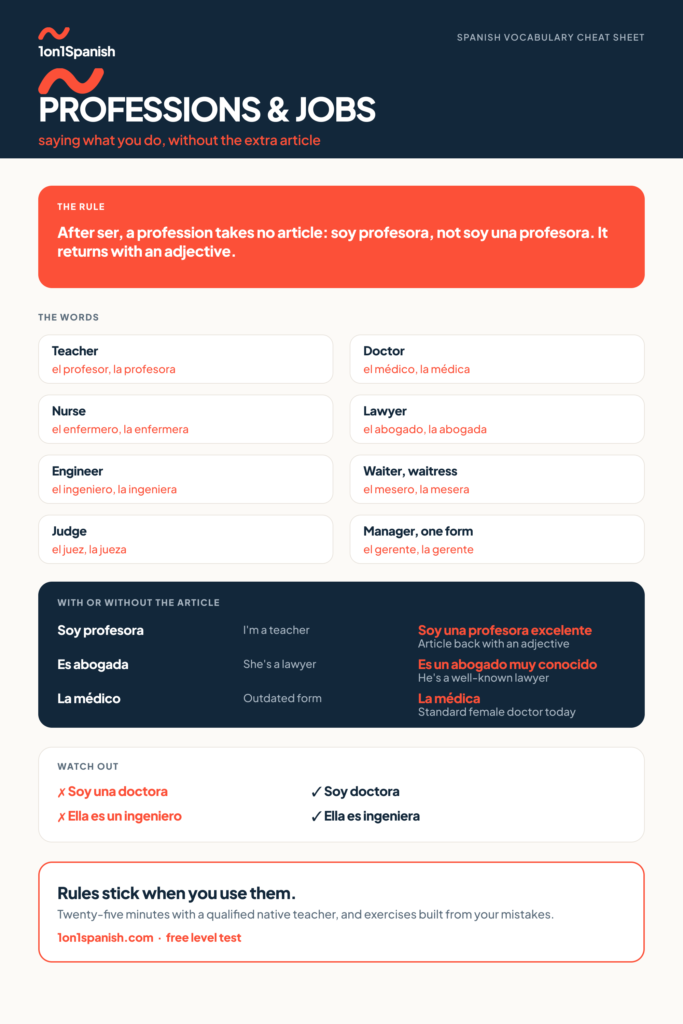
Take the chart with you
The chart is free to view and share. Drop your email and we’ll send the print-ready US Letter PDF — the version you stick on the fridge.
Practice
Practice professions vocabulary with a real teacher
Charts get you halfway. The other half is saying it out loud to someone who corrects you on the spot. At 1on1Spanish you get 25-minute private lessons with a qualified native teacher, exercises built from the mistakes you make in class, and AI practice between lessons.
First month $1. No contracts, cancel anytime.
Reading about it only gets you so far. Learn Spanish online in 25-minute conversations and use it.
Take your free level testBuilt on RingTeacher's method — 700,000+ classes delivered since 2017, teaching English to Spanish speakers. Now in the other direction.
Frequently asked questions
How do you say your profession in Spanish?
With ser and no article: soy profesor, soy enfermera, soy ingeniero. English speakers almost always add “a” by habit — soy una profesora — which is understood but not how a native speaker phrases it. The article only comes back if you add a description: soy una profesora dedicada.
What jobs use Spanish in the United States?
Healthcare, education, customer service, legal and court interpretation, social work and government services are the fields where Spanish fluency is most consistently in demand across the US, given how large the Spanish-speaking population is. Some roles, like medical or court interpreter, require formal certification on top of language skill.
What is the feminine form of doctor in Spanish?
La médica. It’s now the standard form, replacing the older habit of defaulting to la médico for a woman. The same pattern applies to la jueza (judge) and la presidenta (president) — Spanish has been updating profession vocabulary to mark gender explicitly where it used to default to masculine.
Are all Spanish profession words gendered?
No. Words like el/la estudiante, el/la gerente and el/la periodista keep the same form for men and women — only the article (el or la) changes. Others, like profesor/profesora or médico/médica, change the ending itself. There’s no single rule that predicts which pattern a given profession follows; it has to be learned word by word.
Do I need to say “un” or “una” before my job title in Spanish?
Not when the sentence is just stating the job: soy contador, no article needed. Add the article back only when a description follows: soy un contador muy organizado. This is one of the most common small errors English speakers make, because English always uses “a” or “an” before a profession and Spanish doesn’t when there’s nothing else in the sentence.