
Spanish seasons and greetings: names, phrases and timing
The four seasons in Spanish are simple vocabulary — the complication is that if your teacher is Argentine or Chilean, their winter is your summer. Spanish-speaking countries span both hemispheres, so “it’s cold here” from a teacher in Buenos Aires in July means something completely different from the same sentence from a teacher in Mexico City. This page covers the season names, the seasonal greetings people actually use, and the hemisphere detail that changes everything about timing. At 1on1Spanish a qualified native teacher brings their own real season and climate into every 25-minute one-on-one lesson.
Reviewed by María Jiménez — Licenciada en Filología Hispánica (BA in Hispanic Philology) · Updated Sep 2026
The four seasons
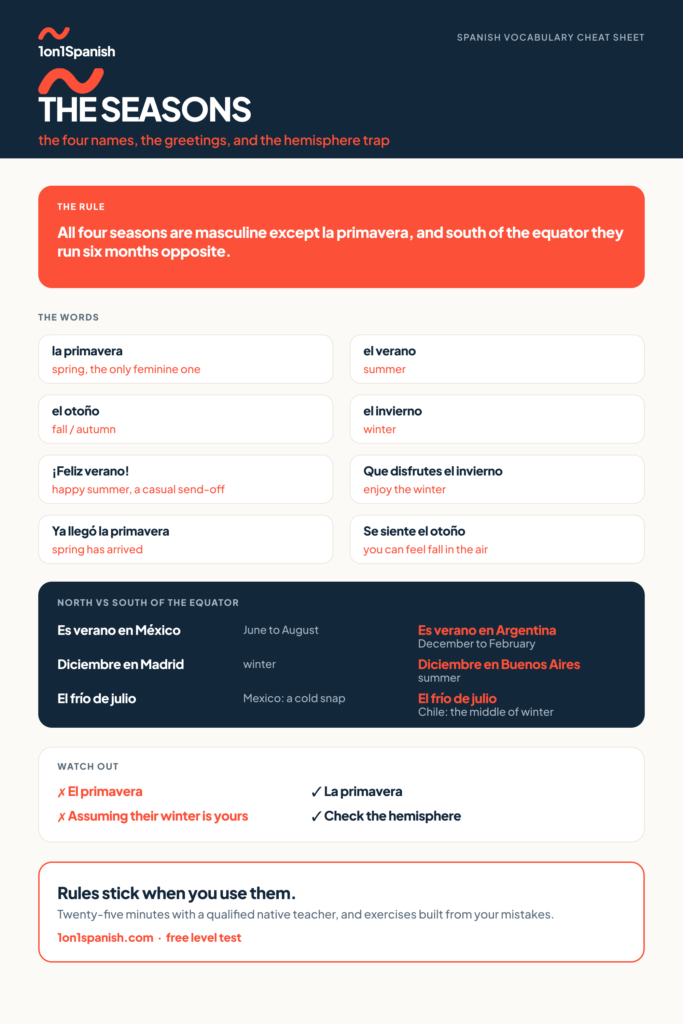
La primavera is spring, el verano summer, el otoño fall or autumn, el invierno winter. All four are masculine except primavera, which is feminine — worth noting since it’s the one that breaks the pattern the others seem to suggest.
Seasonal greetings people actually use
¡Feliz verano! (happy summer!) is a common thing to say as summer break starts, especially to students or coworkers heading into vacation. Que disfrutes el invierno (enjoy the winter) or que pases un buen invierno (have a good winter) work as a casual send-off in colder months. Around a change of season, ya llegó la primavera (spring has arrived) or se siente el otoño (you can feel fall in the air) are natural ways to comment on the weather shifting — small talk, but common small talk. Unlike English holiday greetings, Spanish seasonal greetings aren’t tied to a single fixed date; they show up whenever the season is genuinely starting to feel different.
Why the seasons are reversed south of the equator
This is the detail a season vocabulary list usually skips, and it matters if you take classes with a teacher from Argentina, Chile, Uruguay, or southern Brazil-adjacent regions. When it’s summer in Mexico or the United States, it’s winter in Buenos Aires — the Southern Hemisphere runs exactly six months opposite. Diciembre, enero y febrero are summer months in Argentina and Chile, while they’re winter in Mexico and Spain. This isn’t a small detail: a Chilean teacher casually mentioning el frío de julio is talking about the middle of winter, not a random cold snap.
The months of the year in Spanish don’t move; what moves is which season each one belongs to. So when a teacher in Santiago says hace mucho frío in July, the Spanish weather expressions are the same ones you’d use in Chicago in January.
Quick reference
| Spanish | English | Northern Hemisphere months (roughly) | Southern Hemisphere months (roughly) |
|---|---|---|---|
| la primavera | spring | March–May | September–November |
| el verano | summer | June–August | December–February |
| el otoño | fall/autumn | September–November | March–May |
| el invierno | winter | December–February | June–August |
The ones that don’t work the way you’d expect
The seasons themselves have no regional risk in the sense of different words — everyone says primavera, verano, otoño, invierno. The real risk is timing, not vocabulary.
| Detail | The risk |
|---|---|
| hemisphere reversal | A Southern Hemisphere teacher’s “winter” and “summer” happen on the opposite calendar from a Northern Hemisphere student’s. Confirm which hemisphere your teacher is describing before assuming a season matches your own |
| primavera’s gender | The only feminine season in a set that otherwise looks masculine — a common small slip is defaulting to el primavera by pattern-matching the other three |
| seasonal greetings, timing | Unlike a holiday greeting tied to one date, seasonal greetings shift naturally with the actual weather, which itself shifts by country and hemisphere |
Common mistakes English speakers make
The one feminine season among four, easy to get wrong by pattern-matching el verano, el otoño, el invierno.
A teacher from Chile or Argentina experiences the seasons on the opposite schedule from one in Mexico or Spain.
¡Feliz verano! works as an easygoing send-off, similar to “enjoy your summer,” not a set expression tied to a specific date.
Take the chart with you
The chart is free to view and share. Drop your email and we’ll send the print-ready US Letter PDF — the version you stick on the fridge.
Practice
Practice Spanish seasons and greetings with a real teacher
Charts get you halfway. The other half is saying it out loud to someone who corrects you on the spot. At 1on1Spanish you get 25-minute private lessons with a qualified native teacher, exercises built from the mistakes you make in class, and AI practice between lessons.
First month $1. No contracts, cancel anytime.
These guides are free. When you want someone correcting you out loud, learn Spanish online with a qualified native teacher.
Take your free level testBuilt on RingTeacher's method — 700,000+ classes delivered since 2017, teaching English to Spanish speakers. Now in the other direction.
Frequently asked questions
What are the four seasons called in Spanish?
La primavera (spring), el verano (summer), el otoño (fall/autumn), and el invierno (winter). Primavera is the only one that’s grammatically feminine; the other three are masculine, which is worth remembering since it’s easy to default to el for all four out of habit.
Are the seasons the same time of year in every Spanish-speaking country?
No, and this is the detail most vocabulary lists skip. Countries in the Southern Hemisphere — Argentina, Chile, Uruguay — experience the seasons exactly six months opposite from Mexico, Spain, and the rest of the Northern Hemisphere. December is summer in Buenos Aires and winter in Madrid.
What do Spanish speakers say to greet a new season?
Casual expressions like ¡feliz verano! (happy summer) or que disfrutes el invierno (enjoy the winter) are common, especially around school breaks or when the weather noticeably shifts. Unlike a holiday greeting, these aren’t tied to one fixed date — they show up naturally as the season actually changes.
Why is “primavera” feminine when the other seasons are masculine?
It’s simply how the word developed in Spanish; grammatical gender doesn’t always follow a predictable pattern, and primavera is one of the exceptions worth memorizing directly rather than guessing by analogy with verano, otoño and invierno. Spanish has plenty of these one-off exceptions — noun gender is learned per word, not derived from a universal rule, even when three out of four words in a set seem to agree.
If my teacher says “it’s cold right now,” how do I know which season they mean?
Ask, or consider their location. If your teacher is in Mexico, Spain, or most of Central America, their calendar matches yours. If they’re in Argentina, Chile, or Uruguay, their seasons run six months opposite — so “cold right now” in July means the middle of winter there, not an unusual cold snap.