
Spanish weather expressions: why it’s hacer, not ser
“It is cold” translates word for word into Spanish as está frío, and that sentence is wrong for talking about the weather. Spanish describes weather with hacer (“to make/do”) and, for how a person feels, tener (“to have”) — almost never with ser or estar, the two verbs an English speaker reaches for first. This one grammatical habit is the single biggest weather mistake English speakers make, and it’s worth understanding as a pattern, not memorizing sentence by sentence. At 1on1Spanish a qualified native teacher catches exactly this kind of interference in every 25-minute one-on-one lesson.
Reviewed by María Jiménez — Licenciada en Filología Hispánica (BA in Hispanic Philology) · Updated Sep 2026
Weather goes with hacer
Most weather conditions in Spanish are phrased as something the sky or the day “makes,” always in the third person: hace frío (it’s cold), hace calor (it’s hot), hace sol (it’s sunny), hace viento (it’s windy), hace fresco (it’s cool), hace buen tiempo (the weather’s nice), hace mal tiempo (the weather’s bad). None of these use ser or estar — saying es frío or está frío to describe the weather is a direct and incorrect translation from English, even though both verbs mean roughly “to be.”
For weather you only ever need one form of the verb hacer, the third person singular: hace now, hizo yesterday, va a hacer tomorrow. The sky is always the subject, so hago and haces never come into it.
A few conditions use estar, and that’s where it gets confusing
Not every weather word follows the hacer pattern, and the exceptions are exactly what trips learners up after they’ve memorized the rule above. Está nublado (it’s cloudy), está despejado (it’s clear), and está lloviznando (it’s drizzling) use estar, because these describe a state the sky is in, similar to how estar works for any temporary condition. Rain and snow have their own dedicated verbs and don’t need hacer or estar at all: llueve (it’s raining, from llover) and nieva (it’s snowing, from nevar).
Notice that when weather does take a “to be” verb, it’s always estar, never ser: cloud cover is a condition of the moment, not a permanent trait. That’s the same ser vs. estar rule that decides está cansado against es alto.
How a person feels the weather: that’s tener
This is the part that surprises English speakers most: how you feel about the temperature uses tener, not estar. Tengo frío means “I’m cold” — literally “I have cold.” Tengo calor means “I’m hot.” Saying estoy frío doesn’t describe feeling cold; it describes being cold to the touch, like a dead body or a plate of food, which is not what you mean to say about yourself.
Tengo frío belongs to the same family as tengo hambre, tengo sed and tengo sueño: sensations Spanish treats as things you have. Get comfortable with the verb tener and all of them come for free.
Quick reference
| Spanish | English | Verb pattern |
|---|---|---|
| hace frío | it’s cold | hacer |
| hace calor | it’s hot | hacer |
| hace sol | it’s sunny | hacer |
| hace viento | it’s windy | hacer |
| hace fresco | it’s cool | hacer |
| hace buen tiempo | the weather’s nice | hacer |
| hace mal tiempo | the weather’s bad | hacer |
| está nublado | it’s cloudy | estar |
| está despejado | it’s clear | estar |
| llueve | it’s raining | llover (own verb) |
| nieva | it’s snowing | nevar (own verb) |
| tengo frío | I’m cold | tener |
| tengo calor | I’m hot | tener |
The mistake that gives away a direct translation
This single substitution — ser/estar where Spanish expects hacer or tener — is the clearest sign that a sentence was translated from English rather than built in Spanish from the start.
| Pattern | The risk |
|---|---|
| es frío / está frío for weather | Both sound like a direct translation of “it is cold.” Está frío is correct Spanish, but it means an object feels cold to the touch — a drink, a room, not the outdoor temperature |
| estoy frío for feeling cold | Describes your body being cold to the touch, not the sensation of being cold. Tengo frío is what a person actually says |
| hace lluvia / hace nieve | Rain and snow use their own verbs, llover and nevar, not hacer. Llueve and nieva are the natural forms |
Common mistakes English speakers make
The weather “makes” cold; it doesn’t “be” cold.
You “have” cold, the way Spanish also says tengo hambre (I’m hungry) or tengo sueño (I’m sleepy) — a whole family of feelings expressed with tener.
Rain gets its own verb, not the hacer pattern.
Cloud cover is a temporary state, which is exactly what estar is for — this is one of the few weather expressions that does use a form of “to be.”
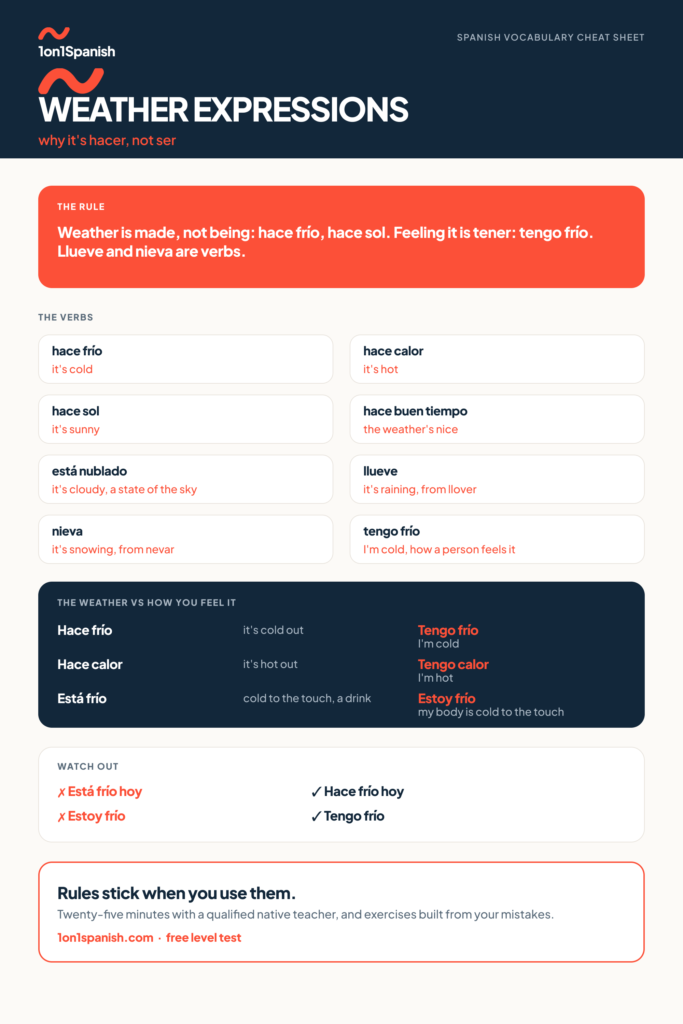
Take the chart with you
The chart is free to view and share. Drop your email and we’ll send the print-ready US Letter PDF — the version you stick on the fridge.
Practice
Practice Spanish weather expressions with a real teacher
Charts get you halfway. The other half is saying it out loud to someone who corrects you on the spot. At 1on1Spanish you get 25-minute private lessons with a qualified native teacher, exercises built from the mistakes you make in class, and AI practice between lessons.
First month $1. No contracts, cancel anytime.
Everything on this page is free to use. If you want feedback on your own Spanish, learn Spanish online with us.
Take your free level testBuilt on RingTeacher's method — 700,000+ classes delivered since 2017, teaching English to Spanish speakers. Now in the other direction.
Frequently asked questions
Why does Spanish use “hacer” for weather instead of “ser” or “estar”?
Spanish treats most weather conditions as something the day or sky “makes” — hace frío, hace sol — rather than a state of being. It’s simply a different grammatical convention than English, which uses “it is.” A handful of conditions, like está nublado, do use estar, because cloud cover behaves more like a temporary state than a condition being “made.”
Is it “tengo frío” or “estoy frío” for “I’m cold”?
Tengo frío is correct — Spanish expresses how a person feels the temperature with tener (“to have”), the same pattern used for tengo hambre (I’m hungry) and tengo sueño (I’m sleepy). Estoy frío is grammatically fine but means something else entirely: that you, as an object, feel cold to the touch.
What’s the Spanish word for “it’s raining”?
Llueve, from the verb llover. Rain and snow don’t follow the hacer pattern that most other weather expressions use — they have their own dedicated verbs, so “it’s snowing” is nieva, from nevar, not hace nieve. Both verbs conjugate only in the third person for weather, since it’s always “it” doing the raining or snowing, never a specific subject.
Does Spanish weather vocabulary change by country?
The core expressions — hace frío, hace calor, llueve, nieva — are standard across every Spanish-speaking country. What varies more is the vocabulary for extreme or regional weather, like words for a heavy tropical downpour, which differ by region far more than everyday phrases do.
What’s the difference between “hace fresco” and “hace frío”?
Hace fresco means it’s cool — pleasant, a light jacket kind of cool. Hace frío means it’s cold, a stronger and less comfortable sensation. The distinction matters in daily conversation the same way “cool” and “cold” do in English, and mixing them up isn’t wrong grammar, just an inaccurate description of the day.