
Months of the year in Spanish: pronunciation and dates
The twelve months are some of the easiest Spanish words to recognize on paper — octubre, noviembre, diciembre look like their English cousins. Saying them naturally and reading a date correctly are a different story: Spanish writes months in lowercase and orders the day before the month, so 3/5 means May 3rd, not March 5th. At 1on1Spanish we drill dates out loud in 25-minute one-on-one lessons with qualified native teachers, online across the United States.
Reviewed by María Jiménez — Licenciada en Filología Hispánica (BA in Hispanic Philology) · Updated Sep 2026
The twelve months
Enero, febrero, marzo, abril, mayo, junio, julio, agosto, septiembre, octubre, noviembre, diciembre.
Most of these are recognizable from English cognates, so the real work is stress and rhythm, not memorization. Junio and julio are the pair that trips people up out loud: they differ by one sound in the middle, and many speakers add a small stress shift — JU-nio, JU-lio — to keep them apart in fast conversation. Febrero keeps its r soft and rolled lightly; dropping it sounds like febrero said with a cold. Septiembre is also spelled and said setiembre in parts of Latin America, though septiembre is the form you’ll see in writing across the region, including Mexico.
Why they’re lowercase
This is the first habit that carries over from English and needs to be unlearned. Spanish capitalizes people, places and proper names, but not months, days of the week, or languages: nací en enero, not Enero. Capitalizing a month isn’t a serious error — a native reader understands it instantly — but it’s one of the fastest tells that a text was written by a learner, the same way writing i instead of I would read strangely in English. The rule is simple to apply once you know it: months only get a capital letter at the start of a sentence, the same as any other word.
Months are one item on a longer list. Days of the week, languages, nationalities and religions all stay lowercase too, and the full set, with the few cases where a capital does come back, is in our guide to Spanish capitalization rules.
Talking about dates: the day comes first
English says May 3rd, month before day. Spanish flips it: el 3 de mayo, day before month, literally “the 3 of May.” This isn’t a minor stylistic choice — it’s the order every native speaker uses, in speech and in writing, and it’s also why numeric dates read backward if you apply the US habit. Written as 3/5, a US reader sees March 5th; a reader used to the Spanish order sees May 3rd. The safest move when the format could confuse anyone — a form, a ticket, a message to a coworker — is to spell the month out: el 3 de mayo, not 3/5.
Saying a date out loud follows the same order and uses ser, not a separate “it is” construction: Hoy es el 3 de mayo. Mi cumpleaños es el 12 de octubre. The word de is required between the day and the month — dropping it (el 3 mayo) is a literal translation of the English pattern and sounds unfinished to a native ear. For “in” a given month, Spanish uses en: en enero, en diciembre, never durante enero unless you specifically mean “throughout” the month.
Two pieces do the work in every date. The verb is always the third person of the ser conjugation, es, whether it’s today or your birthday. The day is a plain cardinal from the Spanish numbers 1-100: el tres, el doce, el veinticuatro. The one exception is the first of the month, el primero de mayo.
Quick reference
| Month | Spanish | Example |
|---|---|---|
| January | enero | Nací en enero. |
| February | febrero | La reunión es en febrero. |
| March | marzo | Llegamos el 1 de marzo. |
| April | abril | Mi hijo nació el 15 de abril. |
| May | mayo | Hoy es 3 de mayo. |
| June | junio | La boda es en junio. |
| July | julio | Vamos de vacaciones en julio. |
| August | agosto | El examen es el 20 de agosto. |
| September | septiembre | Empiezan las clases en septiembre. |
| October | octubre | Mi cumpleaños es el 12 de octubre. |
| November | noviembre | El pago vence en noviembre. |
| December | diciembre | Nos vemos el 24 de diciembre. |
The ones that don’t work the way you’d expect
| Detail | What trips people up |
|---|---|
| lowercase months | Spanish never capitalizes enero, febrero… mid-sentence; only sentence position gets a capital |
| day before month | el 3 de mayo is May 3rd. Reading a numeric date the US way (3/5 = March 5th) gets the wrong month |
| de is required | el 3 de mayo, not el 3 mayo. Dropping de reads like a direct, unfinished translation |
| en for “in a month” | en enero (in January), not durante enero unless you mean the whole month took something |
| junio / julio | Nearly identical out loud; native speakers lean on context and a small stress shift to tell them apart |
Common mistakes English speakers make
Months are lowercase mid-sentence, the same as days of the week and languages.
The connector de between day and month isn’t optional — it’s what makes the phrase grammatical, not just stylistic.
When a date matters, spell out the month instead of using numbers, especially on forms shared between US and Latin American readers.
To say what month it currently is, Spanish more often uses estamos en — “we’re in January” — than a direct es enero, which sounds like you’re announcing January rather than stating the current month.
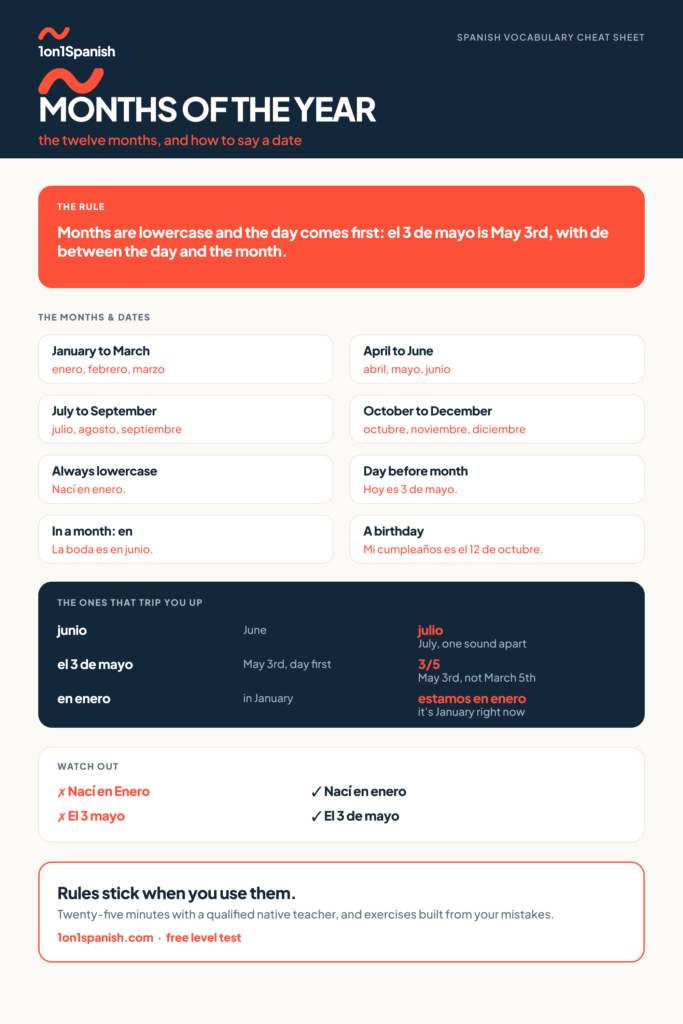
Take the chart with you
The chart is free to view and share. Drop your email and we’ll send the print-ready US Letter PDF — the version you stick on the fridge.
Practice
Practice months and dates with a real teacher
Charts get you halfway. The other half is saying it out loud to someone who corrects you on the spot. At 1on1Spanish you get 25-minute private lessons with a qualified native teacher, exercises built from the mistakes you make in class, and AI practice between lessons.
First month $1. No contracts, cancel anytime.
Reading about it only gets you so far. Learn Spanish online in 25-minute conversations and use it.
Take your free level testBuilt on RingTeacher's method — 700,000+ classes delivered since 2017, teaching English to Spanish speakers. Now in the other direction.
Frequently asked questions
How do you say the months of the year in Spanish?
Enero, febrero, marzo, abril, mayo, junio, julio, agosto, septiembre, octubre, noviembre, diciembre. Most are recognizable from their English cognates. They’re written in lowercase unless they start a sentence, unlike English, which always capitalizes month names. Junio and julio are the pair native speakers themselves sometimes stress differently to keep apart in fast speech.
Why are months lowercase in Spanish?
Spanish only capitalizes proper names — people, places, brands — and treats months, days of the week, and languages as common words. Nací en enero uses a lowercase enero the same way it uses a lowercase lunes for Monday. Capitalizing a month isn’t confusing to a native reader, but it reads as a translated sentence rather than a written one.
Does Spanish write the day or the month first in a date?
The day comes first: el 3 de mayo is May 3rd, not March 5th. This matters most with numeric dates — 3/5 reads as May 3rd under the Spanish order and March 5th under the US order. When a date needs to be unambiguous, spell the month out instead of using numbers.
How do you say “in” a month in Spanish, like “in January”?
With en: en enero, en diciembre. Durante enero also works but means “throughout” or “during the whole month,” a narrower meaning than the general “in January.” For the current month, native speakers often say estamos en enero — “we’re in January” — rather than a bare es enero.
What’s the difference between septiembre and setiembre?
They’re the same month, spelled two ways. Septiembre is the standard form across almost all written Spanish, including Mexico and most of Latin America. Setiembre, without the p, appears in parts of South America and is accepted but less common. If you’re not sure which to write, septiembre is the safer default.