
Terms of endearment in Spanish: mi amor to gordita
This is the vocabulary list where a literal translation actively misleads you. Gordita means “little fat one,” and in most English-speaking contexts calling someone that would end a relationship. In Mexican Spanish, said to a partner, a daughter or a close friend, it’s warm — one of the most common terms of affection there is. Terms of endearment carry more emotional risk than any other vocabulary on this site, because getting the register wrong doesn’t just sound foreign — it can land as rude in a moment that’s supposed to be tender. At 1on1Spanish, a qualified native teacher walks you through exactly who you can say each one to, in 25-minute one-on-one lessons.
Reviewed by María Jiménez — Licenciada en Filología Hispánica (BA in Hispanic Philology) · Updated Sep 2026
Between romantic partners
Mi amor (my love) and mi vida (my life) work everywhere in the Spanish-speaking world and carry no regional risk — they’re the safest starting point. Cariño (dear, sweetheart) is slightly more neutral, usable with a partner or a close family member. Corazón (heart) — ven aquí, corazón — leans tender and works both romantically and with children. Mi cielo (my sky/heaven) is soft and common across Latin America. None of these need translation to land correctly; they mean roughly what they say.
The ones that sound like insults but aren’t
This is the category that needs explaining out loud, because reading it cold gives you the wrong idea. Gordo / gordita (“fatty,” literally) is one of the most common affectionate nicknames in Mexican Spanish — used by parents for children, between partners, between close friends, regardless of anyone’s actual body type. Flaco / flaca (“skinny”) works the same way in the opposite direction. Negro / negrita is used affectionately in parts of Latin America, particularly the Southern Cone and Caribbean, though — unlike gordo and flaco — this one carries real regional and cultural sensitivity around race and is worth understanding rather than using casually as a learner.
The pattern across all of these: physical-description nicknames that would be unthinkable in English are ordinary affection in Spanish, precisely because they’re not meant literally.
Family terms that double as endearments
Mijo / mija (a contraction of mi hijo/hija, “my son/daughter”) is used by parents, and often by older relatives, for anyone younger — not necessarily their own child. Viejo / vieja (“old man/woman”) is a common, affectionate way spouses refer to each other after years together, especially in Mexico — it signals long familiarity, not disrespect. Chiquito / chiquita (“little one”) works for children or as a gentle nickname for someone smaller or younger.
These all grow out of the plain Spanish family vocabulary: hijo, abuelo, tío. Knowing the literal word first is what lets you hear when it’s being used as a nickname instead.
Quick reference
| Spanish | Literal meaning | Who it’s for |
|---|---|---|
| mi amor | my love | partner |
| mi vida | my life | partner |
| cariño | dear, sweetheart | partner, close family |
| corazón | heart | partner, children |
| mi cielo | my sky/heaven | partner, children |
| gordo / gordita | fatty | partner, child, close friend (Mexico especially) |
| flaco / flaca | skinny | partner, child, close friend |
| mijo / mija | my son/daughter | any younger person, by an older speaker |
| viejo / vieja | old man/woman | long-term spouse or partner |
| chiquito / chiquita | little one | children, younger people |
| negro / negrita | — | close relationships, Southern Cone/Caribbean, use with awareness |
| güero / güera | light-skinned/haired | Mexico, affectionate, physical-description nickname |
Where this actually carries risk
The pattern that repeats across every word on this list: the same word can be warm with the right person and wrong with the wrong one. Register and relationship decide everything.
That makes this list a close cousin of Spanish slang: both are safe with the right people and a misstep with everyone else, and both are learned by listening to who says what to whom before you try it yourself.
| Word or pattern | The risk |
|---|---|
| gordo/gordita, flaco/flaca outside close relationships | Fine from a parent, partner or lifelong friend. Said by an acquaintance, a coworker or — especially — a foreigner still learning the culture, it can land as commenting on someone’s body rather than as affection. Context and relationship decide the tone, not the word itself |
| negro/negrita | Carries real regional and racial sensitivity that varies significantly by country. Used affectionately within families and close relationships in some places; risky as a learner to use outside that context until you understand the specific dynamic |
| mija/mijo from a stranger | Common from an older relative or even a stranger in some Latin American communities as warm, informal address — but it assumes a closeness or age gap that can feel presumptuous if used by a peer |
| Using any of these too early | All of these terms signal closeness. Using mi amor or gordita with someone you just met — even meaning to be friendly — reads as overly familiar, the same way it would in English |
Common mistakes English speakers make
If a Mexican partner or in-law calls their daughter gordita, it’s affection, not a comment on weight.
These terms assume the closeness of family or a real friendship — using them too early feels presumptuous, not friendly.
Its comfort level varies by country and relationship in ways that are easy to misjudge as a learner.
between generations, not childish — an older relative calling an adult mija is normal, warm Spanish.
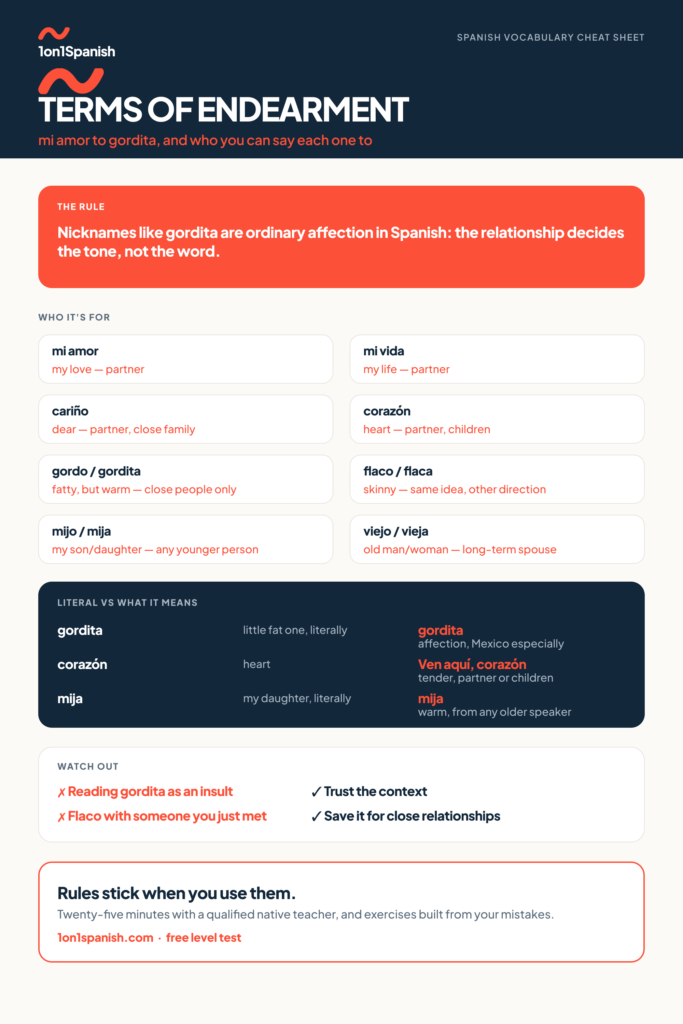
Take the chart with you
The chart is free to view and share. Drop your email and we’ll send the print-ready US Letter PDF — the version you stick on the fridge.
Practice
Practice terms of endearment with a real teacher
Charts get you halfway. The other half is saying it out loud to someone who corrects you on the spot. At 1on1Spanish you get 25-minute private lessons with a qualified native teacher, exercises built from the mistakes you make in class, and AI practice between lessons.
First month $1. No contracts, cancel anytime.
Grammar you can read. Speaking you cannot. Learn Spanish online and practice it live.
Take your free level testBuilt on RingTeacher's method — 700,000+ classes delivered since 2017, teaching English to Spanish speakers. Now in the other direction.
Frequently asked questions
Why do Spanish speakers call people “gordita” as a term of endearment?
Because in Mexican Spanish and much of Latin America, physical-description nicknames aren’t meant literally — they’re markers of closeness, used by parents, partners and close friends regardless of anyone’s actual size. It’s the same emotional logic as an English speaker saying “hey buddy” without meaning the person is literally their construction partner. Context and relationship, not the dictionary meaning, carry the tone.
Is it okay for me to call my partner “gordita” or “flaco”?
If your partner is from a culture where this is common — especially Mexican — and the relationship is close, generally yes, and many partners use these terms warmly every day. If you’re unsure, ask directly, or start with safer, universal options like mi amor or cariño, which carry no risk of misunderstanding anywhere.
What’s the safest term of endearment in Spanish?
Mi amor and mi vida — both mean roughly what they say, carry no regional variation in meaning, and work for a romantic partner anywhere in the Spanish-speaking world. Cariño is a close second and slightly more flexible, usable with close family as well as a partner.
What does “mija” mean and who can say it?
Mija is a contraction of mi hija (“my daughter”), and it’s used far beyond literal parent-child relationships — an older relative, a family friend, sometimes even a stranger in a warm, informal interaction, might use it for any younger woman. It signals warmth and a generational gap more than a literal family tie. Mijo is the equivalent for a younger man.
Are terms of endearment the same across every Spanish-speaking country?
No. Mi amor, mi vida and cariño travel everywhere safely, but words like gordo/gordita and especially negro/negrita carry different weight, comfort level and cultural history from one country to the next. What’s completely normal in one family or region can feel different in another, which is exactly why context and a real teacher matter more than a list.