
Spanish family members: words, phrases and in-laws
Family vocabulary looks simple on a list — madre, padre, hermano — until you meet someone’s whole family and need the words for a mother-in-law, a stepbrother, or the cousin everyone calls by a nickname. Spanish also has a habit English doesn’t: it turns almost any family word into a term of affection with a diminutive ending. At 1on1Spanish we practice real family conversations with qualified native teachers in 25-minute one-on-one lessons.
Reviewed by María Jiménez — Licenciada en Filología Hispánica (BA in Hispanic Philology) · Updated Sep 2026
The immediate family
Los padres means parents — both mother and father together — not “the dads.” It’s one of the first false friends in this topic: los papás also means parents in everyday speech (colloquial, common in Mexico), but los parientes means relatives in general, a much wider word that includes aunts, cousins and in-laws. Mixing up padres and parientes is a common and understandable slip.
La madre (mother), el padre (father), el hijo / la hija (son/daughter), los hijos (children, or sons — Spanish uses the masculine plural for a mixed group). This last point matters across the whole topic: hermanos can mean “brothers” or “a brother and a sister together” — Spanish defaults to the masculine plural whenever the group includes at least one male, so tengo dos hermanos could mean two brothers or one brother and one sister. Context or a follow-up question is the only way to know. That masculine default for mixed groups is a general rule of masculine and feminine in Spanish nouns, and it works the same way with los padres, los tíos and los abuelos.
In-laws and step-family: the words English builds with a suffix
English adds “-in-law” to almost any relative to mark a family-by-marriage connection — mother-in-law, brother-in-law. Spanish uses different, unrelated words instead, and they need to be learned individually. La suegra (mother-in-law), el suegro (father-in-law), los suegros (in-laws in general, or specifically the parents-in-law), el cuñado / la cuñada (brother-in-law / sister-in-law), el yerno (son-in-law), la nuera (daughter-in-law).
Step-family works differently again: Spanish adds -astro/-astra, not a separate word. El padrastro (stepfather), la madrastra (stepmother), el hermanastro / la hermanastra (stepbrother/stepsister), el hijastro / la hijastra (stepson/stepdaughter). These endings carry a slightly clinical, formal tone in some families — many people simply say el hijo de mi esposo/esposa instead, the same way English speakers sometimes avoid “stepson” in casual conversation.
The diminutive: how Spanish says “with love”
This is what makes family Spanish sound warm instead of like a vocabulary list. Adding -ito/-ita to a family word turns it affectionate: abuelita (grandma, warmer than abuela), mamita or mami (mom, casual and loving), hermanito (little brother, or just “bro” affectionately, even between adults). The same ending, and a longer list of what people actually call each other at home, is in our guide to Spanish terms of endearment.
Mijo and mija — contractions of mi hijo and mi hija — are how a parent or older relative addresses a child or younger family member, and they’ve spread beyond literal parent-child use to a general term of warmth from an older speaker to a younger one. None of these are baby talk in the way a diminutive can sound in English; adults use them with each other constantly, especially in Mexican Spanish. The mi inside them is the same one you’ll need for every relative, mi suegra, mis hermanos, and it’s covered in Spanish possessive adjectives.
Quick reference
| English | Spanish | Note |
|---|---|---|
| parents | los padres | not los parientes (relatives) |
| mother / father | la madre / el padre | mamá / papá in daily use |
| son / daughter | el hijo / la hija | |
| siblings (mixed) | los hermanos | defaults masculine for a mixed group |
| mother-in-law | la suegra | not built with “-in-law” logic |
| father-in-law | el suegro | |
| brother/sister-in-law | el cuñado / la cuñada | |
| son-in-law / daughter-in-law | el yerno / la nuera | |
| stepfather / stepmother | el padrastro / la madrastra | |
| grandma (affectionate) | la abuelita | vs. neutral la abuela |
The ones that don’t work the way you’d expect
| Detail | What trips people up |
|---|---|
| padres vs parientes | padres is only “parents”; parientes is the wider word for relatives |
| hermanos | Can mean “brothers” or “siblings” — masculine plural covers a mixed group |
| in-laws | No “-in-law” pattern; each relationship has its own word (suegra, cuñado, yerno) |
| padrastro | The -astro/-astra ending marks step-family, not a negative or informal tone |
| mijo / mija | A contraction of mi hijo/hija, used affectionately beyond literal parent-child pairs |
Common mistakes English speakers make
Parientes means relatives broadly — cousins, aunts, in-laws included — not specifically mother and father.
Hermanos alone already covers a mixed group; adding y hermanas is redundant, not more precise.
There’s no suffix to attach — in-law relationships each get their own noun.
These aren’t baby talk in Spanish; they’re standard warmth, used constantly in family conversation regardless of age.
The -astro ending marks the step-relationship, not disrespect — though some families do prefer el esposo de mi mamá in casual speech.
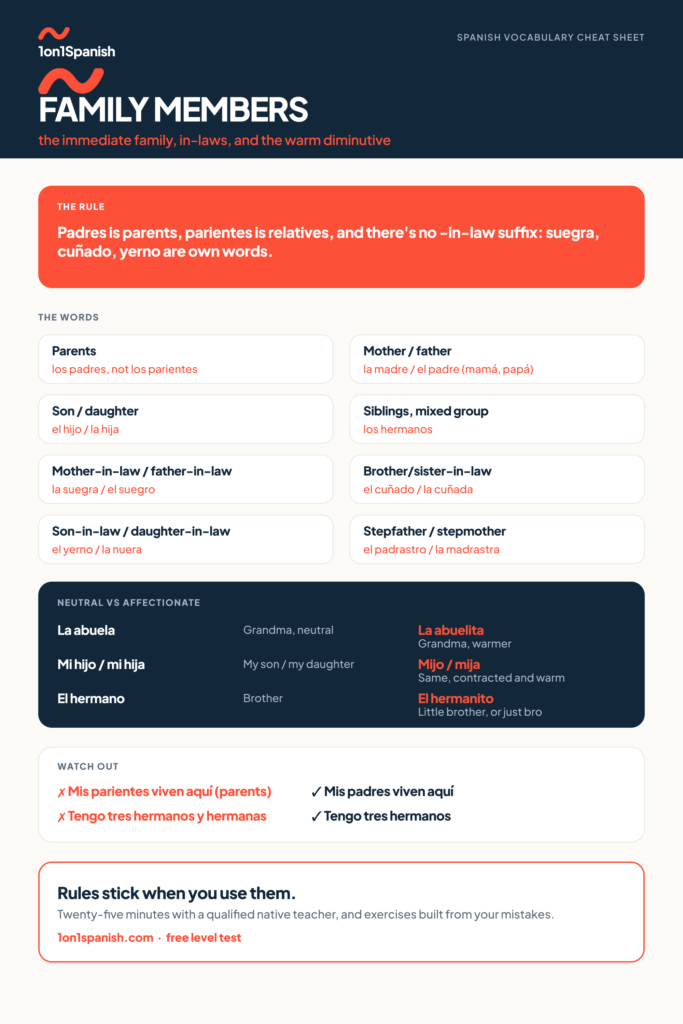
Take the chart with you
The chart is free to view and share. Drop your email and we’ll send the print-ready US Letter PDF — the version you stick on the fridge.
Practice
Practice Spanish family vocabulary with a real teacher
Charts get you halfway. The other half is saying it out loud to someone who corrects you on the spot. At 1on1Spanish you get 25-minute private lessons with a qualified native teacher, exercises built from the mistakes you make in class, and AI practice between lessons.
First month $1. No contracts, cancel anytime.
Prefer to practice with a person? Take one-on-one Spanish lessons online with a qualified native teacher.
Take your free level testBuilt on RingTeacher's method — 700,000+ classes delivered since 2017, teaching English to Spanish speakers. Now in the other direction.
Frequently asked questions
What is the Spanish word for parents?
Los padres. It’s a common false friend to confuse with los parientes, which means relatives in general — cousins, aunts, in-laws, anyone connected by family, not specifically mother and father. Los papás also means parents and is used constantly in everyday, informal speech, especially in Mexico.
How do you say in-laws in Spanish?
Spanish doesn’t build in-law words with a suffix the way English does. Each relationship has its own noun: la suegra (mother-in-law), el suegro (father-in-law), el cuñado / la cuñada (brother/sister-in-law), el yerno (son-in-law), la nuera (daughter-in-law). Los suegros can mean the in-laws generally or specifically the parents-in-law, depending on context.
Does hermanos always mean brothers?
Not necessarily. Spanish defaults to the masculine plural for a mixed-gender group, so tengo dos hermanos could mean two brothers, or one brother and one sister. There’s no shortcut in the word itself to tell which — you’d usually ask a follow-up question or wait for more context to know the exact mix.
Why do Spanish speakers add -ito or -ita to family words?
To add warmth, not to talk down to someone. Abuelita sounds more affectionate than abuela, the way “grandma” feels warmer than “grandmother” in English, but Spanish uses this pattern far more often and across more words — mamita, hermanito, mijito. Adults use these constantly with each other; they’re not baby talk.
What does mijo or mija mean?
It’s a contraction of mi hijo (my son) or mi hija (my daughter), originally how a parent addresses a child. In everyday use, especially in Mexican Spanish, it’s expanded into a general term of affection from an older speaker to someone younger — an aunt to a niece, a grandmother to any child in the family, even a close friend to someone they see as family.