
Spanish slang: the words people actually use
Slang is the gap between the Spanish you studied and the Spanish you hear. It’s also the most regional part of the language: chido is Mexican, chévere is Caribbean and Andean, bacán is Chilean and Peruvian, and all three mean roughly “cool”. Below are the expressions you’ll actually run into in the United States — where the largest Hispanic community is of Mexican origin — grouped so you know where each one belongs and when not to use it. At 1on1Spanish we teach the informal register with qualified native teachers in 25-minute lessons.
Slang is not the same thing as an idiom. Meter la pata is understood from Mexico to Spain and works in almost any register; güey is Mexican and belongs with friends. The fixed expressions that travel are on our Spanish idioms page; this one is the regional, informal layer.
Reviewed by María Jiménez — Licenciada en Filología Hispánica (BA in Hispanic Philology) · Updated Sep 2026
The slang you’ll hear most in the United States
Mexican Spanish dominates informal speech across most of the US, so this is the set that pays off first.
Güey (also written wey) is the all-purpose “dude”. Between friends it’s constant: ¿Qué onda, güey? With someone you just met, it’s too familiar. Not offensive, but strongly marked.
Chido means cool or great. Está chido tu carro. Padre does the same job in the exclamation ¡Qué padre! — literally “how father”, which makes no sense until you accept that slang doesn’t translate.
Órale is the Swiss army knife: agreement (órale, vamos), surprise (¡órale!), and encouragement (órale, apúrate). Tone carries the meaning.
¿Qué onda? is “what’s up”, literally “what wave”. Neta means “for real”: ¿Es neta? is are you serious, and la neta is the truth. Chamba is work in the sense of a job — tengo mucha chamba is I’ve got a lot on.
Ahorita deserves its own warning. It looks like “right now” and it means anything from this second to never, depending on tone and speaker. Ask for a time if it matters.
Slang from the rest of Latin America
You’ll meet these through coworkers, in-laws, music and television.
Chévere — Caribbean, Venezuela, Colombia. Cool, nice, fine. Todo chévere. Bacán — Chile, Peru. Same idea. Pana — Venezuela, Ecuador, Dominican Republic: a close friend. Parcero or parce — Colombia: same. Boludo — Argentina, Uruguay: the local güey, affectionate between friends and insulting from a stranger. Che — Argentina: “hey”, the word that gave Ernesto Guevara his nickname. Pura vida — Costa Rica: hello, goodbye, thanks, all good.
Slang from Spain, so you recognize it
Not the default variety on this site, but it’s what you get on European television and streaming.
Vale is OK — the single most common word in Spain and almost unused in Latin America, where sale, listo or dale take its place. Tío / tía is dude. Guay is cool. Molar means to like: me mola. Currar is to work.
Quick reference
| Word | Where | What it means | Example |
|---|---|---|---|
| güey / wey | Mexico | dude | ¿Qué onda, güey? |
| chido | Mexico | cool | Está chido el lugar. |
| órale | Mexico | OK / wow / come on | Órale, ya vámonos. |
| neta | Mexico | for real, the truth | ¿Es neta? |
| chamba | Mexico, Peru | job, work | Tengo mucha chamba hoy. |
| ahorita | Mexico | in a moment (or never) | Ahorita te llamo. |
| chévere | Caribbean, Colombia | cool, great | Todo chévere. |
| bacán | Chile, Peru | cool | Qué bacán tu depa. |
| pana | Venezuela, Ecuador | close friend | Es mi pana. |
| parce | Colombia | buddy | Hola, parce. |
| boludo | Argentina, Uruguay | dude (or idiot) | Dale, boludo. |
| che | Argentina | hey | Che, ¿vienes? |
| pura vida | Costa Rica | all good | ¡Pura vida! |
| vale | Spain | OK | Vale, nos vemos. |
| tío / tía | Spain | dude | Ese tío es mi jefe. |
The words that change meaning across borders
This is where slang stops being decoration and starts being a real risk. Same word, different country, different meaning — and some of these will get you in trouble.
| Word | In one place | In another |
|---|---|---|
| coger | to take, to grab (Spain) | vulgar in Mexico and most of Latin America — use tomar or agarrar |
| pinche | kitchen assistant (Spain) | a strong intensifier, close to a swear word, in Mexico |
| torta | cake (Spain) | a sandwich in Mexico |
| guagua | bus (Cuba, Puerto Rico, Canary Islands) | baby in Chile |
| chucho | dog (Central America) | cold, as in shivering, in other regions |
| plata | silver | money, across most of Latin America |
| fresa | strawberry | a preppy, stuck-up person in Mexico |
The safe rule while you’re learning: if you’re not sure, use the neutral word. Tomar el autobús works everywhere. Regional slang used correctly builds rapport; used wrong it’s a story your coworkers retell. More on regional differences in the Spanish-speaking countries guide.
Tomar itself is the neutral choice for a reason: the tomar conjugation page covers why it replaces coger across Latin America. And the bus has its own regional names, camión, guagua, colectivo, which are sorted by country in our transportation vocabulary.
Common mistakes English speakers make with slang
✗ Using slang at work on day one. Güey and boludo are for friends. In a meeting, with a client, or with your partner’s parents, they land as disrespect. Understand them first, use them later.
✗ Mixing regions in one sentence. Qué chévere, güey marks you as someone who learned Spanish from a playlist. Pick the variety of the people you actually talk to — in the US, that’s usually Mexican.
✗ Translating slang literally. ¡Qué padre! is not about fathers and ¿qué onda? is not about waves. Learn the whole expression as one unit; the words inside it stopped meaning what they mean.
✗ Trusting ahorita. Treat it as “sometime soon” and confirm: ¿Ahorita ahorita, o en una hora? Native speakers ask this too.
✗ Assuming slang from a song is current. Lyrics preserve expressions long after people stop saying them, the same way English songs still say groovy.
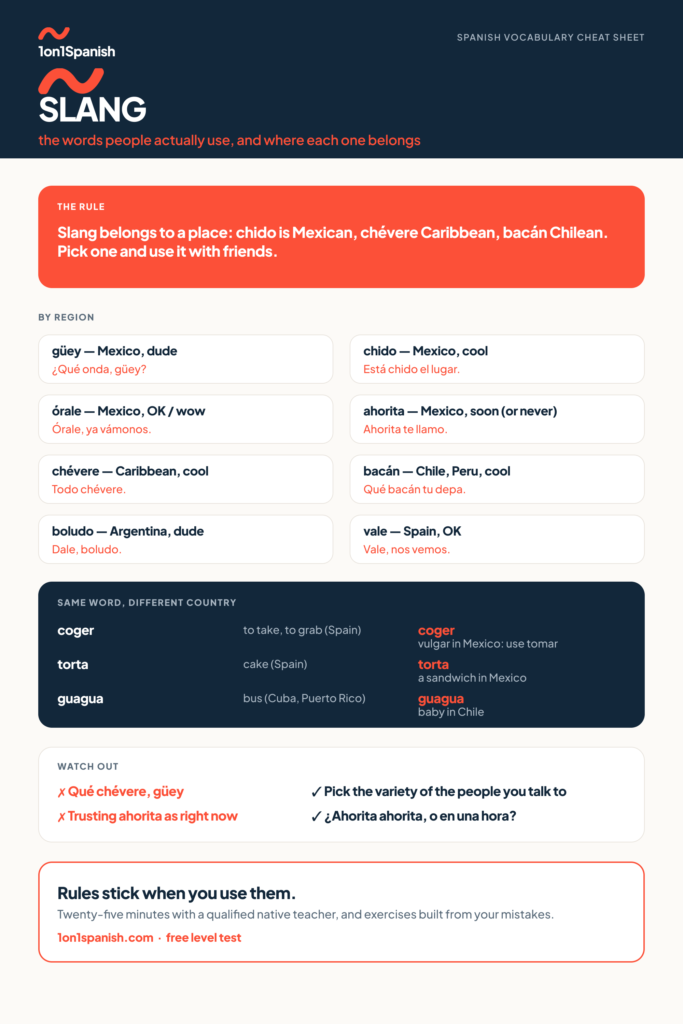
Take the chart with you
The chart is free to view and share. Drop your email and we’ll send the print-ready US Letter PDF — the version you stick on the fridge.
Practice
Practice Spanish slang with a real teacher
Charts get you halfway. The other half is saying it out loud to someone who corrects you on the spot. At 1on1Spanish you get 25-minute private lessons with a qualified native teacher, exercises built from the mistakes you make in class, and AI practice between lessons.
First month $1. No contracts, cancel anytime.
You can go further with someone listening: Learn Spanish with 1on1Spanish, 25 minutes at a time.
Take your free level testBuilt on RingTeacher's method — 700,000+ classes delivered since 2017, teaching English to Spanish speakers. Now in the other direction.
Frequently asked questions
What is the most common Spanish slang word?
It depends on the country, which is the whole problem with slang. In Mexico, and therefore in most Spanish you’ll hear in the United States, güey is the one you’ll notice first — it works like “dude” and appears several times per sentence between friends. Órale and chido come next. In Spain the equivalent everyday word is vale, which means OK and is almost never used in Latin America.
Is Spanish slang the same in every country?
No, and it’s the part of the language that varies most. Cool is chido in Mexico, chévere in Venezuela and Colombia, bacán in Chile and Peru, and guay in Spain. Some words flip meaning across borders: guagua is a bus in the Caribbean and a baby in Chile. Standard Spanish travels everywhere; slang belongs to a place.
Which Spanish slang words should I avoid?
Avoid coger outside Spain — it’s vulgar in Mexico and most of Latin America, where tomar or agarrar do the job. Avoid pinche in Mexico unless you know exactly what you’re doing. And avoid all familiar address words (güey, boludo, tío) at work, with clients, or with people older than you. Slang builds closeness you haven’t earned yet.
How do I learn Spanish slang if textbooks don’t teach it?
By hearing it and being corrected, which is the one thing a book can’t do. Television, music and podcasts from a single country get you the input; a teacher tells you whether an expression is current, regional, rude, or ten years out of date. That last filter is what stops learners from repeating something they picked up from a song.
What does “órale” mean in Spanish?
It’s Mexican and it has three jobs, sorted out by tone. As agreement it means OK or let’s go: órale, vamos. As surprise it means wow: ¡órale, qué grande! As encouragement it means come on, hurry up: órale, que se hace tarde. There’s no single English equivalent, which is why it’s one of the first words learners notice and one of the last they use naturally.