
Spanish travel vocabulary: phrases for every stage of a trip
A travel vocabulary list organized alphabetically is useless the moment you’re standing at immigration and need one specific phrase, fast. This page is organized instead by when you’ll actually need each expression — arrival, hotel, getting around, and asking for help — so you can find what you need in the moment, not after scrolling. At 1on1Spanish a qualified native teacher runs through exactly these situations in role-play during your 25-minute lessons, so the phrases are already familiar before you land.
Reviewed by María Jiménez — Licenciada en Filología Hispánica (BA in Hispanic Philology) · Updated Sep 2026
Arriving: immigration and customs
¿Tiene algo que declarar? — do you have anything to declare? Vengo de vacaciones / de negocios — I’m here on vacation / for business. Me quedo dos semanas — I’m staying two weeks. ¿Dónde recojo mi equipaje? — where do I pick up my luggage? Perdí mi maleta — I lost my suitcase, worth knowing before you need it, not after.
Getting to where you’re staying
¿Dónde puedo tomar un taxi? — where can I get a taxi? ¿Cuánto cuesta hasta el centro? — how much is it to downtown? ¿Me puede llevar a esta dirección? — can you take me to this address? ¿Aceptan tarjeta? — do you take cards? (worth asking before the ride, not after, since cash-only taxis are still common in many cities).
The taxi is only the first option. Buses, the metro and ride shares each have their own words, and the bus changes name by country, camión in Mexico, guagua in the Caribbean, colectivo in Argentina. Those are sorted out in our list of Spanish transportation words.
At the hotel
Tengo una reservación a nombre de… — I have a reservation under the name of… ¿A qué hora es el check-in / check-out? — what time is check-in/check-out? ¿El desayuno está incluido? — is breakfast included? La llave no funciona — the key doesn’t work. ¿Hay wifi? — is there wifi? Necesito otra almohada — I need another pillow.
Getting around and asking for directions
¿Cómo llego a…? — how do I get to…? ¿Está lejos de aquí? — is it far from here? ¿Para dónde sale este autobús? — where does this bus go? Siga derecho, luego doble a la izquierda — go straight, then turn left, the kind of answer you’ll get back and need to follow.
The answer is the hard part, because it comes back as a string of commands: siga, doble, cruce. Those forms, plus left, right, blocks and corners, are on our directions in Spanish page, and they’re worth learning before the trip rather than during it.
Quick reference
| Spanish | English | When you’d use it |
|---|---|---|
| ¿tiene algo que declarar? | do you have anything to declare? | customs |
| vengo de vacaciones | I’m here on vacation | immigration |
| ¿dónde recojo mi equipaje? | where do I pick up my luggage? | arrival |
| perdí mi maleta | I lost my suitcase | baggage claim problem |
| ¿dónde puedo tomar un taxi? | where can I get a taxi? | ground transport |
| ¿cuánto cuesta hasta…? | how much is it to…? | negotiating a fare |
| tengo una reservación a nombre de… | I have a reservation under… | hotel check-in |
| ¿el desayuno está incluido? | is breakfast included? | hotel check-in |
| la llave no funciona | the key doesn’t work | hotel problem |
| ¿cómo llego a…? | how do I get to…? | getting directions |
| ¿está lejos de aquí? | is it far from here? | getting directions |
| siga derecho | go straight | following directions |
Where a phrase-book answer isn’t enough
The tricky part of travel Spanish isn’t the phrase you say — it’s understanding the answer that comes back, which a phrase book can’t prepare you for.
| Situation | The risk |
|---|---|
| asking for directions | You’ll get a real answer, often fast and full of local shortcuts (“hasta la esquina de la farmacia”), not a textbook response. Ask the person to repeat with repita, por favor rather than guessing |
| ordering a taxi | In many Latin American cities, agreeing on a price before the ride (¿cuánto cuesta?) is normal and expected, unlike a metered taxi in the US |
| hotel front desk register | Hotel staff usually address guests with usted; responding in tú isn’t offensive, but matching usted back reads as more polished |
Common mistakes English speakers make
Asking ¿cuánto cuesta? is only half useful if you can’t understand the number that comes back.
Either is understood, so this is a minor detail, not a real risk.
Travel Spanish that’s grammatically perfect but missing basic courtesy words reads as abrupt, more than it would in English.
Asking for a repeat is completely normal and expected from a traveler — it doesn’t mark you as a beginner.
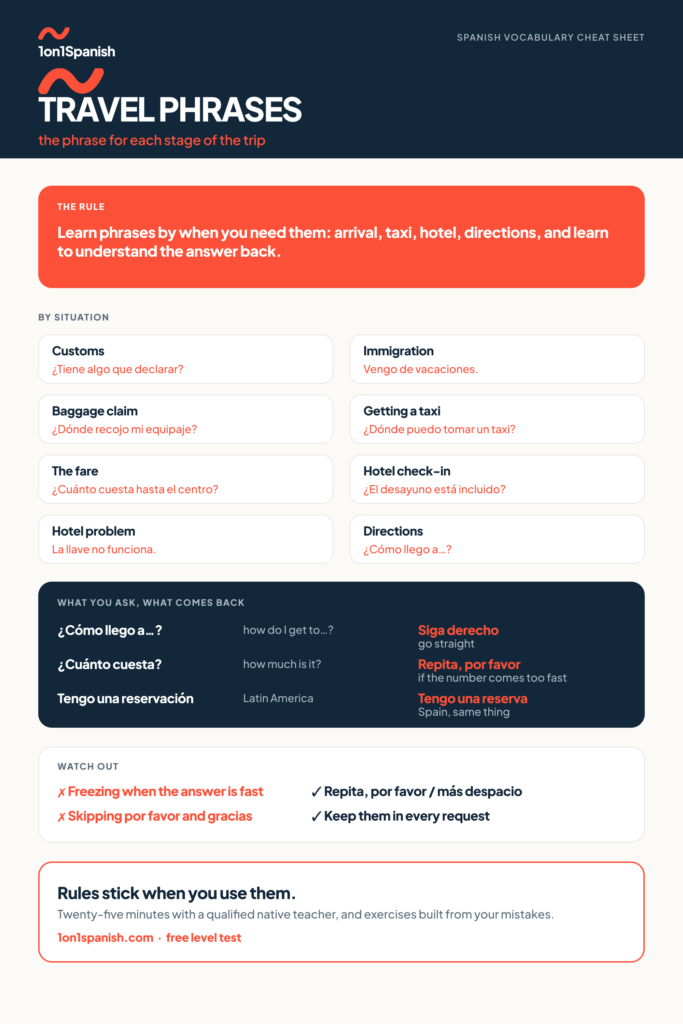
Take the chart with you
The chart is free to view and share. Drop your email and we’ll send the print-ready US Letter PDF — the version you stick on the fridge.
Practice
Practice Spanish travel vocabulary with a real teacher
Charts get you halfway. The other half is saying it out loud to someone who corrects you on the spot. At 1on1Spanish you get 25-minute private lessons with a qualified native teacher, exercises built from the mistakes you make in class, and AI practice between lessons.
First month $1. No contracts, cancel anytime.
These guides are free. When you want someone correcting you out loud, learn Spanish online with a qualified native teacher.
Take your free level testBuilt on RingTeacher's method — 700,000+ classes delivered since 2017, teaching English to Spanish speakers. Now in the other direction.
Frequently asked questions
What Spanish phrases do I need most at the airport?
¿Tiene algo que declarar? (do you have anything to declare?), vengo de vacaciones (I’m here on vacation), and ¿dónde recojo mi equipaje? (where do I pick up my luggage?) cover the two moments where you’re most likely to be asked something directly: immigration and customs. Knowing them before you land takes the pressure off that first conversation.
Is Spanish travel vocabulary the same in every country?
The core phrases — greetings, directions, hotel check-in — are understood everywhere. What varies is smaller vocabulary: a bus can be el autobús, el camión (Mexico), la guagua (Caribbean) or el colectivo (parts of South America), depending on where you are. Learning the general phrase and staying flexible on local words works better than memorizing one country’s version.
Which Spanish travel phrases should I avoid?
None are risky, but relying only on memorized questions without learning basic numbers or directions leaves you unable to understand the answer. A phrase that gets you a response you can’t follow doesn’t actually help — pair travel phrases with numbers and direction words.
How do I learn Spanish for travel if I only have a few weeks before a trip?
Focus on the phrases tied to the situations you’ll actually face — airport, hotel, transportation — rather than general vocabulary, and practice saying them out loud with someone who can correct your pronunciation. A short, focused set of lessons before a trip does more than weeks of app-based review.
What’s the polite way to ask for something in Spanish while traveling?
Add por favor to the request and lead with a question rather than a command: ¿me puede ayudar, por favor? (can you help me, please?) instead of a blunt imperative. Spanish speakers generally expect more verbal courtesy around requests than English speakers default to, especially with strangers or service staff.