
Vegetables in Spanish: names, genders and regional words
Ask for judías verdes in Mexico and you’ll get a confused look, because the vegetable you want is ejotes there. Vegetable names are some of the most regional vocabulary in Spanish — more than fruit, because so many staple vegetables were named independently in different countries before Spanish ever arrived. This page gives you the word used across most of the United States’ Spanish- speaking population, which traces mostly to Mexico, and flags where another country says it differently. At 1on1Spanish you’ll hear real, current vocabulary from a qualified native teacher in every 25-minute lesson, not just the textbook default.
Reviewed by María Jiménez — Licenciada en Filología Hispánica (BA in Hispanic Philology) · Updated Sep 2026
The everyday vegetables
La papa is potato in Latin America (Spain says la patata instead — see the risk table below). La cebolla is onion, el tomate tomato, la zanahoria carrot, el pepino cucumber, la lechuga lettuce, el brócoli broccoli, la coliflor cauliflower, el espárrago asparagus, el apio celery, el rábano radish, and el elote corn on the cob in Mexico and Central America — most of South America says el choclo instead, and Spain says la mazorca or simply el maíz.
The same regional split runs through fruits in Spanish, where a single fruit can carry three names across the map. Learn the two lists together and the Mexican default for both will cover most of the Spanish you hear in the United States.
The ones that trip learners up the most
El chile (chili pepper) is a Mexican staple word, and it covers everything from a mild jalapeño to a fiery habanero — Spanish doesn’t use one word the way English uses “pepper” as a catch-all. Most of South America says el ají instead, and Spain uses el pimiento for the mild, non-spicy bell pepper specifically. Los frijoles (beans) are called los porotos in Argentina, Chile and Uruguay, and las habichuelas in Puerto Rico and parts of the Caribbean — three completely different words for the same food, all correct in their region.
El ejote (green bean) is Mexican and Central American; la judía verde is Spain’s word, and la vainita or la vaina covers much of northern South America. La calabaza is squash or pumpkin depending on context and region; el zapallo is the word for the same family of vegetables in the Southern Cone.
Quick reference
| English | Spanish (Latin American default) | Regional variant |
|---|---|---|
| potato | la papa | la patata (Spain) |
| onion | la cebolla | — |
| tomato | el tomate | el jitomate (central Mexico) |
| carrot | la zanahoria | — |
| cucumber | el pepino | — |
| lettuce | la lechuga | — |
| broccoli | el brócoli | — |
| cauliflower | la coliflor | — |
| corn (on the cob) | el elote (Mexico/Central America) | el choclo (South America), la mazorca (Spain) |
| chili pepper | el chile (Mexico) | el ají (South America), el pimiento (Spain, mild) |
| beans | los frijoles (Mexico) | los porotos (Southern Cone), las habichuelas (Caribbean) |
| green bean | el ejote (Mexico) | la judía verde (Spain), la vainita (northern South America) |
| squash / pumpkin | la calabaza | el zapallo (Southern Cone) |
| garlic | el ajo | — |
| spinach | la espinaca | — |
| celery | el apio | — |
| radish | el rábano | — |
| asparagus | el espárrago | — |
| eggplant | la berenjena | — |
| avocado | el aguacate | la palta (Argentina, Chile, Peru) |
Where the word actually changes
This is the real risk with vegetable vocabulary: a word that’s perfectly normal in one country can draw a blank stare, or mean something else, two countries over.
It’s also the reason a menu can be harder to read than a grammar book. The dish names and mealtime words that sit around these vegetables are in our list of food and drink words in Spanish, with the same country-by-country notes.
| Word | The situation |
|---|---|
| chile / ají / pimiento | Chile is what most teachers here will use, since Mexican Spanish is the majority variety in the US. Ají isn’t wrong — it’s the Southern Cone and Andean word — but using it with a Mexican audience just sounds unfamiliar rather than incorrect. Pimiento in Spain refers specifically to the mild bell pepper, not spicy chilis |
| frijoles / porotos / habichuelas | All three mean beans; none is more “correct.” Using frijoles with an Argentine speaker won’t confuse them, but porotos is what they’d actually say at home |
| papa / patata | Papa is universal across Latin America; patata is Spain’s word. Note that el Papa (capitalized, masculine) means “the Pope” — an easy mix-up in writing, though context almost always makes it clear which one is meant |
| elote / choclo | Elote also refers to a popular Mexican street food — corn on the cob with mayonnaise, cheese and chili — not just the raw vegetable, so the word carries more cultural weight than a simple translation suggests |
Common mistakes English speakers make
Some chiles are mild; the word itself doesn’t signal heat level the way English speakers often assume.
Not wrong Spanish — just the European variant, which reads as unfamiliar to most Latin American speakers.
None is a translation error; they’re regional defaults, the way “soda,” “pop” and “coke” all mean the same drink in different parts of the US.
Swapping a Latin American term for a regional one can also swap the article: el pimiento stays masculine, but double-check gender whenever you substitute a variant.
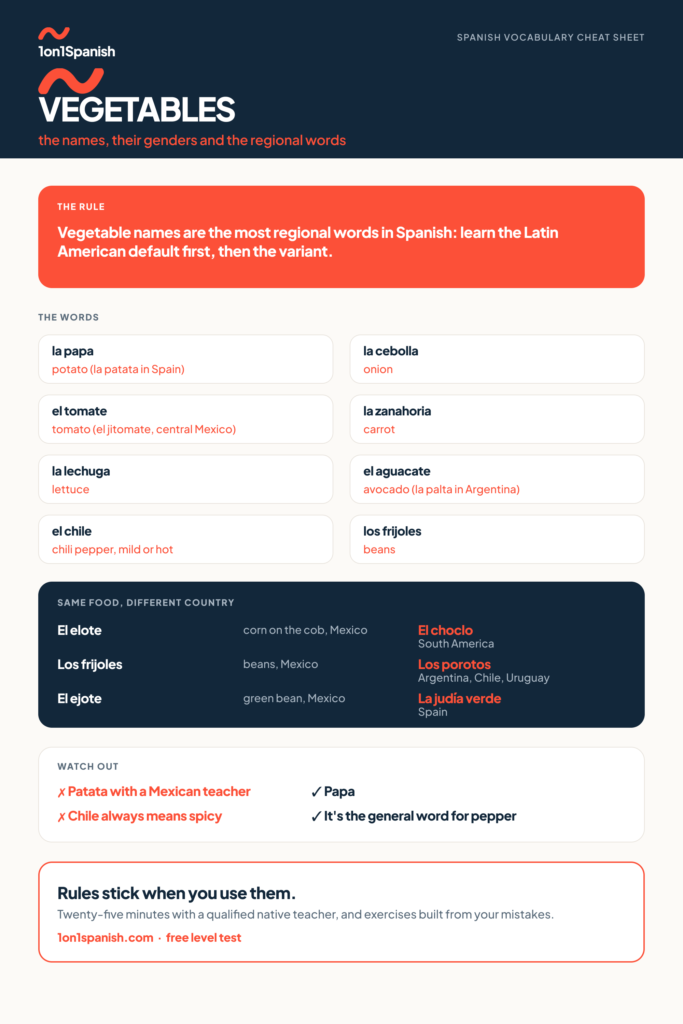
Take the chart with you
The chart is free to view and share. Drop your email and we’ll send the print-ready US Letter PDF — the version you stick on the fridge.
Practice
Practice vegetables in Spanish with a real teacher
Charts get you halfway. The other half is saying it out loud to someone who corrects you on the spot. At 1on1Spanish you get 25-minute private lessons with a qualified native teacher, exercises built from the mistakes you make in class, and AI practice between lessons.
First month $1. No contracts, cancel anytime.
You can go further with someone listening: Learn Spanish with 1on1Spanish, 25 minutes at a time.
Take your free level testBuilt on RingTeacher's method — 700,000+ classes delivered since 2017, teaching English to Spanish speakers. Now in the other direction.
Frequently asked questions
What is the word for potato in Spanish?
Papa is the word used across almost all of Latin America, including Mexico — the majority Spanish-speaking population in the United States. Patata is Spain’s word for the same vegetable. Both are correct; which one you’ll hear from a teacher usually depends on where they’re from.
Is “chile” or “ají” correct for pepper?
Both are correct, and they’re regional rather than right versus wrong. Chile is the word used in Mexico and most of Central America; ají takes over through much of South America. If you’re learning the variety spoken by most Hispanic communities in the US, chile is the one to default to.
Why do beans have three different names in Spanish?
Spanish spread across a huge geographic area over centuries, and everyday food vocabulary filled in locally rather than staying uniform. Frijoles is Mexican and Central American, porotos is used in Argentina, Chile and Uruguay, and habichuelas is common in Puerto Rico and parts of the Caribbean — three regional defaults for the exact same food.
Is vegetable vocabulary different from fruit vocabulary in terms of regional variation?
Both vary by country, but vegetables tend to vary more, partly because staples like beans, corn and chili peppers were named independently by different Indigenous and colonial food traditions before Spanish spread across the continent. Fruit names shift by region too, just somewhat less dramatically.
How do I know which vegetable word to use if I’m not sure where my teacher is from?
Default to the Mexican term — papa, chile, frijoles, elote — since it’s the variety most widely understood across the US and most commonly taught here. If your teacher uses a different regional word, they’ll usually mention it naturally, and understanding both versions is more useful than worrying about which one is “correct.”