
Spanish plural nouns: how to form the plural in Spanish
Add -s to a noun ending in an unstressed vowel, add -es to a noun ending in a consonant or a stressed í or ú, and turn a final -z into -ces. English gets by with one ending and a short list of survivals like “children” and “feet”, so Spanish looks harder until you notice the choice is made by the last letter and nothing else. 1on1Spanish teaches the pattern in 25-minute one-on-one lessons with qualified native teachers, online across the United States.
Reviewed by María Jiménez — Licenciada en Filología Hispánica (BA in Hispanic Philology) · Updated Sep 2026
The three rules
Unstressed vowel → add -s. Casa → casas. Carro → carros. Libro → libros. Taxi → taxis. Tribu → tribus. This covers most Spanish nouns, because most of them end in a vowel.
Consonant → add -es. Papel → papeles. Ciudad → ciudades. Reloj → relojes. Color → colores. Mes → meses. Words ending in -y join this group, since the y counts as a consonant here: rey → reyes, ley → leyes.
Final -z → -ces. Lápiz → lápices. Vez → veces. Luz → luces. Pez → peces. Voz → voces. Spanish doesn’t write ze inside a word, so the z is swapped for c before the ending. It is a spelling rule, not a pronunciation change.
The article moves with the noun: el papel → los papeles, la luz → las luces. Gender never changes in the plural.
Adjectives pluralize with exactly the same three rules, which is half of making adjectives agree in Spanish: casas blancas, papeles azules, niños felices. And all four shapes of the article are on the Spanish definite and indefinite articles page.
Stressed endings, and the words that don’t change
A noun ending in a stressed -á, -é, -ó simply takes -s: café → cafés, sofá → sofás, dominó → dominós. A noun ending in a stressed -í or -ú formally takes -es: israelí → israelíes, tabú → tabúes. Everyday speech shortens these to israelís and tabús, and both are accepted. Menú has already settled on the short form: its plural is menús.
Some nouns are identical in singular and plural. If the word ends in -s or -x and the stress falls anywhere but the last syllable, nothing is added: el lunes / los lunes, la crisis / las crisis, el paraguas / los paraguas, el tórax / los tórax. Only the article tells you the number.
That rule is narrower than it looks. Mes, autobús, inglés and país are stressed on the final syllable, so they behave normally: meses, autobuses, ingleses, países.
Reference chart
| Noun ends in | Add | Example | Plural |
|---|---|---|---|
| unstressed vowel | -s | la mesa | las mesas |
| stressed -á, -é, -ó | -s | el café | los cafés |
| stressed -í, -ú | -es (or -s) | el tabú | los tabúes / los tabús |
| consonant | -es | la ciudad | las ciudades |
| -z | -ces | el lápiz | los lápices |
| -y | -es | la ley | las leyes |
| -s or -x, stress not on last syllable | nothing | la crisis | las crisis |
The accents that appear and disappear
Adding a syllable can move where the stress sits in writing, so the written accent has to follow. It is the same rule applied twice, in opposite directions. If the underlying rule is still fuzzy, the rules for Spanish accent marks explain why examen has no accent and exámenes does.
| The accent appears | The accent disappears |
|---|---|
| el examen → los exámenes | la canción → las canciones |
| el joven → los jóvenes | el inglés → los ingleses |
| la imagen → las imágenes | el autobús → los autobuses |
| el margen → los márgenes | el jardín → los jardines |
| el origen → los orígenes | el alemán → los alemanes |
| el crimen → los crímenes | la lección → las lecciones |
The logic is the same in both columns: the spoken stress never moves, and the written accent only exists to mark it when the spelling rules would put it somewhere else. In examen the stress is already where the rules expect it, so no accent is written; add a syllable and it needs marking. Canción works the other way round: the accent is needed in the singular and stops being needed in the plural.
Common mistakes English speakers make
The -es gets added without swapping the z for a c. It is the most visible plural error in written Spanish, and it also loses the accent on the first syllable.
English never adds accents when a word grows, so the new accent gets skipped. Both exámenes and jóvenes come up constantly in ordinary conversation.
The reverse error, made by people who have learned the first one. The accent on canción belongs to the singular only.
English adds -s to everything, so consonant endings get the wrong ending. Say the word out loud: papels is unpronounceable in Spanish, which is why the -e is there.
Words that already end in -s with the stress earlier in the word don’t change at all. Los lunes, las crisis, los paraguas, los análisis.
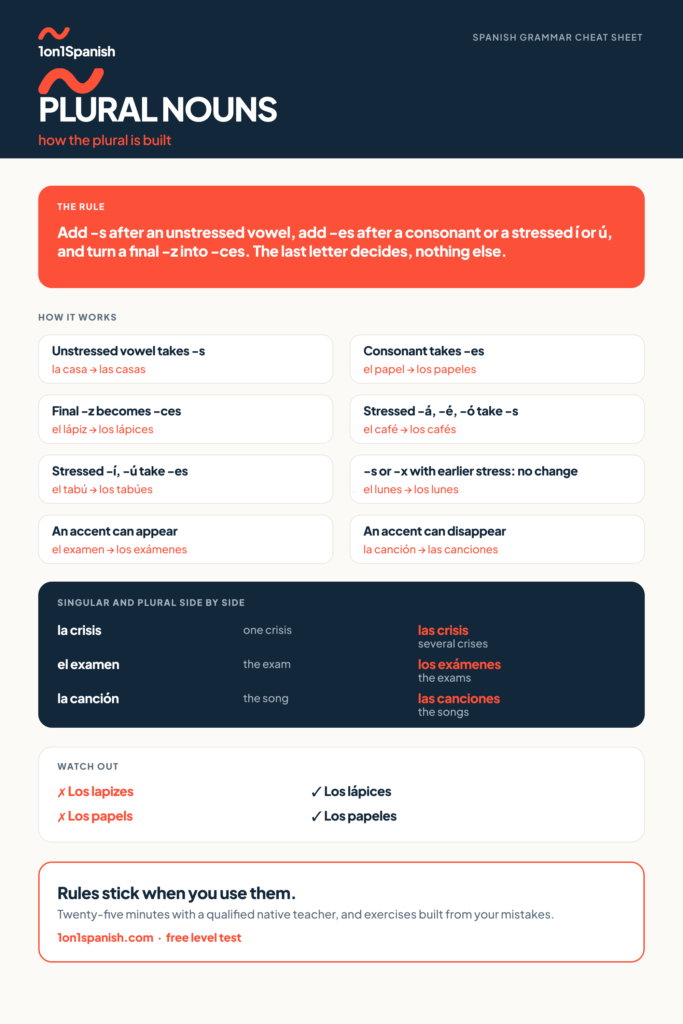
Take the chart with you
The chart is free to view and share. Drop your email and we’ll send the print-ready US Letter PDF — the version you stick on the fridge.
Practice
Practice Spanish plurals with a real teacher
Charts get you halfway. The other half is saying it out loud to someone who corrects you on the spot. At 1on1Spanish you get 25-minute private lessons with a qualified native teacher, exercises built from the mistakes you make in class, and AI practice between lessons.
First month $1. No contracts, cancel anytime.
Prefer to practice with a person? Take one-on-one Spanish lessons online with a qualified native teacher.
Take your free level testBuilt on RingTeacher's method — 700,000+ classes delivered since 2017, teaching English to Spanish speakers. Now in the other direction.
Frequently asked questions
How do you make a noun plural in Spanish?
Look at the last letter. Unstressed vowel: add -s, so casa becomes casas. Consonant: add -es, so papel becomes papeles. Final -z: change it to -ces, so lápiz becomes lápices. The article changes too — el becomes los, la becomes las — and the gender of the noun stays exactly the same.
Why does lápiz become lápices in Spanish?
Because Spanish spelling doesn’t allow ze inside a word, so the z is replaced by c before the plural ending. The sound is unchanged in Latin America and in most of the United States, where c before e and z are both pronounced as an s. The same swap happens with vez → veces, luz → luces and pez → peces.
Which Spanish nouns are the same in singular and plural?
Nouns ending in -s or -x whose stress is not on the last syllable: el lunes / los lunes, la crisis / las crisis, el paraguas / los paraguas, el análisis / los análisis, el tórax / los tórax. Only the article shows the number. Words stressed on the final syllable are not included, so mes becomes meses and autobús becomes autobuses.
Why do some Spanish words gain or lose an accent in the plural?
The spoken stress never moves; the written accent only marks it when the default spelling rules would put it elsewhere. Adding a syllable changes what the default is. Examen needs no accent but exámenes does, and canción needs one while canciones doesn’t. It’s one rule producing opposite results depending on the word.
Do Spanish speakers ever use the plural where English uses the singular?
Yes, in a few fixed cases. Gafas, tijeras and vacaciones are normally plural, the way “glasses” and “scissors” are in English, and estar de vacaciones has no singular. Going the other way, a masculine plural covers a mixed group: mis hermanos can be brothers, or brothers and sisters together.