
Spanish false cognates: words that look English but aren’t
A false cognate looks like an English word, sometimes shares its Latin root, and has drifted far enough in meaning that reading it as its English twin produces a sentence that’s wrong, confusing, or occasionally embarrassing. Most cognates between English and Spanish are trustworthy — nación really does mean “nation” — which is exactly why the handful of exceptions catch people off guard. At 1on1Spanish we flag these in 25-minute one-on-one lessons with qualified native teachers, online across the United States. Learning them by name, as a fixed list, is faster than trying to spot them in the moment.
Reviewed by María Jiménez — Licenciada en Filología Hispánica (BA in Hispanic Philology) · Updated Sep 2026
Words that mean something completely different
A few false cognates don’t just shift in meaning — they land somewhere unrelated, and getting one wrong changes the whole sentence. Embarazada means “pregnant,” not “embarrassed”; the word for embarrassed is avergonzada. Éxito means “success,” not “exit”; the word for exit is salida. Actualmente means “currently” or “right now,” not “actually”; the word for actually is en realidad or de hecho. Realizar means “to carry out” or “to accomplish” a task, not “to become aware of something” — that second meaning is darse cuenta. Say estoy embarazada meaning “embarrassed” and a native speaker hears a very different, and very specific, announcement. Embarazada and avergonzada are both passing states, so they go with estar; if that choice still feels shaky, the page on when to use ser or estar sorts it out, and how to conjugate estar has the forms.
Words with a narrower or shifted meaning
Other false cognates are close enough to their English look-alike that the mismatch is subtler. Sensible means “sensitive,” not “reasonable” or “practical” — the word for that is sensato. Asistir means “to attend” an event, not “to help” — the word for help is ayudar. Pretender means “to intend” or “to try to,” not “to pretend” — the word for pretend is fingir. Recordar means “to remember,” not “to record” — the word for record is grabar. Each of these still carries a thread of connection to its English cousin, which makes the wrong guess feel more reasonable and harder to catch. Ayudar, at least, is regular all the way through, so the ayudar conjugation holds no surprises once you’ve swapped it in for asistir.
The delicate ones — handle with care
A small group of false cognates matter more than the rest because getting them wrong can sound awkward or even alarming, not just incorrect. Molestar means “to bother” or “to annoy” — no me molestes is simply “don’t bother me” — not the English word it visually resembles. Constipado means “having a cold,” as in a stuffy nose, not the English medical term it looks like; estoy constipado is a perfectly normal thing to say to a coworker. Both words are common, ordinary, and completely appropriate in everyday Spanish — the discomfort only exists in the English-speaking listener’s head until the true meaning clicks.
Reference chart
| Spanish word | Looks like | Actually means | Real translation of the English word |
|---|---|---|---|
| embarazada | embarrassed | pregnant | avergonzada |
| éxito | exit | success | salida |
| actualmente | actually | currently, right now | en realidad, de hecho |
| realizar | realize | to carry out, accomplish | darse cuenta |
| asistir | assist | to attend | ayudar |
| sensible | sensible | sensitive | sensato |
| molestar | molest | to bother, annoy | — |
| constipado | constipated | having a cold | estreñido |
| ropa | rope | clothes | cuerda, soga |
| sopa | soap | soup | jabón |
| carpeta | carpet | folder | alfombra |
| librería | library | bookstore | biblioteca |
| colegio | college | school (K-12) | universidad |
| pretender | pretend | to intend, to try to | fingir |
| recordar | record | to remember | grabar |
Exceptions and edge cases: not everything is fake
Most English-Spanish cognates are true and trustworthy — información, decisión, animal, hospital all mean exactly what they look like. False cognates are the exception, not the rule, and even within them the line isn’t always sharp: realizar is a true cognate for “to realize a profit” or “to realize a plan,” and only a false one for “to realize” in the sense of becoming aware.
Sensible is never “reasonable” in Spanish — that one has no safe overlap — while asistir keeps a faint connection to “assist” in formal contexts like asistencia médica (medical assistance), even though the everyday verb means “to attend.” Treat each word on its own rather than assuming the whole category behaves the same way.
Common mistakes English speakers make
Reaching for embarazada to say “embarrassed” is the single most repeated false-cognate mistake, and it announces something the speaker didn’t mean to say.
Éxito means success, not exit — useful information at the airport, not just in conversation.
Actualmente means “currently.” Using it to mean “actually,” as a correction, reverses the intended meaning of the sentence.
Asistir means to attend, so this sentence reads as “I’m going to attend my friend,” not “help” him move.
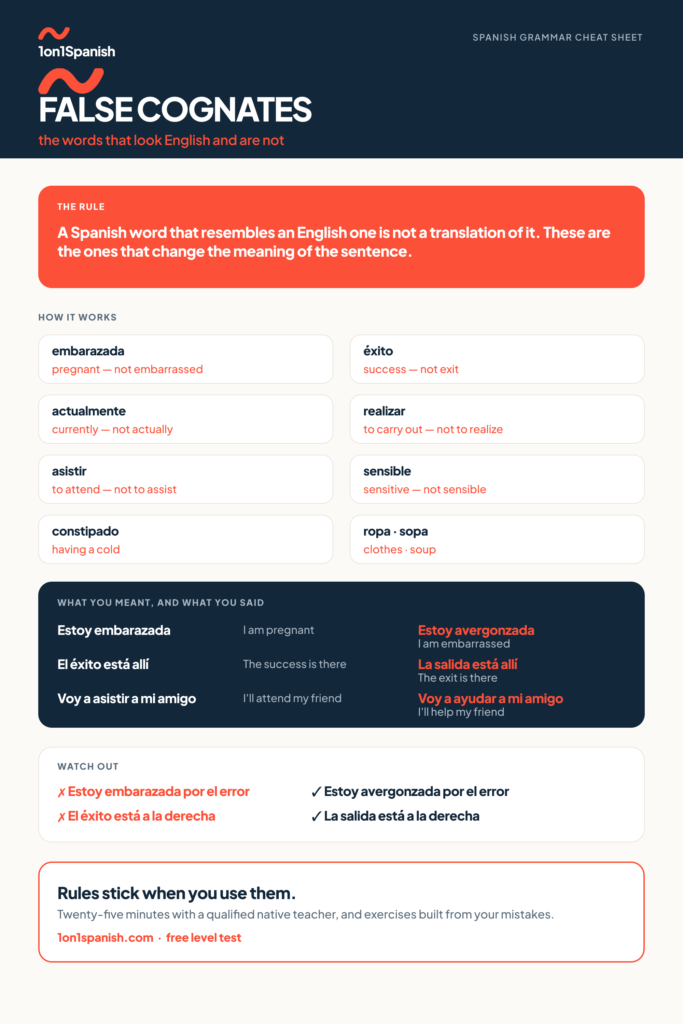
Take the chart with you
The chart is free to view and share. Drop your email and we’ll send the print-ready US Letter PDF — the version you stick on the fridge.
Practice
Practice Spanish false cognates with a real teacher
Charts get you halfway. The other half is saying it out loud to someone who corrects you on the spot. At 1on1Spanish you get 25-minute private lessons with a qualified native teacher, exercises built from the mistakes you make in class, and AI practice between lessons.
First month $1. No contracts, cancel anytime.
You can go further with someone listening: Learn Spanish with 1on1Spanish, 25 minutes at a time.
Take your free level testBuilt on RingTeacher's method — 700,000+ classes delivered since 2017, teaching English to Spanish speakers. Now in the other direction.
Frequently asked questions
What is a false cognate in Spanish?
A word that looks like an English word — sometimes sharing the same Latin root — but that means something different today. Embarazada looks like “embarrassed” but means “pregnant.” Most Spanish-English cognates are reliable; false cognates are the exceptions worth learning by name.
Why doesn’t embarazada mean embarrassed in Spanish?
Both words trace back to a similar root, but they drifted apart over centuries. Embarazada settled on “pregnant” in Spanish, while “embarrassed” took a different path in English. The word for embarrassed in Spanish is avergonzada (or avergonzado for a man).
Is éxito the same as “exit” in Spanish?
No. Éxito means “success” — Tuvo mucho éxito en su carrera is “He was very successful in his career.” The word for the English “exit,” as in a door or a highway ramp, is salida, and it’s the one you actually want printed above a door in an emergency.
What’s the difference between actualmente and “actually”?
Actualmente means “currently” or “right now”: Actualmente vivo en Miami. “Actually,” used to correct or clarify something in English, translates as en realidad or de hecho: En realidad, vivo en Texas. Confusing the two flips the meaning of a sentence.
What’s the most common false cognate mistake in Spanish?
Saying embarazada to mean “embarrassed,” which instead means “pregnant” and changes the sentence completely. The word you want is avergonzado or avergonzada. The second most common is mixing up asistir (to attend) with “assist,” so voy a asistir a mi colega says you’re going to attend your coworker rather than help them. Both slip through because the words look almost identical in print.