
Time expressions in Spanish: telling time and frequency
Two different skills hide behind “time expressions in Spanish”: saying what time it is right now, and describing how often something happens. Both use vocabulary that doesn’t map cleanly onto English, starting with the fact that the one o’clock hour is grammatically singular while every other hour is plural. This page covers both — telling time and frequency — since they’re the expressions that come up in almost every real conversation, from scheduling a class to explaining your routine. At 1on1Spanish a qualified native teacher corrects the small slips that a chart alone can’t catch, in every 25-minute one-on-one lesson.
Reviewed by María Jiménez — Licenciada en Filología Hispánica (BA in Hispanic Philology) · Updated Sep 2026
Telling time: singular only for one o’clock
Spanish uses son las for every hour except one, which takes es la instead, because una is singular. Es la una (it’s one o’clock), but son las dos, son las tres, son las cuatro, and so on — this trips up almost every learner at least once, since English treats every hour identically (“it’s one,” “it’s two”). Minutes attach with y (past the hour) or menos (to the hour): son las dos y media (it’s two thirty), son las tres y cuarto (it’s a quarter past three), son las cinco menos diez (it’s ten to five). En punto means “on the dot”: son las ocho en punto.
Two things have to be automatic before any of this comes out smoothly: es and son from how to conjugate ser, and the numbers in Spanish up to 59, because the minutes are read as plain numbers, las cuatro y veinticinco.
Morning, afternoon, night — and noon and midnight
De la mañana (in the morning), de la tarde (in the afternoon), de la noche (at night) attach to the hour the way “a.m.” and “p.m.” do in English: son las nueve de la mañana. El mediodía is noon and la medianoche is midnight — both are exact times, not general periods, so a mediodía means “at noon” specifically, not “around lunchtime.”
Frequency: how often, not just when
This is the other half of “time expressions,” and it’s just as useful in daily conversation. Siempre (always), casi siempre (almost always), a veces (sometimes), de vez en cuando (once in a while, from time to time), rara vez (rarely), casi nunca (almost never), nunca (never). Frequency by interval works with cada: cada día (every day), cada dos días (every other day), cada semana (every week), una vez a la semana (once a week), dos veces al mes (twice a month).
Words like siempre, a veces and nunca are adverbs, which is why they never change form and why they can sit before or after the verb. Where they go in the sentence, and the rest of the family, is in our guide to Spanish adverbs.
Quick reference
| Spanish | English |
|---|---|
| es la una | it’s one o’clock |
| son las dos | it’s two o’clock |
| son las dos y media | it’s two thirty |
| son las tres y cuarto | it’s a quarter past three |
| son las cinco menos diez | it’s ten to five |
| en punto | on the dot |
| el mediodía / la medianoche | noon / midnight |
| siempre | always |
| a veces | sometimes |
| de vez en cuando | once in a while |
| rara vez | rarely |
| casi nunca | almost never |
| nunca | never |
| cada día | every day |
| cada dos días | every other day |
| una vez a la semana | once a week |
The pattern that breaks the rule
Es la una is the one exception to “son las + hour,” and it’s easy to forget because every other hour in Spanish follows the plural pattern without exception.
| Pattern | The risk |
|---|---|
| es la una vs. son las… | Learners often default to son la una, applying the plural pattern everywhere. Una is grammatically singular, so the verb has to be singular too: es la una |
| a veces vs. algunas veces | Both mean “sometimes” and are interchangeable in most contexts; a veces is more common in everyday speech, algunas veces leans slightly more formal or written |
| de vez en cuando | Doesn’t translate word for word (“from time to time” is close, but “of time in when” makes no sense literally) — treat it as a fixed unit meaning “occasionally” |
Common mistakes English speakers make
One o’clock is the single exception to the plural pattern that governs every other hour.
Media (half) is far more natural for the half hour than spelling out treinta, though both are technically correct.
Lunch itself might happen later; mediodía is a specific time, not a general period of the day.
Siempre means literally always, with no exceptions — overusing it makes a routine sound more rigid than it is.
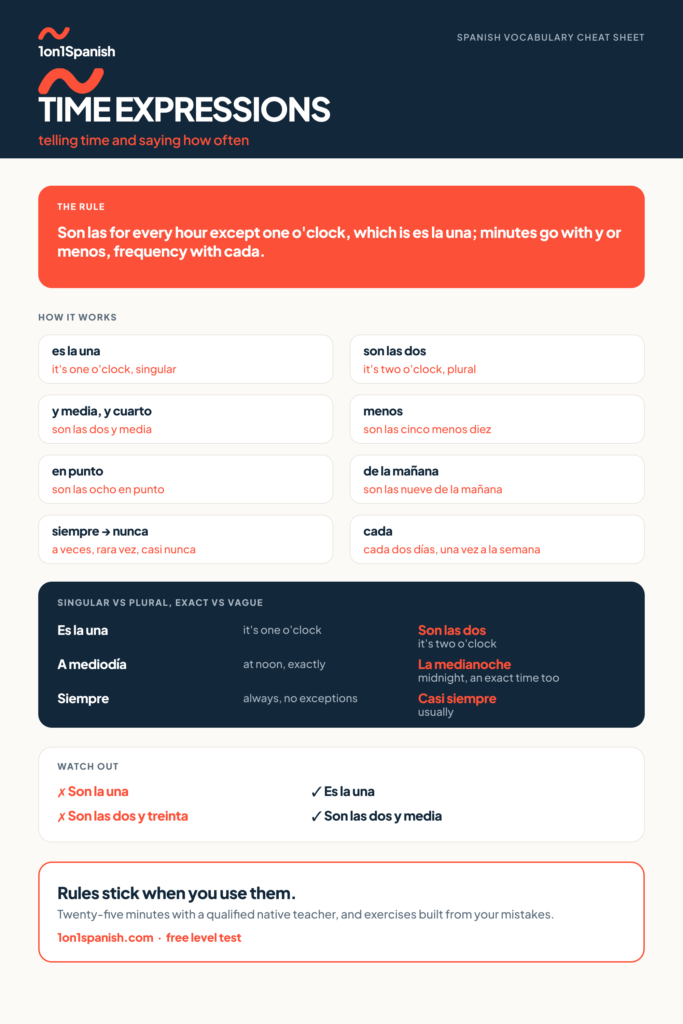
Take the chart with you
The chart is free to view and share. Drop your email and we’ll send the print-ready US Letter PDF — the version you stick on the fridge.
Practice
Practice time expressions in Spanish with a real teacher
Charts get you halfway. The other half is saying it out loud to someone who corrects you on the spot. At 1on1Spanish you get 25-minute private lessons with a qualified native teacher, exercises built from the mistakes you make in class, and AI practice between lessons.
First month $1. No contracts, cancel anytime.
Reading about it only gets you so far. Learn Spanish online in 25-minute conversations and use it.
Take your free level testBuilt on RingTeacher's method — 700,000+ classes delivered since 2017, teaching English to Spanish speakers. Now in the other direction.
Frequently asked questions
Why is it “es la una” but “son las dos”?
Because una (one) is grammatically singular, so it takes the singular verb es. Every other hour — las dos, las tres, and so on — is plural, so it takes son. It’s the one exception in an otherwise consistent pattern, which is exactly why it’s the mistake almost every learner makes at least once.
What’s the difference between “a veces” and “de vez en cuando”?
Both mean roughly “sometimes” or “once in a while,” and in most everyday conversation they’re interchangeable. If there’s a nuance, de vez en cuando can lean slightly more occasional or irregular, while a veces is the more general, more frequent default choice in speech.
How do you say “half past” and “quarter past” in Spanish?
Half past uses y media: son las dos y media (it’s two thirty). Quarter past uses y cuarto: son las tres y cuarto (it’s a quarter past three). For time approaching the hour, Spanish switches to menos: son las cinco menos cuarto (it’s a quarter to five).
Is there a difference between “nunca” and “casi nunca”?
Yes — nunca means never, with no exceptions, while casi nunca means almost never, allowing for rare occasions. Using nunca when you mean casi nunca overstates how absolute something is; a Spanish speaker would take nunca literally. The same distinction applies at the other end of the scale: siempre means always without exception, and casi siempre leaves room for the occasional day that doesn’t fit the pattern.
How do you say “every other day” in Spanish?
Cada dos días, literally “every two days.” It follows a general pattern with cada (each/every) plus a number and a time unit: cada tres semanas (every three weeks), cada seis meses (every six months). This structure covers almost any recurring interval you need to describe.