
Spanish punctuation rules: ¿, ¡ and what’s different
Spanish punctuation isn’t English punctuation with a few extra symbols on top — the opening question and exclamation marks are required, not decorative, dialogue uses a dash instead of quotation marks, and numbers write the decimal point and the thousands separator backwards from English. Getting these wrong doesn’t just look foreign, it can make a sentence briefly unreadable until the reader hits the closing mark and has to reread it. At 1on1Spanish we cover this in 25-minute one-on-one lessons with qualified native teachers, online across the United States.
Below are the five differences that come up in real writing, starting with the two everyone already half-knows.
Reviewed by María Jiménez — Licenciada en Filología Hispánica (BA in Hispanic Philology) · Updated Sep 2026
¿ and ¡ open the sentence — they’re not optional
Spanish marks a question or an exclamation at both ends: ¿Cómo estás?, ¡Qué sorpresa! The opening mark isn’t stylistic flourish, it’s functional — Spanish word order doesn’t always signal a question the way English does with “do” or “does”, so the ¿ at the start warns the reader before they’ve read the sentence, not after. Dropping it is one of the most visible non-native markers in Spanish writing, even in a text message. In speech the same job falls to pitch, and the intonation of Spanish questions page covers what your voice has to do, since the word order won’t.
The opening mark only goes at the start of the question or exclamation itself, not necessarily the whole sentence: Oye, ¿vienes a la fiesta? keeps Oye outside the marks because it isn’t part of the question. Inside the marks, ¿Cómo estás? also carries two accents, and they come from different rules: interrogatives like cómo and qué take a tilde whenever they’re asking, and estás gets its own from the Spanish stress and accent rules.
Dialogue uses a dash, not quotation marks
Spanish fiction and formal dialogue traditionally use a long dash — called a raya — to open each line of speech, instead of English-style quotation marks:
—¿Vienes mañana? —preguntó Ana. —No puedo, tengo que trabajar —respondió Carlos.
Each new speaker starts a new dash, and a second dash reappears mid-line to set off a narrator’s tag like preguntó Ana without closing the character’s speech. This convention is strongest in literary and journalistic Spanish; everyday digital writing — texts, social media, casual emails — increasingly borrows English-style quotation marks, so both forms show up in the real world.
Angle quotes for quoting text
Formal Spanish, especially in Spain and in print, favors angle quotes — «comillas angulares» — over the double quotation marks English uses: Ella dijo: «Nos vemos a las ocho». Latin American Spanish uses these less consistently and often defaults to regular double quotes instead, so both are considered correct depending on region and formality; what matters is knowing the angle-quote style exists and isn’t a typo when it shows up in a Spanish book or article.
The decimal comma and the thousands point
Spanish and English write numbers with the comma and the period swapped. English writes 1,000.50; Spanish writes 1.000,50. A period marks thousands, a comma marks the decimal:
| Meaning | English and most of Latin America | Spain and much of South America |
|---|---|---|
| One thousand | 1,000 | 1.000 |
| Ten and a half | 10.5 | 10,5 |
| A price | $1,250.75 | $1.250,75 |
This one splits by country, and the split matters more than the rule. Mexico, Central America, the Caribbean and Spanish as written in the United States use the same marks as English: a comma for thousands and a period for decimals. Spain, Argentina and much of South America do the opposite. The Real Academia accepts both. So if you write to a Mexican colleague, $1,250.75 is right; write the same figure to Madrid and a European-style 1.000 is one thousand, not one point zero zero zero. When in doubt, spell the number out or say the currency.
No Oxford comma
Spanish doesn’t use a comma before the final “and” in a list. English style guides argue over the Oxford comma; Spanish never adds one: Compré manzanas, peras y uvas, with no comma before y. Adding one, the way many English writers do out of habit, reads as a punctuation error rather than a stylistic choice.
Common mistakes English speakers make
Skipping the opening ¿ is the single most common punctuation error in Spanish writing, and it also strips out the accent that tells the reader the sentence is a question in the first place.
Same problem with exclamations: the opening ¡ isn’t optional, even in casual texting.
Adding a comma before the final y out of Oxford-comma habit is a small, constant tell in otherwise fluent writing.
Keeping English-style commas and periods in a Spanish number swaps which mark means what: a Spanish reader could parse 1,250.75 as one point two five, not one thousand two hundred fifty.
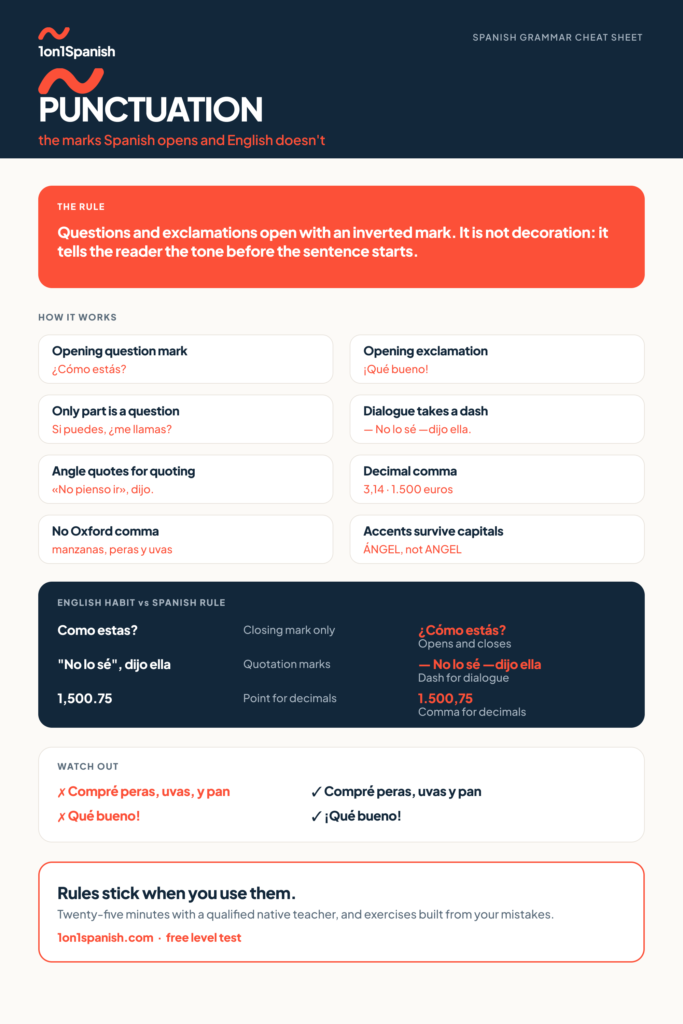
Take the chart with you
The chart is free to view and share. Drop your email and we’ll send the print-ready US Letter PDF — the version you stick on the fridge.
Practice
Practice Spanish punctuation rules with a real teacher
Charts get you halfway. The other half is saying it out loud to someone who corrects you on the spot. At 1on1Spanish you get 25-minute private lessons with a qualified native teacher, exercises built from the mistakes you make in class, and AI practice between lessons.
First month $1. No contracts, cancel anytime.
The fastest way to make this stick is to say it to someone. Learn Spanish online with a real teacher.
Take your free level testBuilt on RingTeacher's method — 700,000+ classes delivered since 2017, teaching English to Spanish speakers. Now in the other direction.
Frequently asked questions
Why does Spanish use an upside-down question mark?
Because Spanish word order doesn’t always flag a question in advance the way English does with “do” or “does”. The opening ¿ warns the reader at the very start of the sentence instead of only at the end, so the sentence can be read with the right intonation from the first word. The same logic applies to the opening ¡ before an exclamation.
Is the opening ¿ or ¡ ever optional in Spanish?
No, not in standard writing. Dropping the opening mark and keeping only the closing one is common in casual texting among native speakers, but it’s not correct usage and it’s one of the fastest tells of non-native writing when it happens consistently rather than as an informal shortcut.
How does Spanish punctuate dialogue?
Traditionally with a long dash, the raya, at the start of each line of speech instead of quotation marks, with a second dash used to insert a narrator’s tag mid-line. Everyday digital writing increasingly uses English-style quotation marks instead, so both forms are common depending on how formal the text is.
Does Spanish use commas and periods the same way as English in numbers?
No, they’re swapped. Spanish uses a period for thousands and a comma for decimals: 1.000,50 means one thousand and a half, the opposite of what those marks would mean read as English punctuation. Misreading this can turn one number into a completely different one.
Does Spanish use the Oxford comma?
No. Spanish never places a comma before the final y (“and”) in a list: Compré manzanas, peras y uvas, with no comma before y. Adding one out of English habit is read as a small punctuation error, not a stylistic choice, in standard Spanish writing.