
Spanish classroom vocabulary: objects and live-class phrases
Most classroom vocabulary lists are built for a room with desks and a chalkboard — not for the way adults actually study Spanish now, which is one-on-one, by video call. What you need isn’t el pupitre or la pizarra, it’s the handful of phrases that keep a live lesson moving: how to ask your teacher to slow down, how to say you can’t hear them, how to ask how something is spelled. At 1on1Spanish every 25-minute lesson is a real conversation with a qualified native teacher, and these are the exact phrases that conversation starts with.
Reviewed by María Jiménez — Licenciada en Filología Hispánica (BA in Hispanic Philology) · Updated Sep 2026
The moment class starts
The first minute of a video lesson is its own small ritual, and it’s almost entirely functional. ¿Me escuchas bien? (“Can you hear me OK?”) and Sí, te escucho bien are the opening check. Se congeló la pantalla means “the screen froze” — worth knowing before it happens, not during. Un momento, se me fue el internet buys you a second if your connection drops.
When you don’t understand something
This is the vocabulary that actually saves a lesson from turning into a guessing game. Repite, por favor — please repeat that. ¿Puedes hablar más despacio? — can you speak more slowly? No entendí eso último — I didn’t understand that last part. ¿Cómo se dice “spreadsheet” en español? — how do you say “spreadsheet” in Spanish, useful for exactly the vocabulary a textbook won’t have. ¿Cómo se escribe esa palabra? — how do you spell that word, which matters more on a video call than it ever did in a physical classroom, since you can’t always see text clearly. To follow the answer when your teacher spells it out, you need the letter names in the Spanish alphabet: be, uve, jota. And más despacio and ¿cómo se dice? also open our list of common Spanish phrases, since they work just as well outside class.
The tech side of a video lesson
This is vocabulary a printed classroom list from ten years ago simply doesn’t have, and it’s the part that actually differs between a live one-on-one class and an app. Comparte la pantalla — share your screen. No te escucho — I can’t hear you (different from no te entiendo, which means “I don’t understand you”). Se cortó el audio — the audio cut out. ¿Me ves bien? — can you see me OK? Voy a apagar la cámara un segundo — I’m going to turn off my camera for a second.
The objects your teacher might still mention
A live class does still involve a few physical things, even by video: el cuaderno (notebook), la libreta (also notebook, used interchangeably in most of Latin America), el lápiz (pencil), el bolígrafo or la pluma (pen — pluma is more common in Mexico), los audífonos (headphones), la cámara (camera), el micrófono (microphone), and la tarea (homework). Your teacher may also mention la pantalla compartida (the shared screen) or el documento (the document) if you’re working from a shared file together.
Quick reference
| Spanish | English | When you’d use it |
|---|---|---|
| ¿me escuchas bien? | can you hear me OK? | starting the call |
| se congeló la pantalla | the screen froze | tech problem |
| repite, por favor | please repeat that | didn’t catch something |
| ¿puedes hablar más despacio? | can you speak more slowly? | too fast to follow |
| no entendí eso último | I didn’t understand that last part | asking for clarification |
| ¿cómo se dice…? | how do you say…? | missing a word |
| ¿cómo se escribe esa palabra? | how do you spell that word? | need it in writing |
| comparte la pantalla | share your screen | reviewing a document together |
| no te escucho | I can’t hear you | audio problem |
| se cortó el audio | the audio cut out | connection dropped |
| el cuaderno / la libreta | notebook | taking notes |
| la tarea | homework | end of class |
| los audífonos | headphones | audio equipment |
| el micrófono | microphone | audio equipment |
Formal or informal with your teacher
Whether you use tú or usted with a teacher varies more than learners expect, and it’s not purely regional — it depends on the teacher’s own style and how the lesson opens. The rule for choosing between the two with anyone new is in our guide to Spanish greetings, and a teacher is the easiest person to ask directly.
| Situation | The risk |
|---|---|
| addressing your teacher | Many adult online classes default to tú to keep things conversational, but some teachers — especially older or more formal ones — prefer usted. Mirror what your teacher uses in the first minute, or simply ask: ¿te puedo tratar de tú? |
| pluma vs bolígrafo vs lapicero | All three mean “pen.” Pluma is common in Mexico, bolígrafo is understood everywhere and safe as a default, lapicero shows up in parts of South America and can also mean “pencil case” depending on the country |
| computadora vs computador vs ordenador | Computadora is standard across most of Latin America, computador in Colombia and Chile, ordenador in Spain — all three are correct, just regional |
Common mistakes English speakers make
No te entiendo means the words don’t make sense to you; no te escucho means you can’t hear them at all. Mixing these up sends your teacher down the wrong troubleshooting path.
A 25-minute lesson is too short to spend three of them nodding along to something you didn’t follow.
Traditional classroom lists spend most of their space on furniture and wall fixtures that never come up in a one-on-one video lesson.
¿Cómo se llama? asks what something is called; ¿cómo se escribe? asks how it’s spelled — a small distinction that matters the first time you need to write down a word.
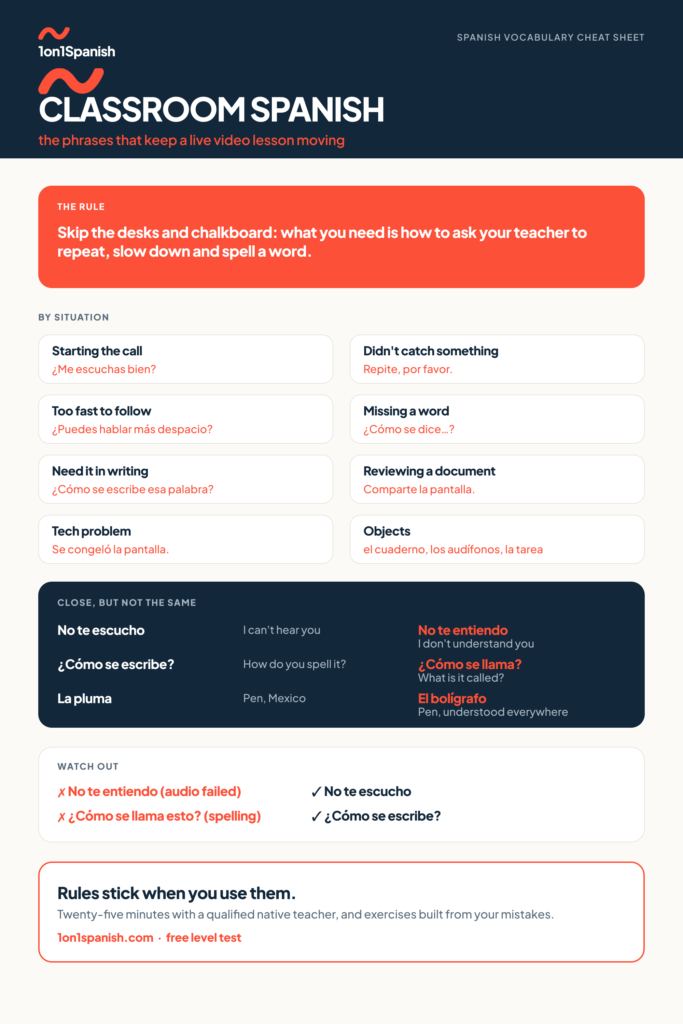
Take the chart with you
The chart is free to view and share. Drop your email and we’ll send the print-ready US Letter PDF — the version you stick on the fridge.
Practice
Practice Spanish classroom vocabulary with a real teacher
Charts get you halfway. The other half is saying it out loud to someone who corrects you on the spot. At 1on1Spanish you get 25-minute private lessons with a qualified native teacher, exercises built from the mistakes you make in class, and AI practice between lessons.
First month $1. No contracts, cancel anytime.
Everything on this page is free to use. If you want feedback on your own Spanish, learn Spanish online with us.
Take your free level testBuilt on RingTeacher's method — 700,000+ classes delivered since 2017, teaching English to Spanish speakers. Now in the other direction.
Frequently asked questions
What is the most useful classroom phrase in Spanish?
For a live video lesson, repite, por favor (please repeat that) is the one you’ll reach for most. It’s short, polite, and it works in almost any moment of confusion — far more useful day to day than any object name, since it keeps the conversation moving instead of stalling it.
Is classroom Spanish the same in every online class?
The phrases about hearing, repeating and understanding are essentially universal across Latin American Spanish. What varies more are object names like pluma versus bolígrafo for pen, which shift by country. In a one-on-one class, your teacher’s own region shapes which version you’ll hear most.
Which classroom phrases should I avoid?
None are risky, but confusing no te entiendo (I don’t understand you) with no te escucho (I can’t hear you) sends the conversation in the wrong direction — your teacher will try to explain something again instead of checking your microphone. Keep the two clearly separate.
How do I learn classroom Spanish if I only take online classes?
By using the phrases from the first lesson onward instead of waiting until you’re “ready.” They’re short, low-stakes, and a good teacher expects to hear them constantly from a new student — that’s literally what they’re for. A one-on-one class also gives you room to try a phrase, get it wrong, and hear the correction immediately, which is harder to arrange with a group or a self-paced app.
What does “comparte la pantalla” mean?
It means “share your screen,” the request you’ll hear whenever a lesson moves to a shared document, a set of slides, or an exercise you’re reviewing together. It’s one of the phrases that a printed classroom vocabulary list from a physical school simply wouldn’t include.