
Spanish idioms: the ones adults actually hear and use
Idioms are the expressions where a word-for-word translation actively hurts you: dar en el clavo means “to hit the nail on the head” — accurate, as it happens — but estar como agua para chocolate does not mean anything about water or chocolate once you’re actually in a conversation. It means someone is fuming. Below are the idioms that come up in real, everyday adult conversation — at work, with in-laws, complaining about traffic — grouped by what they’re used for, with the region noted whenever the meaning or the phrase itself changes. At 1on1Spanish a qualified native teacher explains what an idiom means the moment you hear it wrong, in a 25-minute one-on-one lesson.
Reviewed by María Jiménez — Licenciada en Filología Hispánica (BA in Hispanic Philology) · Updated Sep 2026
Idioms about mindset and mood
These describe a state of mind, and they carry the emotional weight that a plain adjective doesn’t.
Estar en las nubes — to be daydreaming, distracted, not paying attention. Literally “to be in the clouds.” Perdón, ¿qué dijiste? Estaba en las nubes. Ponerse las pilas — literally “to put in your batteries,” meaning to get serious, get moving, stop wasting time. A boss says it to a slow team; a parent says it to a teenager. No tener pelos en la lengua — literally “to have no hairs on your tongue,” meaning to speak bluntly, say exactly what you think without softening it. Mi abuela no tiene pelos en la lengua. Estar como agua para chocolate — Mexican in origin (and the title of the famous novel), meaning to be at the boiling point, furious or about to explode. It describes intensity, not literal water.
Three of these four are built on verbs you already conjugate, and the idiom doesn’t change the conjugation, only the meaning. Estaba en las nubes follows the estar conjugation exactly; ponte las pilas is the reflexive ponerse, covered on the poner conjugation page.
Idioms about effort and outcome
These come up constantly at work and in everyday problem-solving.
Dar en el clavo — to hit the nail on the head, to get something exactly right. Meter la pata — literally “to put in the paw/hoof,” meaning to mess up, put your foot in it. Metí la pata con ese correo. Ser pan comido — to be a piece of cake, something easy. Hablar hasta por los codos — literally “to talk even through your elbows,” meaning to talk nonstop, a mile a minute. Affectionate, not usually an insult. Costar un ojo de la cara — to cost an arm and a leg, literally “an eye from your face.” Ese departamento cuesta un ojo de la cara.
Sayings and proverbs you’ll hear from anyone over 40
These are complete sentences, closer to English proverbs than to short idioms, and they’re common enough that a native speaker will drop one mid-conversation without explaining it.
Más vale tarde que nunca — better late than never. Ojos que no ven, corazón que no siente — out of sight, out of mind, literally “eyes that don’t see, heart that doesn’t feel.” Quien no arriesga, no gana — nothing ventured, nothing gained, literally “who doesn’t risk, doesn’t win.” No hay mal que por bien no venga — every cloud has a silver lining, literally “there’s no bad from which good doesn’t come.” Camarón que se duerme, se lo lleva la corriente — a Mexican favorite: “the shrimp that falls asleep gets carried off by the current,” meaning stay alert or you’ll miss out.
Quick reference
| Idiom | Literal words | What it actually means |
|---|---|---|
| dar en el clavo | to give in the nail | to get something exactly right |
| meter la pata | to put in the paw | to mess up |
| ponerse las pilas | to put in your batteries | to get serious, hurry up |
| estar en las nubes | to be in the clouds | to be distracted, daydreaming |
| no tener pelos en la lengua | to have no hairs on the tongue | to speak bluntly |
| ser pan comido | to be eaten bread | to be very easy |
| hablar hasta por los codos | to talk even through the elbows | to talk nonstop |
| costar un ojo de la cara | to cost an eye from the face | to be very expensive |
| estar como agua para chocolate | to be like water for chocolate | to be furious (Mexico) |
| tomar el pelo | to take the hair | to tease, pull someone’s leg |
| más vale tarde que nunca | better late than never | (same, proverb) |
| ojos que no ven, corazón que no siente | eyes that don’t see, heart that doesn’t feel | out of sight, out of mind |
| camarón que se duerme, se lo lleva la corriente | the shrimp that falls asleep gets swept away | stay alert or you’ll miss out |
Where the same idiom means something different, or doesn’t travel
Estar como agua para chocolate is understood everywhere the novel and film traveled, but it’s strongest and most natural in Mexican Spanish; in other countries a listener may need a second to place it. Camarón que se duerme is also a Mexican favorite that’s less automatic in the Southern Cone, where the same warning is more likely phrased directly. Tomar el pelo works across the Spanish-speaking world, but its tone can range from playful teasing to mild deception depending on context, so it’s worth listening for how it’s used before using it yourself.
Idioms travel better than Spanish slang words, which can flip meaning from one country to the next. An idiom that doesn’t land usually just gets a blank look; slang used in the wrong country can get you a very different reaction.
| Idiom | The risk |
|---|---|
| estar como agua para chocolate | Sounds native in Mexican Spanish; in Spain or the Southern Cone it lands as a cultural reference more than an everyday phrase |
| meter la pata | Casual and safe with friends and coworkers; too informal for a written apology or a formal complaint |
| hablar hasta por los codos | Meant affectionately — using it about a stranger, rather than someone you know, can come across as rude |
Common mistakes English speakers make
Estar en las nubes has nothing to do with weather once it’s an idiom; treat it as a single vocabulary item, not four words to decode separately.
Ojos que no ven, corazón que no siente fits a reflective conversation; dropping it into small talk about the weather sounds oddly formal.
Estar como agua para chocolate is instantly understood in Mexico and less automatic elsewhere; a Chilean speaker might use a different phrase for the same feeling.
Native speakers mix plain language with the occasional idiom for effect — stacking three in a row sounds rehearsed, not natural.
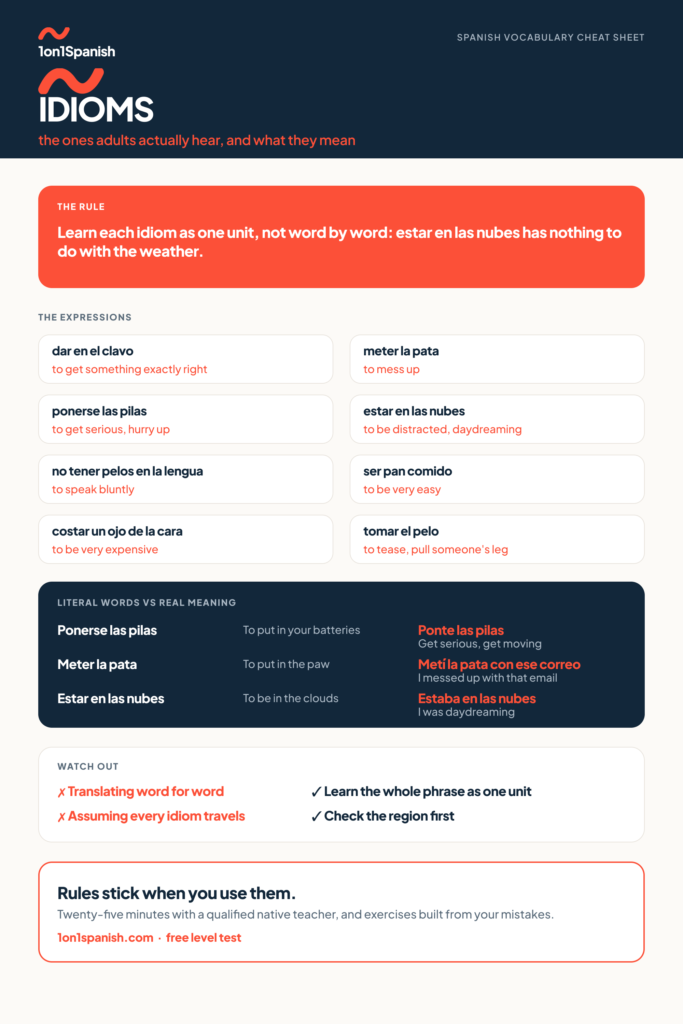
Take the chart with you
The chart is free to view and share. Drop your email and we’ll send the print-ready US Letter PDF — the version you stick on the fridge.
Practice
Practice Spanish idioms with a real teacher
Charts get you halfway. The other half is saying it out loud to someone who corrects you on the spot. At 1on1Spanish you get 25-minute private lessons with a qualified native teacher, exercises built from the mistakes you make in class, and AI practice between lessons.
First month $1. No contracts, cancel anytime.
The fastest way to make this stick is to say it to someone. Learn Spanish online with a real teacher.
Take your free level testBuilt on RingTeacher's method — 700,000+ classes delivered since 2017, teaching English to Spanish speakers. Now in the other direction.
Frequently asked questions
What is the most common Spanish idiom?
There isn’t a single global winner, but meter la pata (to mess up) and ponerse las pilas (to get serious, hurry up) come up constantly in everyday conversation across Latin America, especially at work or between friends giving each other a hard time. Both are safe in casual and semi-formal settings, which is part of why they’re so frequent.
Are Spanish idioms the same in every country?
Many are understood everywhere, but usage varies. Estar como agua para chocolate is Mexican in origin and lands most naturally there; other countries recognize it but may reach for a different phrase for the same feeling. As with slang, the safest approach while learning is to notice which idioms the people around you actually use, rather than memorizing a global list.
Which Spanish idioms should I avoid?
None are dangerous the way some slang can be, but formal writing — a cover letter, a complaint to a landlord — is not the place for meter la pata or hablar hasta por los codos. Save proverbs like más vale tarde que nunca for reflective conversation rather than small talk, where they can sound unexpectedly serious.
How do I learn Spanish idioms if textbooks don’t teach them?
By hearing them used and asking what they mean on the spot, which is exactly what a book can’t offer. Textbooks tend to list idioms out of context, which makes them hard to recall later. A teacher who uses one naturally in conversation, and explains it right then, is what makes it stick.
What does “ponerse las pilas” mean in Spanish?
Literally “to put in your batteries,” it means to get serious, focus, or hurry up — the kind of thing a boss says to a slow team or a parent says to a distracted teenager. It’s encouraging more than harsh, closer to “let’s get moving” than to a real scolding, and it’s used across almost all of Latin America.