
Restaurant Spanish phrases: from sitting down to the bill
Ordering food in Spanish is one of the first real conversations a learner has outside a classroom, and it follows a predictable order: getting seated, ordering, and paying. This page walks through that order, because the phrase you need at the door isn’t the one you need at the end of the meal — and the ending is where most English speakers get caught off guard, since in Latin America the bill doesn’t arrive automatically. At 1on1Spanish a qualified native teacher runs through exactly this kind of situation in role-play during 25-minute one-on-one lessons.
Reviewed by María Jiménez — Licenciada en Filología Hispánica (BA in Hispanic Philology) · Updated Sep 2026
Getting seated
Una mesa para dos, por favor — a table for two, please. Tengo una reservación a nombre de… — I have a reservation under the name of… ¿Hay mesa disponible? — is there a table available? ¿Podemos sentarnos afuera? — can we sit outside?
Ordering
¿Qué me recomienda? — what do you recommend? (formal, addressing the server with usted, which is standard). Para mí, el… — I’ll have the…, the natural way to order without a full sentence. ¿Qué trae este plato? — what comes with this dish? Sin cebolla, por favor — without onion, please, useful for any dietary preference. Para tomar, un agua / una cerveza / un jugo — to drink, a water / a beer / a juice.
What comes after para mí, el… is the Spanish food and drink vocabulary, which is where the regional surprises live: the same dish can have a different name two countries over. And if you do want a full sentence, the verb is pedir, the verb for ordering: voy a pedir el pescado.
During the meal
Está delicioso — it’s delicious, the kind of small comment that’s genuinely expected mid-meal, not just at the end. ¿Me trae más agua, por favor? — can you bring me more water, please? Todo bien, gracias — everything’s good, thanks, the standard reply when a server checks in.
¿Me trae…? is the form you’ll reuse most during a meal: more bread, another beer, the menu again. It’s the usted form of the traer conjugation, and phrasing it as a question keeps it polite without a single extra word.
Paying: the part that surprises people
La cuenta, por favor — the check, please. This is the phrase that matters most, because in most of Latin America, the bill is not brought automatically once you’re finished eating — asking for it is expected, not rude. Waiting for it to appear on its own can mean sitting at the table for a while with no bill in sight. ¿Aceptan tarjeta? — do you take cards? ¿Está incluida la propina? — is the tip included? (worth asking, since the answer varies by country). Quédese con el cambio — keep the change.
Quick reference
| Spanish | English | When you’d use it |
|---|---|---|
| una mesa para dos, por favor | a table for two, please | arriving |
| tengo una reservación a nombre de… | I have a reservation under… | arriving, reserved |
| ¿qué me recomienda? | what do you recommend? | ordering |
| para mí, el/la… | I’ll have the… | ordering |
| sin cebolla, por favor | without onion, please | ordering, preferences |
| está delicioso | it’s delicious | during the meal |
| ¿me trae más agua? | can you bring me more water? | during the meal |
| la cuenta, por favor | the check, please | ending the meal |
| ¿aceptan tarjeta? | do you take cards? | paying |
| ¿está incluida la propina? | is the tip included? | paying |
| quédese con el cambio | keep the change | paying |
Where the habits actually differ from the US
The phrases themselves are simple. The custom around them is what actually catches people off guard.
| Habit | The risk |
|---|---|
| asking for the bill | In most of Latin America and Spain, waiting for the check to appear on its own can mean waiting a long time — you’re expected to ask: la cuenta, por favor. This isn’t considered rushed or impolite |
| tipping | Whether a tip is included, expected, or optional varies significantly by country — asking ¿está incluida la propina? avoids both under-tipping and paying twice |
| addressing the server | Usted is the safer default with restaurant staff in most formal settings, though casual spots may lean more relaxed |
Common mistakes English speakers make
The custom of bringing the bill automatically once the meal ends is a US habit, not a Latin American one.
Expected tip percentages, and whether a service charge is already built in, vary by country — confirm rather than guess.
You don’t need a complex sentence to order — this shorthand is how native speakers actually do it.
Disculpe, pedí esto sin cebolla (excuse me, I ordered this without onion) is normal and expected, not confrontational.
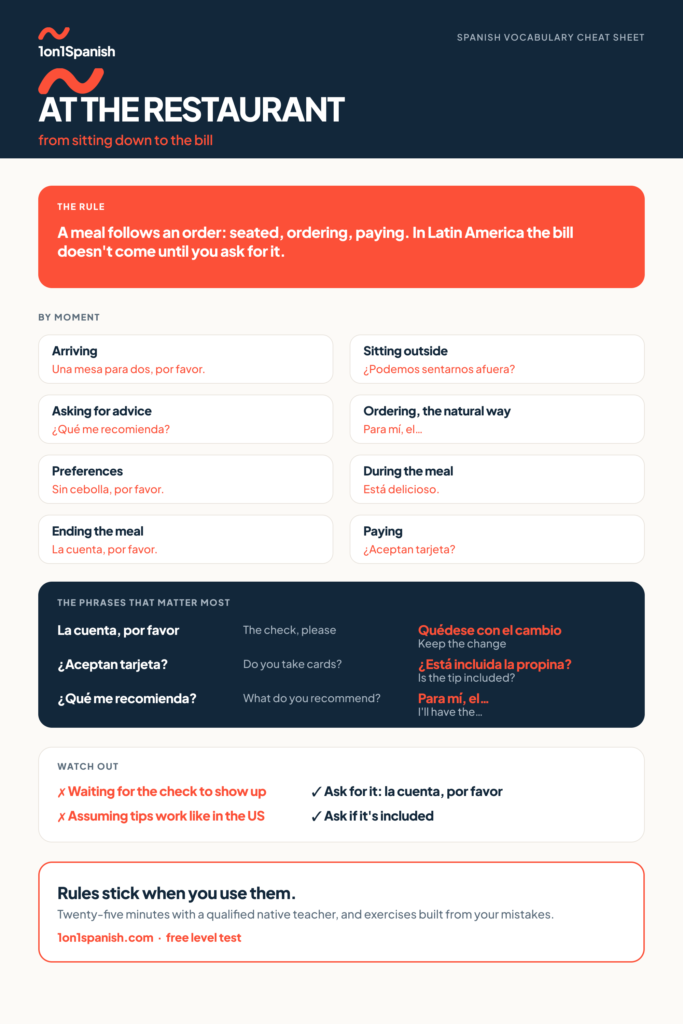
Take the chart with you
The chart is free to view and share. Drop your email and we’ll send the print-ready US Letter PDF — the version you stick on the fridge.
Practice
Practice restaurant Spanish phrases with a real teacher
Charts get you halfway. The other half is saying it out loud to someone who corrects you on the spot. At 1on1Spanish you get 25-minute private lessons with a qualified native teacher, exercises built from the mistakes you make in class, and AI practice between lessons.
First month $1. No contracts, cancel anytime.
The fastest way to make this stick is to say it to someone. Learn Spanish online with a real teacher.
Take your free level testBuilt on RingTeacher's method — 700,000+ classes delivered since 2017, teaching English to Spanish speakers. Now in the other direction.
Frequently asked questions
How do you ask for the bill in Spanish?
La cuenta, por favor (the check, please). This is one of the most important restaurant phrases to know, because in most Latin American countries and in Spain, the check isn’t brought automatically once you finish eating — you’re expected to ask for it, and doing so is completely normal, not rushed or impolite.
What’s a polite way to order food in Spanish?
Para mí, el/la… (I’ll have the…) is short, natural, and exactly how native speakers order — you don’t need a full sentence. Adding por favor at the end keeps it polite: para mí, la sopa, por favor. If you’re unsure about a dish, ¿qué me recomienda? (what do you recommend?) is a polite, common way to ask the server directly instead of guessing.
Is it true that restaurants don’t bring the check automatically in Latin America?
Yes, generally. Unlike the US, where the check often appears once plates are cleared, most restaurants in Latin America and Spain wait for you to ask. Sitting at the table after finishing your meal, waiting, can mean a long wait — asking for la cuenta is the expected move.
Should I use “tú” or “usted” with a server?
Usted is the safer default in most restaurant settings, especially anything beyond very casual. Some servers or casual spots may respond with tú, and you can follow their lead, but starting formal is unlikely to seem out of place. Servers themselves often address customers with usted too, so mirroring their register back is generally the safest, easiest choice to make.
How do I ask if the tip is included in Spanish?
¿Está incluida la propina? (is the tip included?). Tipping customs and whether a service charge is automatically added to the bill vary by country, so asking directly avoids either under-tipping or accidentally tipping twice. It’s a completely normal question to ask a server, not an awkward one, and most will answer it without hesitation.