
Shopping Spanish vocabulary: sizes, prices, fitting rooms
Shopping is one of the first situations where textbook Spanish and real Spanish visibly diverge: asking for a size, trying something on, and asking a price all use words and constructions that don’t translate directly from English. At 1on1Spanish we practice these exact exchanges with qualified native teachers in 25-minute one-on-one lessons, so ordering, asking, and paying stop feeling like a script.
Reviewed by María Jiménez — Licenciada en Filología Hispánica (BA in Hispanic Philology) · Updated Sep 2026
Trying something on: probarse
English says “try on”; Spanish uses the reflexive verb probarse, literally “to try oneself”: ¿Puedo probarme esta camisa? (Can I try this shirt on?), me la voy a probar (I’m going to try it on). The reflexive pronoun is required — dropping it, puedo probar esta camisa, sounds like you want to sample the shirt the way you’d sample food, not wear it briefly to check the fit. El probador is the fitting room: ¿Dónde está el probador?
¿Puedo probarme esta camisa? packs two grammar points into five words. The me works the way it does in every other Spanish reflexive verb, and esta is one of the demonstrative adjectives, which have to match the noun: esta camisa, este pantalón, estos zapatos.
Sizes: la talla and el número
Clothing size is la talla: ¿Qué talla usas? (What size do you wear?), necesito una talla más grande (I need a bigger size). Shoe size is a different word entirely — el número: ¿Qué número calzas? (What shoe size do you wear? — literally “what number do you shoe”), uso el número ocho (I wear an 8). Mixing these up, asking for la talla of a shoe, is understood but marks you instantly as translating from English, where “size” covers both.
Sizing systems also don’t line up between the US and Latin America — a US size 8 shoe isn’t a número 8 in Mexico — so when it matters, the safest question is ¿cuál es mi talla/número aquí?, letting the clerk convert, rather than assuming your US size transfers directly.
Asking the price: cuánto cuesta vs. cuánto vale
Both questions work and mean the same thing: ¿cuánto cuesta? and ¿cuánto vale? are interchangeable ways to ask “how much is it?” Costar and valer both mean roughly “to cost” or “to be worth,” and regional preference varies more than meaning does — both are understood everywhere in Latin America. A shorter, very common version drops the verb’s subject entirely: ¿cuánto es? (how much is it, literally “how much is”), the version you’ll hear most at a register.
Asking the price is the easy half. The answer comes back fast, as a full number with the currency last, so make sure the Spanish numbers up to 100 are automatic before you rely on ¿cuánto cuesta? in a store.
Haggling isn’t the default
This is the detail that surprises people who’ve traveled to a street market and assume it transfers everywhere: regatear (to haggle) is common in open-air markets and with independent vendors, but it’s not expected — and can come across as rude — in a formal store, a mall, or any shop with fixed, printed prices. If a price tag is on the item, treat it as final. Haggling belongs to a specific context: markets, street stalls, informal sales, not a retail counter.
Quick reference
| English | Spanish | Example |
|---|---|---|
| to try on | probarse | ¿Puedo probarme esto? |
| fitting room | el probador | ¿Dónde está el probador? |
| size (clothing) | la talla | ¿Qué talla usas? |
| size (shoes) | el número | ¿Qué número calzas? |
| how much is it? | ¿cuánto cuesta? / ¿cuánto vale? | ¿Cuánto cuesta esta camisa? |
| receipt | el recibo | ¿Me da el recibo, por favor? |
| cash | efectivo | Voy a pagar en efectivo. |
| to pay | pagar | ¿Puedo pagar con tarjeta? |
| discount | el descuento | ¿Hay descuento? |
| to haggle | regatear | En el mercado sí se puede regatear. |
The ones that don’t work the way you’d expect
| Detail | What trips people up |
|---|---|
| probarse | Needs the reflexive pronoun; dropping it changes “try on” into something closer to “sample” |
| talla vs número | Clothing uses talla, shoes use número — English “size” covers both, Spanish doesn’t |
| cuánto cuesta / vale | Fully interchangeable; neither one is more correct or more formal than the other |
| regatear | Normal in markets, out of place and potentially rude in a store with fixed prices |
| tarjeta | Means credit or debit card generically; if it matters, ask ¿tarjeta de crédito o débito? |
Common mistakes English speakers make
Without the reflexive me, it sounds like you want to taste-test the shirt, not wear it briefly.
Shoe size uses número, not talla — the two words for “size” aren’t interchangeable across categories.
Haggling over a marked, printed price in a regular store reads as pushy, not savvy.
US and Latin American sizing systems don’t match one-to-one for clothing or shoes.
Both ¿cuánto cuesta? and ¿cuánto vale? are standard, natural questions — there’s no hierarchy between them.
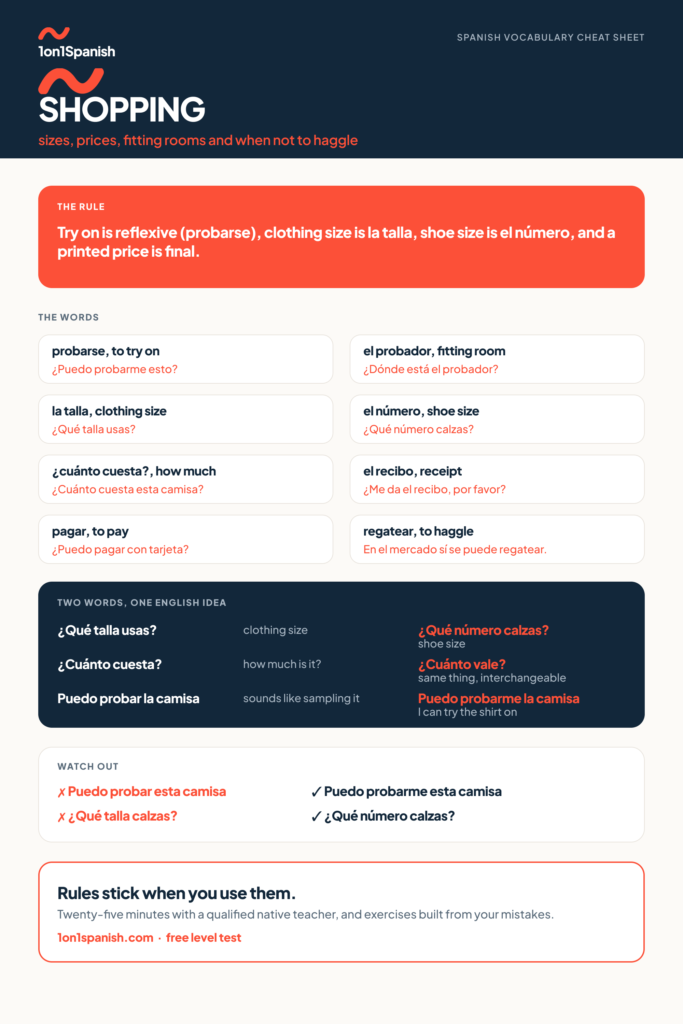
Take the chart with you
The chart is free to view and share. Drop your email and we’ll send the print-ready US Letter PDF — the version you stick on the fridge.
Practice
Practice shopping Spanish vocabulary with a real teacher
Charts get you halfway. The other half is saying it out loud to someone who corrects you on the spot. At 1on1Spanish you get 25-minute private lessons with a qualified native teacher, exercises built from the mistakes you make in class, and AI practice between lessons.
First month $1. No contracts, cancel anytime.
You can go further with someone listening: Learn Spanish with 1on1Spanish, 25 minutes at a time.
Take your free level testBuilt on RingTeacher's method — 700,000+ classes delivered since 2017, teaching English to Spanish speakers. Now in the other direction.
Frequently asked questions
How do you say “try on” in Spanish?
Probarse, a reflexive verb: ¿Puedo probarme esta camisa? (Can I try this shirt on?). The reflexive pronoun matters — without it, probar alone leans toward “to sample” or “to test,” which sounds odd applied to clothing. El probador is the fitting room where you’d go to do it.
What’s the difference between talla and número in Spanish?
Talla is used for clothing size — ¿qué talla usas? — while número is used for shoe size — ¿qué número calzas? English uses “size” for both, but Spanish keeps them as two separate words, and using the wrong one for the wrong category is one of the fastest tells of a direct translation from English.
Is it ¿cuánto cuesta? or ¿cuánto vale? to ask a price?
Either one works and both are correct: costar and valer both mean roughly “to cost” or “to be worth” here, and native speakers use them interchangeably. A shorter, very common version at a register is simply ¿cuánto es?, “how much is it.”
Is it normal to haggle over prices in Spanish-speaking stores?
Only in specific settings — open-air markets, street vendors, informal sales. In a formal store, a mall, or anywhere with fixed, printed prices, haggling is not expected and can come across as rude or out of place. Regatear belongs to the market, not the register.
Do clothing sizes match between the US and Latin America?
No, sizing systems for both clothing and shoes differ by country and don’t line up one-to-one with US sizes. The safest approach when it matters is to ask ¿cuál es mi talla/número aquí? and let the salesperson convert, rather than assuming a US size transfers directly.