
Sports in Spanish: names and the right verb to use
Sports vocabulary is easy to memorize and surprisingly easy to get wrong out loud, because English uses one verb — “play” — for almost everything, and Spanish splits that job across three different verbs depending on the sport. Learn the names without the verbs and you’ll still sound off every time you talk about your weekend. At 1on1Spanish you drill the whole phrase, verb and all, with a qualified native teacher in every 25-minute one-on-one lesson.
Reviewed by María Jiménez — Licenciada en Filología Hispánica (BA in Hispanic Philology) · Updated Sep 2026
Team and ball sports: jugar
Jugar — to play — goes with sports that involve a ball or a shared game against an opponent. El fútbol is soccer, and in the United States this is the word Spanish speakers use even though English “football” means something else; American football is el fútbol americano. El béisbol, el básquetbol or básquet, el vóleibol, el tenis — all take jugar: juego fútbol los sábados, juega tenis con su papá. Note that in most of Latin America the “al” that grammar books teach — jugar al fútbol — is often dropped in everyday speech: jugar fútbol is what you’ll actually hear, especially in Mexico.
One more thing to get right out loud: jugar changes its stem, juego, juegas, juega, but jugamos. The full jugar conjugation chart has every tense, and the same verb covers board games and instruments on our hobbies in Spanish list.
Individual and physical sports: practicar and hacer
Sports without a ball, or that are more about individual training than a match against someone, usually pair with practicar or hacer instead of jugar. La natación (swimming), el ciclismo (cycling), el atletismo (track and field), las artes marciales (martial arts), el yoga — all go with practicar: practico natación tres veces por semana. Hacer shows up with a slightly more casual register for the same idea, especially with exercise-adjacent activities: hago ejercicio, hago yoga. Using jugar with swimming or running sounds as odd in Spanish as saying “I play swimming” does in English — the mistake is the same shape in both directions.
Hago is the irregular first person that makes hago ejercicio sound right; the rest of the hacer conjugation is worth having down, since the same verb runs weather, chores and time expressions.
Talking about fans, teams and results
El equipo is team, el aficionado or el fanático is fan, el partido is the game or match itself (not el juego, which is more general — juego is closer to “game” in the board-game sense, while partido is specifically a sports match). Ganar is to win, perder to lose, empatar to tie. Mi equipo ganó el partido — my team won the game. ¿Quién va ganando? — who’s winning right now, useful mid-match.
Quick reference
| English | Spanish | Verb it takes |
|---|---|---|
| soccer | el fútbol | jugar |
| American football | el fútbol americano | jugar |
| basketball | el básquetbol / el básquet | jugar |
| baseball | el béisbol | jugar |
| volleyball | el vóleibol | jugar |
| tennis | el tenis | jugar |
| golf | el golf | jugar |
| swimming | la natación | practicar / nadar |
| running | correr | correr (verb itself) |
| cycling | el ciclismo | practicar / andar en bici |
| track and field | el atletismo | practicar |
| martial arts | las artes marciales | practicar / hacer |
| yoga | el yoga | practicar / hacer |
| boxing | el boxeo | practicar |
| team | el equipo | — |
| fan | el aficionado / el fanático | — |
| game / match | el partido | — |
| to win | ganar | — |
| to lose | perder | — |
| to tie | empatar | — |
Where this actually goes wrong out loud
The verb mismatch is the single biggest source of “sounds foreign” sentences in this whole topic, and it’s almost invisible on paper — you only hear it as wrong.
| Pattern | The risk |
|---|---|
| jugar + individual sport | Juego natación is understandable but off — it reads like “I play swimming.” Practico natación or simply nado is what a native speaker says |
| jugar al fútbol vs jugar fútbol | Textbooks teach jugar al fútbol as the “correct” full form, and it’s not wrong, but everyday spoken Mexican and Central American Spanish drops the al constantly. Both are fine; only one is what you’ll actually hear |
| partido vs juego | Using juego for a specific sports match (instead of partido) is understood but marks you as translating from English rather than thinking in Spanish |
| fútbol vs soccer | Assuming fútbol needs “americano” attached by default is backwards — fútbol alone always means soccer in Spanish; American football is the one that needs the extra word |
Common mistakes English speakers make
Swimming, running and most solo sports don’t take jugar.
The definite article after jugar is optional in everyday speech, but el alone with no a isn’t the pattern — it’s either jugar al fútbol or jugar fútbol, not jugar el fútbol.
Juego leans toward “game” in the abstract or board-game sense; a specific match is partido.
Only fútbol needs the disambiguating word, because fútbol alone means soccer and could be confused with American football; basketball doesn’t have that ambiguity in Spanish.
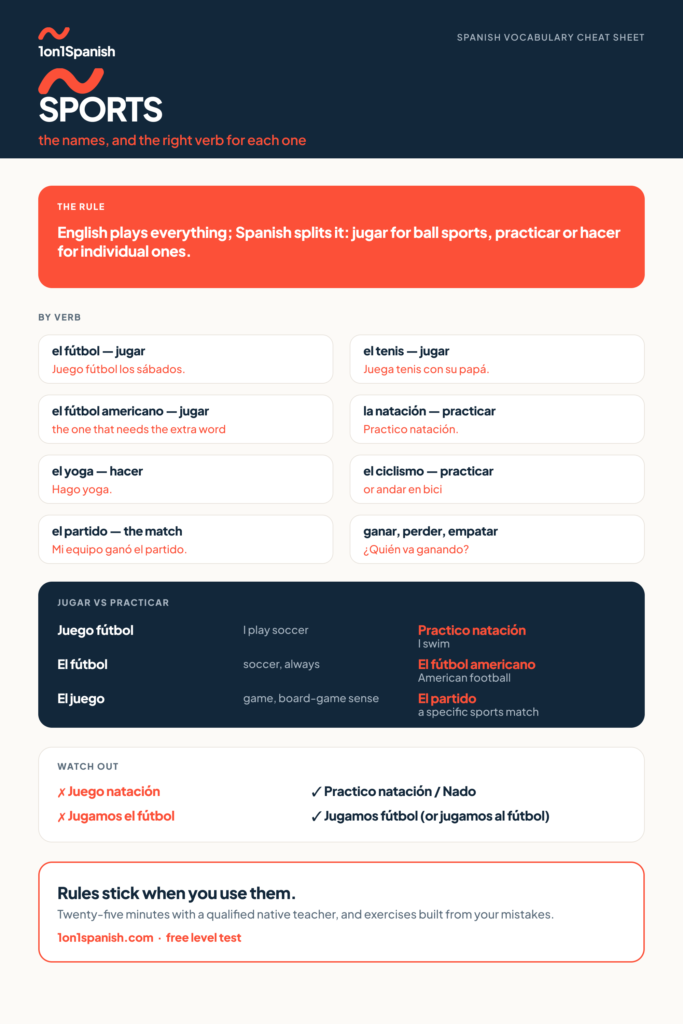
Take the chart with you
The chart is free to view and share. Drop your email and we’ll send the print-ready US Letter PDF — the version you stick on the fridge.
Practice
Practice sports in Spanish with a real teacher
Charts get you halfway. The other half is saying it out loud to someone who corrects you on the spot. At 1on1Spanish you get 25-minute private lessons with a qualified native teacher, exercises built from the mistakes you make in class, and AI practice between lessons.
First month $1. No contracts, cancel anytime.
When you are ready to speak it out loud, try online Spanish lessons with a native teacher.
Take your free level testBuilt on RingTeacher's method — 700,000+ classes delivered since 2017, teaching English to Spanish speakers. Now in the other direction.
Frequently asked questions
What verb do you use for sports in Spanish?
It depends on the sport. Team and ball sports — soccer, basketball, tennis — take jugar, the same “play” you’d expect. Individual or physical sports without a ball — swimming, running, martial arts — usually take practicar or hacer instead. Using jugar with swimming sounds as odd to a native speaker as “I play swimming” does in English.
Is it jugar al fútbol or jugar fútbol?
Both are correct. Jugar al fútbol, with the a plus the article, is the fuller form taught in grammar books. In everyday spoken Spanish, especially in Mexico and Central America, the al is often dropped and people simply say jugar fútbol. Neither marks you as wrong; the second one is just more common in casual conversation.
What is soccer called in Spanish?
Fútbol, and that word alone always refers to soccer — never American football, which needs the extra word americano to distinguish it. This is the opposite of English, where “football” needs no qualifier for the American sport and “soccer” is the specified term.
What’s the difference between partido and juego?
Partido is a specific sports match — el partido de mañana is tomorrow’s game. Juego is more general, closer to “game” in the sense of a board game or an abstract concept. For talking about a specific match you watched or played, partido is the natural choice.
How do you say “my team won” in Spanish?
Mi equipo ganó. To ask who’s currently ahead mid-game, you’d say ¿Quién va ganando? — literally “who’s going winning,” a common construction for describing an ongoing result. Perder is to lose and empatar is to tie, rounding out the three outcomes of any partido.